Chunky Gold Chain Renaissance Design Guide
Explore the chunky gold chain revival with design insights on link styles, proportions, layering techniques, and the cultural forces driving this trend.
Chunky gold chains are reclaiming center stage in 2026, powered by a cultural appetite for bold self-expression, nostalgic design references, and a decisive shift away from the delicate minimalism that dominated the previous decade. This guide explores the design principles, link styles, and construction techniques behind the revival.
The Cultural Forces Behind the Revival
The return of chunky gold chains is not a random swing in taste. It is the product of several cultural currents converging at once, each amplifying the others in ways that have made thick gold chains impossible to ignore.
Nostalgia plays a significant role. The 1990s and early 2000s are now firmly within the fashion nostalgia cycle, and few accessories define that era more clearly than a heavy gold chain. Hip-hop culture of the 1990s elevated the gold chain from accessory to symbol, and that symbolic weight persists. Younger consumers who did not experience the original wave are discovering it fresh, while older consumers are reconnecting with styles they once loved.
Celebrity influence remains a powerful accelerator. Rihanna has become synonymous with layering thick gold chains over diamond chokers, blending luxury with urban energy. Hailey Bieber is regularly photographed in oversized paperclip links and bold Cuban chains worn against simple white t-shirts. Musicians, athletes, and designers have made chunky gold chains a fixture of red carpet appearances and everyday street style. Social media multiplies this visibility, turning a single paparazzi shot of a bold chain into millions of impressions within hours. The maximalist jewelry movement of 2026 provides the broader context, but chunky chains sit at its very center.
Industry data suggests that demand for chunky gold chains is growing by 15 to 20 percent in 2026, driven largely by Gen Z's preference for retro maximalism. The World Gold Council's Gold Demand Trends report confirms that gold jewelry demand in key markets continues to rise despite higher spot prices, with bold statement pieces leading the charge in consumer willingness to invest.
There is also a practical element at work. After years of delicate chains that tangled easily and broke under modest stress, consumers are gravitating toward jewelry that feels substantial and durable. A chunky chain delivers tactile satisfaction that a 1mm cable chain simply cannot.
Link Styles for Chunky Chain Design
The link style determines everything about a chunky chain, from its visual character and how it catches light to its weight on the neck and how it drapes across the chest. Designers and buyers benefit from understanding the distinct personality of each option.
Cuban Links
Cuban links are the undisputed leader of the chunky chain category. These tightly interlocking oval links are cut and twisted so each link nests closely against the next, creating a dense, smooth surface with minimal gaps. The result is a chain that looks like a solid ribbon of gold when viewed from a distance while revealing intricate link structure up close.
Cuban links at 8mm to 14mm width deliver the classic chunky aesthetic. At 14mm and above, they enter statement territory. The tight link construction means Cuban chains are among the heaviest per unit of length, which contributes to their luxurious feel but also increases the gold required. Miami Cuban links, a tighter and slightly rounder variation, have become especially popular for their refined density.
Paperclip Links
Paperclip chains have surged in popularity for their modern, architectural appearance. Each link is an elongated oval or rectangle, resembling a stretched paperclip, and the links connect in alternating orientations to create a flat, graphic pattern. At 15mm to 30mm link length, paperclip chains look unmistakably bold without the weight penalty of solid Cuban links.
The open structure of paperclip chains means they use less gold per inch than comparable Cuban or curb styles. This makes them attractive for designers seeking visual impact at a lower price point. Their flat profile also makes them comfortable to wear, as the links distribute weight across a wider area of skin.
Figaro Chains
Figaro chains create rhythmic visual interest through their alternating pattern, typically three short round links followed by one elongated link. When scaled up to chunky proportions with widths of 8mm to 12mm, the figaro pattern becomes a design statement in its own right. The variation in link size adds depth and texture that uniform link chains lack.
The Italian heritage of figaro chains gives them a classic elegance that softens the boldness of chunky proportions. This blend of sophistication and visual weight makes figaro an excellent choice for wearers who want presence without the streetwear associations that sometimes accompany Cuban links.
Mariner Chains
Mariner chains, also called anchor chains, feature oval links with a central bar running across each link. Originally inspired by the chains used on ship anchors, the mariner link has a nautical character that sets it apart from other styles. At 8mm to 12mm width, mariner chains deliver a distinctive chunky look with a design heritage that resonates in coastal and maritime-inspired fashion.
The central bar within each link adds structural strength, making mariner chains durable relative to their weight. It also creates interesting light play as the bar catches reflections at different angles than the outer oval of each link.
Cable Chains
Cable chains at chunky proportions take the most familiar chain style and amplify it into something entirely different. Standard cable chains consist of uniform oval links interlocking in alternating directions. When those links grow to 8mm or larger, the cable chain transforms from a background player into a bold, graphic accessory.
Oversized cable chains have a clean, unfussy quality that appeals to designers who want simplicity at scale. They layer well because their uniform link pattern creates a predictable visual rhythm that does not compete with other chain styles worn simultaneously.
Rope Chains
Rope chains deserve a place in the chunky chain conversation, even though they are sometimes overlooked in favor of flat-profile styles. A rope chain is made by twisting two or more strands of metal links into a tight spiral pattern that resembles actual rope. At 6mm to 10mm thickness, rope chains produce a dense, textured surface that catches light from every angle and creates a shimmering, almost liquid effect against the skin.
The structural redundancy built into the rope design makes it one of the strongest chain constructions available. Because multiple strands interlock and support each other, a solid rope chain can handle considerable tension without breaking. However, buyers should be aware that hollow rope chains are extremely common on the market. While hollow construction reduces weight and cost, a hollow rope chain is far more fragile and nearly impossible to repair if a link collapses or breaks. For chunky proportions, a solid or semi-hollow rope chain is the safer long-term investment.
Comparing Link Styles at a Glance
Choosing the right link style requires balancing aesthetics, weight, comfort, and budget. The following comparison covers the most important factors for each style at chunky proportions.
| Link Style | Typical Width | Visual Character | Relative Weight | Comfort Level |
|---|---|---|---|---|
| Cuban | 8mm to 14mm | Dense, smooth, luxurious | Heaviest | Moderate |
| Paperclip | 15mm to 30mm links | Modern, architectural, open | Lightest | High |
| Figaro | 8mm to 12mm | Rhythmic, textured, classic | Medium-heavy | Moderate |
| Mariner | 8mm to 12mm | Nautical, structured, distinctive | Medium | High |
| Cable | 8mm to 12mm | Simple, clean, graphic | Medium | High |
| Rope | 6mm to 10mm | Twisted, shimmering, textured | Medium-heavy | Moderate |
Each style serves a different market segment and styling context. Cuban links dominate in streetwear and hip-hop influenced fashion. Paperclip chains skew toward contemporary fashion-forward consumers. Figaro appeals to those seeking European-inspired elegance. Rope chains attract buyers who want eye-catching light play and proven structural strength. Understanding these associations helps designers position their products effectively.
Proportions and Sizing
Getting proportions right is the difference between a chunky chain that looks intentional and one that looks like costume jewelry. Several key measurements interact to create the finished look.
Width and Length Relationships
Chain width and chain length must work together. A 14mm wide chain at choker length (16 inches) creates maximum visual impact because the chain dominates the visible neck area. The same 14mm chain at 24 inches creates a different effect, drawing the eye downward and elongating the torso.
As a general guideline, wider chains tend to look best at shorter lengths and narrower chunky chains (8mm to 10mm) have more flexibility in length. A 10mm Cuban link works beautifully at lengths from 18 to 24 inches, while a 14mm Cuban link looks most balanced between 16 and 20 inches. Beyond 20 inches, very wide chains can feel visually overwhelming unless the wearer has a larger frame.
Weight Considerations
Gold weight is a primary cost driver and a comfort factor. A solid 14K gold Cuban link chain at 12mm width and 20 inches in length can weigh between 80 and 120 grams, translating to significant material cost. To put that in perspective, as of early 2026, 14K gold trades at roughly $84 per gram, meaning the raw gold alone in an 80-gram solid chain runs approximately $6,700 before any fabrication, labor, or retail markup. A comparable hollow chain at 35 to 50 grams brings the gold cost down to roughly $2,900 to $4,200. This is where construction technique becomes critical, and designers must decide early whether a piece will be solid, semi-hollow, or hollow.
For everyday wear, most consumers find chains above 100 grams uncomfortable over extended periods. Designers should consider the intended wear context when determining proportions. A 60-gram chain that looks bold and feels comfortable throughout a full day will earn more consistent wear than a 120-gram chain that spends most of its time in a jewelry box.
Clasp Proportions
The clasp on a chunky chain deserves as much design attention as the links themselves. A standard lobster clasp looks comically small against a 12mm Cuban link chain. Box clasps, toggle closures, and oversized lobster clasps that match the visual scale of the chain create a more cohesive finished piece.
Many designers now treat the clasp as an integrated design element rather than a functional afterthought. Front-facing toggle clasps that sit at the collarbone have become a styling trend, turning the closure into the focal point. Decorative box clasps with engraved or textured surfaces add an element of surprise when the chain is examined closely.
Layering Techniques for Chunky Chains
Layering chunky chains is both an art and a discipline. Done well, it creates depth and visual storytelling. Done poorly, it produces a tangled, noisy mess. The principles below guide successful chunky chain layering. For a deeper exploration of layering across all jewelry types, see our complete chain styling guide.
The Rule of Three
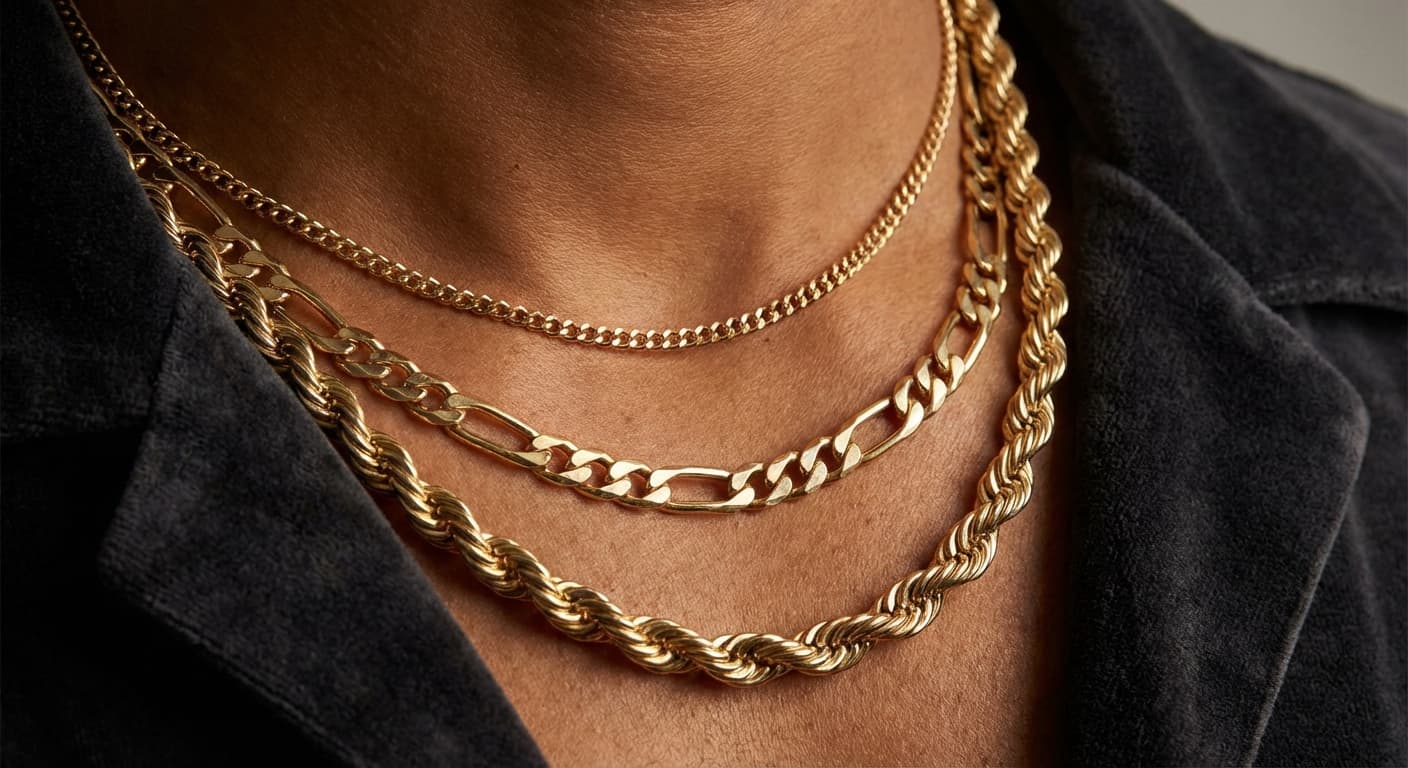
Three chains create the ideal layered composition in most cases. The bottom layer, worn longest, serves as the foundation. The middle layer adds visual complexity. The top layer, worn shortest, frames the face and draws the eye upward.
For chunky chains specifically, vary the width across the three layers. A 14mm choker-length piece at the top, a 10mm chain at mid-length, and an 8mm chain with a pendant at the longest length creates graduated visual interest. Keeping all three at the same width makes the layered look feel flat and repetitive.
Length Spacing
Leave at least two inches between each layer to prevent the chains from sitting on top of each other and tangling. A classic three-layer chunky setup might use 16 inches, 18 to 19 inches, and 21 to 22 inches. Tighter spacing creates a more compact, choker-like cluster effect while wider spacing produces a cascading waterfall look.
Mixing Link Styles Within a Layered Look
Mixing two or three different link styles adds texture and depth. A Cuban link at the top, a paperclip chain in the middle, and a figaro at the longest length creates three distinct visual textures that play off each other without competing. The key constraint is keeping the metal color and finish consistent across all layers, as mixing yellow gold with rose gold or matte with high polish can make the composition feel accidental rather than intentional.
Styling a Chunky Chain as a Solo Statement
Not every chunky chain needs to be layered. A single bold chain worn alone can carry an entire outfit when the styling context is right. The key principle is contrast. A 12mm Cuban link or a wide paperclip chain makes its strongest visual impact against clean, minimal clothing. A crisp white crew-neck t-shirt, a simple black turtleneck, or a relaxed linen button-down provides negative space that lets the chain command attention.
For formal and semi-formal settings, a single chunky chain worn over a tailored blazer or a structured dress bridges the gap between jewelry and outerwear. The chain becomes an architectural element of the outfit rather than a decorative accessory. This approach works especially well with paperclip and mariner link styles, whose geometric patterns complement the clean lines of tailored clothing.
Neckline matters as much as the chain itself. V-necks and scoop necks expose more skin and create a natural frame for a chunky chain to rest against. Crew necks push the chain slightly forward and upward, which amplifies visual weight. High necklines like turtlenecks work best when the chain sits on top of the fabric rather than underneath it.
Construction Techniques for Bold Chains
The way a chunky chain is built determines its weight, durability, comfort, and price. Designers working in the chunky chain space need fluency in several construction approaches.
Solid Construction
Solid construction means every link is made from a uniform piece of metal with no hollow core. Solid chains are the heaviest and most expensive, but they also feel the most luxurious in the hand and on the skin. The weight distribution of a solid chain gives it a satisfying drape that hollow alternatives struggle to replicate.
Solid construction makes the most sense for chains at the narrower end of the chunky spectrum, between 8mm and 10mm, where the total gold weight remains manageable. At 12mm and above, solid construction pushes the price and weight into territory that limits the customer base.
Hollow and Semi-Hollow Construction
Hollow construction uses thin-walled tubes to form each link, creating the visual impression of a solid chunky chain at a fraction of the weight and cost. A well-made hollow chain can reduce gold weight by 40 to 60 percent compared to the same chain in solid construction. This technique opens the chunky chain market to consumers who want the look without the premium price tag.
Semi-hollow construction offers a middle ground, using thicker walls than fully hollow links while still significantly reducing gold content compared to solid. Semi-hollow chains feel more substantial than hollow pieces and resist denting better, making them a popular choice for jewelry brands positioning their chunky chains in the mid-market segment.
The tradeoff is durability, and the gap between solid and hollow is larger than many consumers realize. Hollow chains have wall thicknesses as thin as 0.5 to 1mm, making them vulnerable to dents, kinks, and crushing under pressure. A solid chain with proper care can last decades or even a lifetime, while a hollow chain worn daily may show significant wear within 3 to 10 years. Repair is the most critical difference. A broken solid link can be soldered back together at a jeweler for $30 to $75 in most cases. A broken hollow link often cannot be repaired at all because the thin tube melts into a small ball when heated, destroying the link structure. Many jewelers refuse to work on hollow chain repairs entirely.
Resale value also favors solid construction. Because solid chains contain two to three times the gold weight of equivalent hollow chains, their melt value and secondhand market value remain substantially higher. Designers should communicate these tradeoffs transparently when selling hollow or semi-hollow pieces, and brands that provide honest guidance on durability expectations build stronger customer trust.
Solid vs. Hollow at a Glance
| Factor | Solid | Semi-Hollow | Hollow |
|---|---|---|---|
| Gold Weight (relative) | 100% | 50 to 70% | 40 to 60% |
| Retail Price (relative) | Highest | Mid-range | Lowest |
| Daily Wear Lifespan | Decades to lifetime | 10 to 20 years | 3 to 10 years |
| Repairability | Easily repaired | Repairable with care | Often unrepairable |
| Dent Resistance | Excellent | Good | Poor |
| Resale Value | High | Moderate | Low |
| Best For | Investment, daily wear | Balance of value and durability | Trend-driven, occasional wear |
Italian Machine-Made vs. Handmade
Italian chain-making machinery produces remarkably consistent and precise links at scale, making it the standard for most commercial chunky chains. Machine-made chains offer uniformity, efficient production, and competitive pricing that hand fabrication cannot match for standard link styles.
Handmade chains, by contrast, allow for custom link shapes, one-of-a-kind variations, and artisanal details that machines cannot produce. Hand-fabricated links may have slight variations in size and shape that give the chain an organic, handcrafted character. For designers targeting the luxury and bespoke market, hand fabrication adds a story and a perceived value that mass production lacks.
Gold Selection and Audience Considerations
The choice of gold karat and color profoundly affects the look, durability, and market positioning of a chunky chain.
Karat Considerations
14K gold (58.3% pure gold) offers the best balance of color, durability, and value for chunky chains intended for regular wear. As of early 2026, 14K gold trades at approximately $84 per gram. The alloy metals in 14K gold make it significantly harder and more scratch-resistant than higher karat options, which matters for chains that will encounter friction and contact throughout the day. A typical 14K solid chunky chain in the 8mm to 12mm range runs between $2,000 and $8,000 at retail depending on length and link style, while hollow versions of the same designs start around $500 to $1,500.
18K gold (75% pure gold) delivers a richer, warmer yellow color that many consumers prefer for statement jewelry. At roughly $108 per gram in early 2026, the material cost alone is about 29 percent higher than 14K. The higher gold content produces a softer metal, but for chunky chains that will be worn occasionally rather than daily, the softer composition is less of a concern. Luxury houses like Bottega Veneta, Tiffany and Co., and David Yurman typically use 18K gold for their chunky chain collections, with retail prices in the $7,500 to $15,000 range for statement pieces.
10K gold (41.7% pure gold) represents the entry point for real gold chunky chains. At approximately $60 per gram in early 2026, it is the most affordable option per gram by a wide margin. While the color is paler and the gold content lower, 10K offers the highest durability of all three karats and the lowest price point, making it attractive for trend-driven consumers who want to participate in the chunky chain movement without the investment of higher karat options. A solid 10K Cuban link chain at 8mm to 10mm width typically retails between $1,200 and $4,000.
Color Options
Yellow gold is the traditional and most popular choice for chunky chains, carrying the strongest cultural associations with the 1990s aesthetic that drives much of the current revival. The warmth of yellow gold against skin creates a visual impact that other metals struggle to match at chunky proportions.
Rose gold chunky chains have carved out a distinct niche, particularly among younger consumers and in the fashion-forward segment. The pink undertone of rose gold softens the visual weight of a thick chain, making it feel slightly less aggressive than the same chain in yellow gold.
White gold chunky chains offer a cooler, more contemporary look. However, white gold requires rhodium plating to maintain its bright silver-white finish, and that plating wears off faster on chains than on rings or earrings because of the constant friction against skin and clothing. Designers should factor in replating costs when recommending white gold for chunky chain designs.
Gender-Neutral Appeal and Broad Market Reach
Chunky gold chains have become one of the most genuinely gender-neutral categories in jewelry. The same 10mm Cuban link chain appears in men's lookbooks, women's editorial shoots, and non-binary fashion features without any design modification. This universality represents a significant shift from even five years ago when chunky chains were marketed almost exclusively to men.
The design itself does not change across gender expressions. What changes is the styling context. The same chain might be worn over a crew-neck t-shirt in one context, layered with delicate pendants in another, or paired with a tailored blazer in a third. This versatility is one reason chunky chains have such broad commercial appeal.
For designers, the gender-neutral market means rethinking traditional sizing approaches. Rather than offering "men's" and "women's" versions of the same chain, forward-thinking brands offer a range of widths and lengths without gender labels. A 16-inch option, an 18-inch option, a 20-inch option, and a 22-inch option let customers self-select the fit that works for their body and preference. Our men's jewelry design guide explores how these shifting boundaries are reshaping the entire jewelry market.
Trend Longevity and Market Momentum
The chunky gold chain trend is not a fleeting moment. Several structural factors suggest it has significant staying power through 2026 and into 2027.
Runway and editorial signals remain strong.
Major fashion houses have invested heavily in chain jewelry over the past several seasons. Bottega Veneta launched its signature Drop necklace in solid 18K gold, signaling long-term confidence in the bold chain category. Balenciaga and Tiffany and Co. have built entire collections around oversized chain forms, while David Yurman's "The Chain" collection in 18K yellow gold targets the men's luxury market specifically. When houses at this level commit resources, the trend filters through the market with a multi-year tail. According to the World Gold Council's Gold Demand Trends report, gold jewelry demand in key markets continues to grow despite higher prices, with statement pieces driving consumer willingness to invest.
The 1990s and early 2000s nostalgia cycle still has room to run. Fashion nostalgia typically operates on a 20 to 30 year cycle, meaning the early 2000s aesthetic is just entering peak revival territory now. As long as that nostalgia engine keeps turning, chunky chains benefit from the cultural tailwind.
Chunky gold chains also connect to the broader spring 2026 jewelry forecast, where bold metalwork meets softer elements like pearls and pastels. Pairing a heavy gold chain with a freshwater pearl pendant is one of the most distinctive styling moves of the current season, blending maximalism with organic texture. The trend also intersects with the rise of mismatched and asymmetric jewelry, where pairing a chunky chain necklace with delicate, asymmetric earrings creates deliberate contrast. This interplay between bold and delicate gives stylists and consumers enormous creative range.
Strategic Design Considerations for Brands
Brands entering or expanding in the chunky chain space should consider several strategic factors beyond aesthetics.
Price Architecture
Offering chunky chains across multiple price points is essential for capturing the full market. A three-tier approach works well. An entry tier uses 10K gold hollow construction to hit accessible price points. A mid tier uses 14K semi-hollow construction for customers seeking quality at moderate investment. A premium tier uses 18K solid or semi-hollow construction for the luxury segment.
Each tier should feel intentional rather than like a watered-down version of the tier above. The entry tier might focus on trending link styles like paperclip chains that use less gold per inch. The premium tier might feature hand-finished details, custom clasps, and presentation packaging that justify the higher price.
| Tier | Karat | Construction | Typical Retail Range | Target Customer |
|---|---|---|---|---|
| Entry | 10K | Hollow | $300 to $1,500 | Trend-driven, younger buyers |
| Mid | 14K | Semi-hollow | $1,500 to $5,000 | Quality-conscious everyday wearers |
| Premium | 18K | Solid or semi-hollow | $5,000 to $15,000+ | Luxury segment, collectors |
These ranges reflect 2026 gold prices at approximately $4,500 per troy ounce and will shift as the spot price fluctuates. Brands should review and adjust their pricing quarterly to stay aligned with raw material costs.
Size Inclusivity
Chunky chains look different on different body types, and offering a broad range of lengths ensures that every customer can find their ideal fit. At minimum, brands should offer four length options between 16 and 24 inches. Brands that also offer custom lengths gain a competitive advantage in customer satisfaction and return-rate reduction.
Width options matter equally. Offering the same link style in 8mm, 10mm, and 12mm widths lets customers choose the level of boldness that suits their frame and personal style. A petite customer might find a 10mm chain perfectly bold, while a larger-framed customer might need 14mm to achieve the same visual proportion.
Care and Maintenance Communication
Chunky chains, especially hollow and semi-hollow designs, require specific care guidance that goes well beyond a generic "handle with care" disclaimer. Brands that proactively communicate detailed recommendations reduce warranty claims and build lasting trust.
Cleaning at home. The most effective method for gold chains is soaking the piece in lukewarm water mixed with a few drops of mild dish soap for 10 to 15 minutes. Use a soft-bristled toothbrush to gently work into the crevices between links where oils, lotions, and dead skin cells accumulate. Rinse under clean running water and dry thoroughly with a soft microfiber cloth. Avoid paper towels, which can leave micro-scratches on polished surfaces. For chains worn daily, this cleaning should happen every two to four weeks.
Chemicals to avoid. Chlorine from swimming pools and hot tubs is one of the most damaging substances for gold alloys, particularly 10K and 14K, where the higher proportion of alloy metals reacts with chlorine and causes discoloration and pitting over time. Household bleach, strong detergents, and harsh acids carry similar risks. Perfume, hairspray, and skincare products should always be applied before putting on the chain, not after.
Storage. Each chunky chain should be stored individually in a soft fabric-lined pouch or compartment to prevent tangling and scratching against other pieces. Hanging a chain from a jewelry hook is preferable to coiling it in a pile, especially for hollow designs that can dent under their own weight when compressed. Keep the storage location cool, dry, and away from direct sunlight.
Professional maintenance. An annual visit to a professional jeweler for ultrasonic cleaning and inspection is worthwhile for any chain worn regularly. A jeweler can spot weakening links, worn clasps, and thinning walls in hollow designs before they fail. Professional cleaning and polishing typically costs $25 to $50 and restores the finish to near-new condition. A simple care card included with each purchase goes a long way toward protecting both the chain and the customer relationship.
Designing for the Chunky Chain Renaissance
The chunky gold chain renaissance is a design opportunity that rewards careful attention to link style, proportion, construction, and market positioning. Understanding why chunky chains resonate culturally helps designers create pieces that feel timely without being disposable.
Whether you are a designer building a chunky chain collection, a buyer selecting inventory for a retail program, or a consumer investing in a statement piece, the principles in this guide apply. Link style sets the visual tone. Proportions determine comfort and wearability. Construction technique balances cost, weight, and durability. And thoughtful styling through layering and cross-category pairing transforms a single chain into a versatile wardrobe element.
The chunky gold chain is not merely a trend. It is a design category with deep cultural roots and strong structural support in the current market. The brands and designers who approach it with craft, intention, and respect for its heritage will be the ones whose pieces earn lasting places in their customers' collections.
Design Chunky Chain Jewelry with Tashvi AI
Ready to design your own statement chain? Tashvi AI lets you explore Cuban, curb, figaro, and Byzantine chain designs with AI photorealistic rendering. Experiment with widths, metals, and link styles before committing to production.
Frequently Asked Questions
Quick answers to the questions readers ask most about this guide.
Why are chunky gold chains trending again
Chunky gold chains are experiencing a revival driven by the broader maximalist jewelry movement, celebrity influence from artists and designers, nostalgia for 1990s and early 2000s aesthetics, and a cultural shift toward bold self-expression. Social media visibility has accelerated the trend across demographics.
What link styles work best for chunky chains
Cuban links, figaro chains, paperclip links, mariner chains, and cable chains are the most popular styles for chunky designs. Cuban links dominate the streetwear-influenced market while paperclip chains appeal to the fashion-forward segment. Each link style creates a distinct visual texture and weight profile.
How do you layer chunky chains without looking overdone
Layer in odd numbers, typically three chains of varying lengths and link sizes. Start with a choker-length piece, add a mid-length chain, and finish with a longer pendant chain. Keep the metal consistent and vary the link style rather than mixing too many elements at once.
Are chunky chains gender neutral
Yes. Chunky chains have moved firmly into gender-neutral territory. The same Cuban link chain works across all gender expressions, with styling and proportions adjusting to individual preference. This universality is one reason the trend has such broad commercial appeal across customer segments.
How can designers create lightweight chunky chains
Hollow construction techniques allow chains to look bold while keeping weight and cost manageable. Semi-hollow links, tube construction, and strategic use of air within the link structure reduce gold weight by 40 to 60 percent compared to solid construction without visibly compromising the chunky aesthetic.