Cluster Ring vs Solitaire: Key Differences, Pros, Cons & How to Tell
Cluster rings cost 40-60% less than solitaires of similar size. Quick test: run your fingernail across the top—solitaires are smooth, clusters have tiny ridges. Full comparison with photos inside.
Cluster Ring vs Solitaire: Quick Comparison
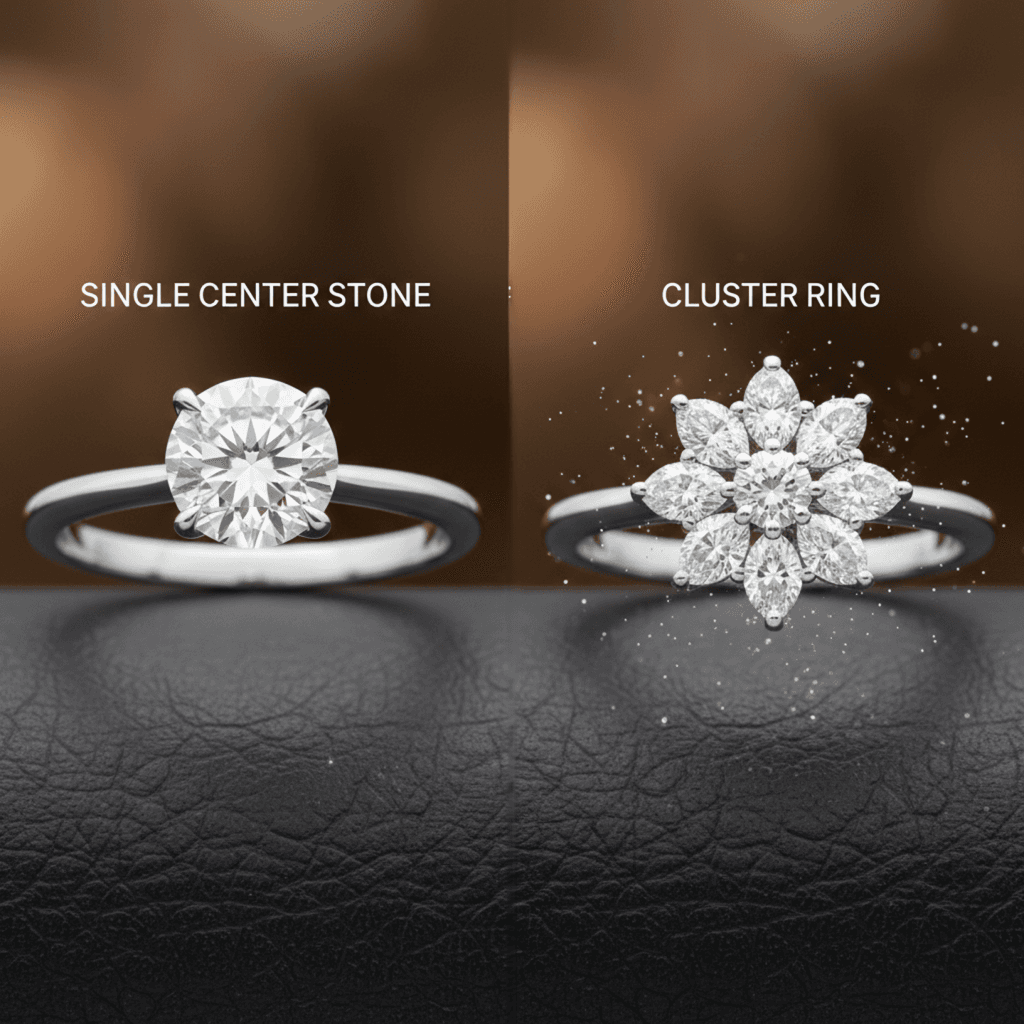
The key difference: A solitaire features one single diamond, while a cluster ring uses multiple small diamonds arranged to look like one larger stone.
| Feature | Solitaire Ring | Cluster Ring |
|---|---|---|
| Stone Count | 1 single diamond | Multiple small diamonds |
| Sparkle Type | Bold, unified flashes | Scattered, glittery shimmer |
| Price | Higher (large stones are rare) | Lower for same visual size |
| Durability | Fewer failure points | More stones can loosen |
| Maintenance | Easy to clean | Harder—dirt collects in gaps |
| Resale Value | Higher | Lower |
| Surface Feel | Perfectly smooth | Tiny ridges between stones |
What Is a Solitaire Ring?
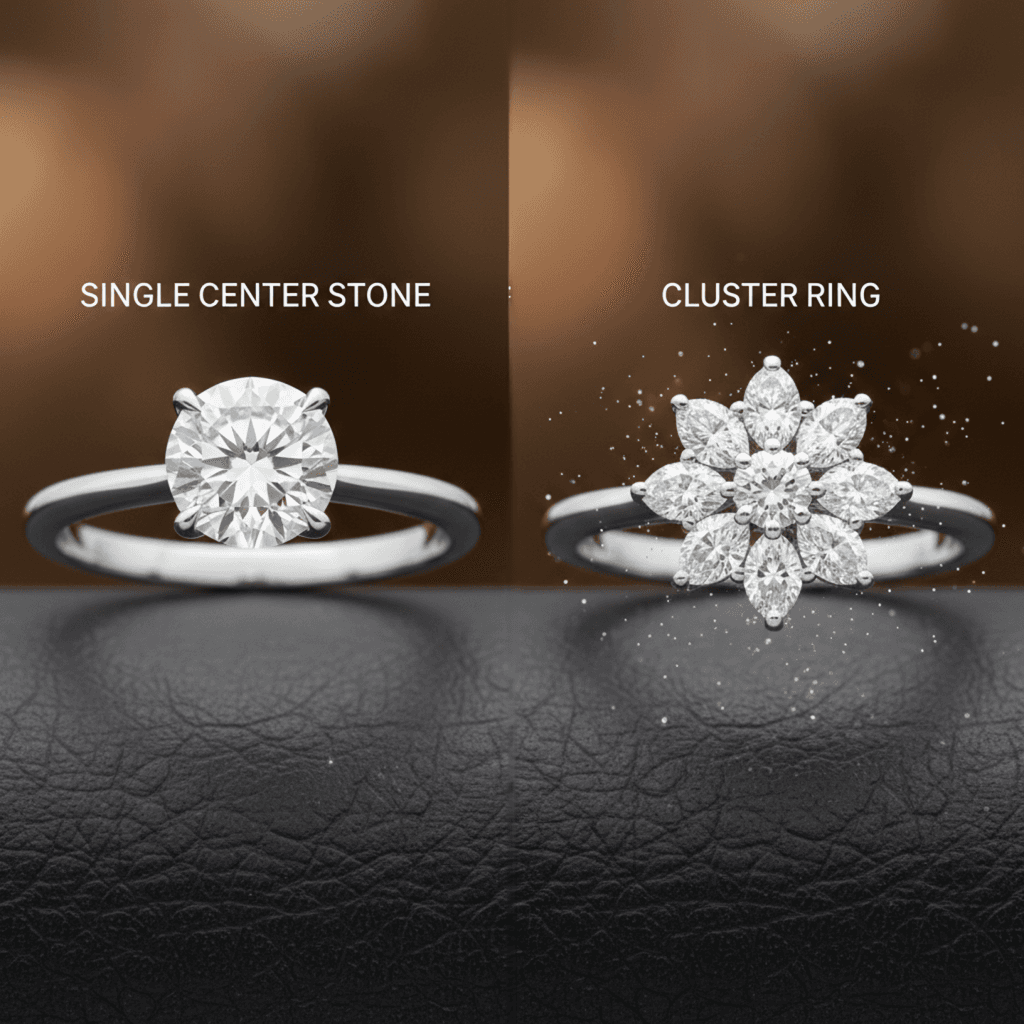
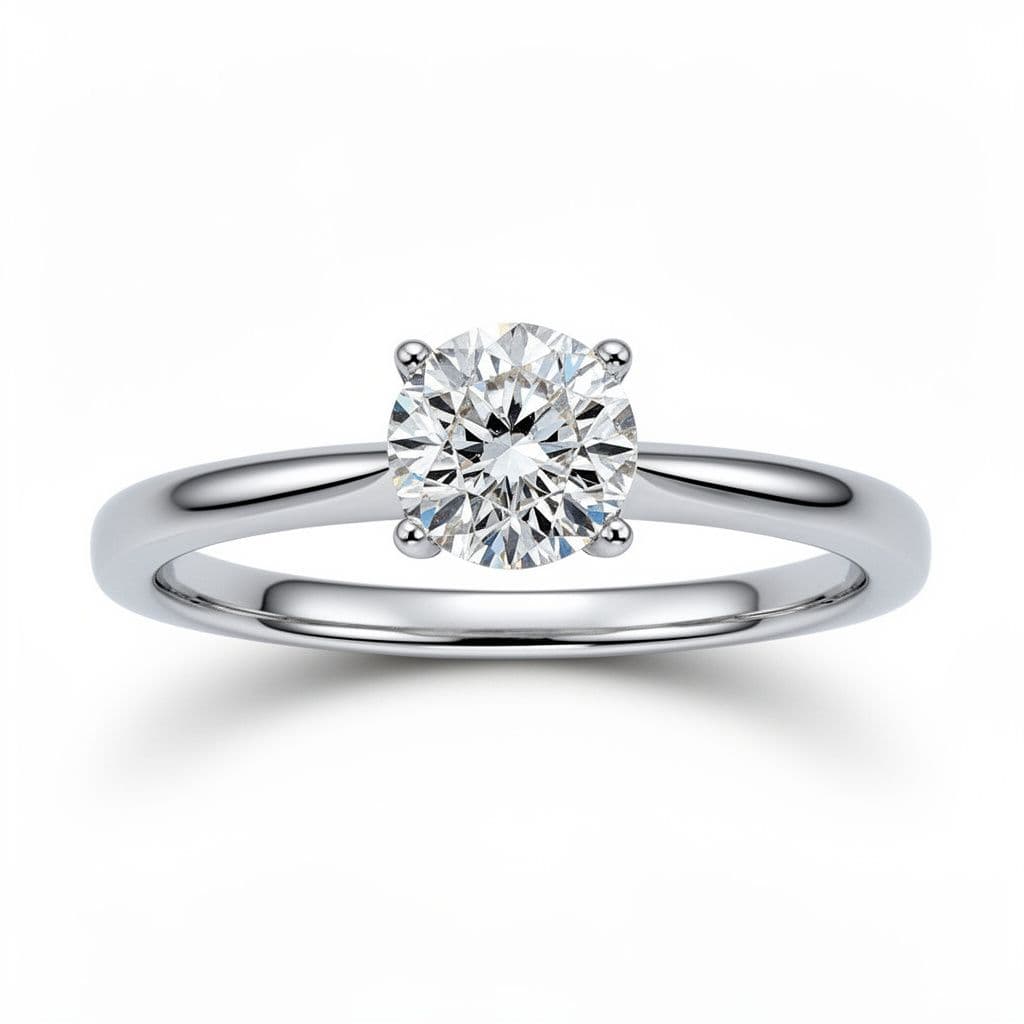
The single center stone ring commonly known as a solitaire embodies timeless elegance and simplicity. Its defining characteristic is the presence of one dominant gemstone, typically a diamond, positioned as the singular focal point of the ring. This stone is a complete and uninterrupted piece of crystal.
The brilliance of a solitaire originates from light entering the gem, interacting with its carefully placed internal facets and reflecting back to the observer. This process creates broad, impactful flashes of white light known as brilliance, and bursts of rainbow colors referred to as fire. The value of a solitaire is almost entirely concentrated in this one central gem. Because large diamonds are significantly rarer than smaller ones, the price increases drastically and nonlinearly as carat weight escalates, a principle long established by the Gemological Institute of America (GIA).
The setting for a solitaire is typically minimalist often employing four or six sturdy prongs to securely cradle the stone while maximizing its exposure to light. This open design ensures optimal light return, enhancing the gem's natural scintillation.
What Is a Cluster Ring?
In stark contrast, the cluster ring achieves its visual impact through the artful arrangement of multiple smaller gemstones. Instead of one large, rare stone, a cluster ring uses several smaller stones grouped meticulously together to form a larger composite shape. The primary objective is frequently to create the desirable illusion of a more substantial single stone at a more accessible price point.
In a cluster setting, you might find a central gem surrounded by a halo of smaller stones or a precise mosaic of gems packed so closely that they appear as a singular surface. These small diamonds, often referred to as melee diamonds, are more abundant and thus less expensive per carat than their larger counterparts. Consequently, a cluster ring can offer a significant visual presence and sparkle for a fraction of the cost of a solitaire of equivalent apparent size.
The light performance of a cluster ring is distinctly different from that of a solitaire. It lacks the broad, cohesive flashes of brilliance. Instead, it produces a rapid shimmering or glittering effect. This effect is due to the multitude of tiny facets reflecting light in scattered directions. The aesthetic is often compared to crushed ice or a vibrant mosaic. As noted by Laurelle Antique Jewellery, these intricate designs were particularly popular during the Victorian and Edwardian eras, a testament to their enduring decorative appeal.

The Crucial Surface Examination and Tactile Test
The most reliable and immediate method for distinguishing between these two ring types involves a tactile and visual examination of the stone's surface.
A single center stone solitaire presents a perfectly smooth continuous top surface or table. Running your fingernail gently across the top of a solitaire will confirm its uninterrupted surface, a single polished plane of material.
A cluster ring is a collection of separate physical components. Even with the most sophisticated illusion setting techniques minute separations or variations in height exist between the individual stones. A gentle sweep of your fingernail across a cluster ring will inevitably feel texture. You will feel the subtle ridges where one stone ends and another begins or the tiny metallic separation walls. This tactile inconsistency is an immediate giveaway.
Analyzing Light Performance and Optics
Observing how a ring interacts with various lighting conditions provides an expert level clue.
A single stone solitaire displays distinct scintillation. As you move the ring the large facets flash on and off creating bold well defined patterns. The entire gem behaves as a single optical unit reflecting light coherently.
A cluster ring produces fragmented and dispersed sparkle. Because numerous small stones are present each positioned at a slightly different angle, light is broken into many tiny scattered reflections. If the perceived large stone on a ring shimmers with a chaotic glitter rather than unified flashes it is structurally a cluster. Tashvi AI's proprietary imaging analysis is built upon these principles, analyzing light reflection patterns to help verify stone structure.
Inspecting the Underside Construction
The structural foundation of the ring offers definitive confirmation visible from the side or bottom. Turn the ring over and look beneath the central setting.
For a single center stone you will observe the pavilion, the lower conical section of the diamond tapering down to a single point called the culet. The structure holding it is typically open and minimalist designed for maximum light entry and maintenance access.
A cluster ring requires a complex support system for its numerous gems. You will not see a single cone shape underneath. Instead you might observe a metal plate with small individual openings beneath each tiny stone or an intricate metal lattice designed to secure the assembly. If the bottom of the setting resembles a complex bowl or structured framework rather than a simple basket holding one object you are examining a cluster setting.
The Role of Metalwork in Illusion
The metalwork in both styles is functional but its visibility differs greatly. In a solitaire the metal setting is minimized to allow the diamond to be the central focus.
In a cluster ring the metal often works actively to enhance the illusion. Highly polished white metals such as platinum or white gold are commonly used to fill the minute gaps between the small diamonds. This reflection helps to blend the seams and visually trick the eye into perceiving a single continuous surface. If a close inspection reveals fine highly polished metallic lines running through the perceived large stone you are identifying the metal walls separating the individual gems of the cluster.
Valuation and Price Expectations
Understanding the economic implications is crucial for accurate identification and appraisal. If a ring visually appears to be a substantial two or three carat diamond but is priced at a level that seems disproportionately low it is likely a cluster ring.
The reason is the rarity factor. A single one carat diamond is significantly more valuable than one carat Total Carat Weight or TCW of small diamonds. According to International Gemological Institute (IGI), this exponential value gradient is a key metric in diamond valuation globally. Tashvi AI pricing analysis algorithms often flag this size versus cost discrepancy immediately when analyzing jewelry data, providing an instant clue to the ring's true structure.
Maintenance and Durability Considerations
The construction directly impacts the longevity and care required for the ring. A solitaire has fewer points of failure. The primary focus is maintaining the security of the main prongs.
A cluster ring is a complex microstructure with numerous small prongs and many individual stones. This complexity increases the potential for a stone to become loose or fall out over time. Furthermore the multiple tiny crevices between the stones can accumulate dirt, oils, and lotions, making cluster rings more difficult to clean effectively. Regular professional cleaning is essential for a cluster ring to maintain its optimal light return.
Conclusion
Identifying a cluster ring versus a single center stone solitaire is a practical skill that combines tactile examination with expert visual analysis of light behavior and structural architecture. By consistently checking the surface texture, observing the unique sparkle pattern, and inspecting the underside construction you can confidently distinguish between these two popular ring styles.
Whether you are drawn to the bold singular brilliance of a solitaire or the intricate multifaceted artistry of a cluster, knowing the structural differences ensures you understand the true value, the maintenance needs, and the craftsmanship embedded in the piece.
Design Your Perfect Ring with Tashvi AI
With Tashvi's AI jewelry design platform, you can bring your ring vision to life whether you prefer a classic solitaire or an elaborate cluster design. Visualize different stone arrangements instantly with photorealistic rendering. Experiment with various settings, metals, and diamond placements. Perfect your design before committing to production.
Start designing your dream ring at Tashvi.ai →
Frequently Asked Questions: Cluster Ring vs Solitaire
What is the difference between a cluster ring and a solitaire?
A solitaire ring features one single diamond as the centerpiece, while a cluster ring uses multiple smaller diamonds arranged together to create the appearance of a larger stone. Solitaires produce bold, unified flashes of light; clusters produce scattered, glittering sparkle.
Are cluster rings worth less than solitaires?
Yes, generally. A 1-carat solitaire diamond is worth significantly more than 1 carat total weight (TCW) of small cluster diamonds because large diamonds are exponentially rarer. However, cluster rings offer more visual impact and sparkle for less money.
How can I tell if a ring is cluster or solitaire?
Run your fingernail gently across the top surface. A solitaire feels completely smooth, while a cluster will have tiny ridges where stones meet. You can also look at the underside—solitaires show one cone-shaped pavilion, clusters show multiple small openings or a metal plate.
Which is better: cluster or solitaire engagement ring?
It depends on your priorities:
- Choose solitaire for: timeless elegance, higher resale value, easier maintenance, symbolic simplicity
- Choose cluster for: more sparkle per dollar, vintage aesthetic appeal, unique visual texture
Do cluster rings sparkle more than solitaires?
Cluster rings produce more scattered, glittery sparkle due to many small facets reflecting light in different directions. Solitaires produce fewer but bolder, more dramatic flashes of light. The sparkle is different in character rather than more or less intense.
Related Guides
- What Are Melee Diamonds? - The small diamonds used in cluster rings are called melee diamonds. Learn about sizes, cuts, and pricing.
- What Is a Bypass Ring? - Another unique alternative to traditional solitaires
- Best AI Jewelry Design Tools 2026 - Compare tools for designing cluster and solitaire rings with AI
Frequently Asked Questions
Quick answers to the questions readers ask most about this guide.
What is the difference between a cluster ring and a solitaire?
A solitaire ring features one single diamond as the centerpiece, while a cluster ring uses multiple smaller diamonds arranged together to create the appearance of a larger stone. Solitaires have bold, unified flashes of light; clusters produce scattered, glittering sparkle.
Are cluster rings worth less than solitaires?
Yes, generally. A 1-carat solitaire diamond is worth significantly more than 1 carat total weight of small cluster diamonds because large diamonds are exponentially rarer. However, cluster rings offer more visual impact for less money.
How can I tell if a ring is cluster or solitaire?
Run your fingernail gently across the top surface. A solitaire feels completely smooth, while a cluster will have tiny ridges where stones meet. You can also look at the underside—solitaires show one cone-shaped pavilion, clusters show multiple small openings or a metal plate.
Which is better: cluster or solitaire engagement ring?
It depends on priorities. Solitaires offer timeless elegance, higher resale value, and easier maintenance. Cluster rings provide more sparkle and visual size for the budget but require more careful cleaning and have more potential for loose stones.
Do cluster rings sparkle more than solitaires?
Cluster rings produce more scattered, glittery sparkle due to many small facets reflecting light in different directions. Solitaires produce fewer but bolder, more dramatic flashes of light. The effect is different rather than more or less.