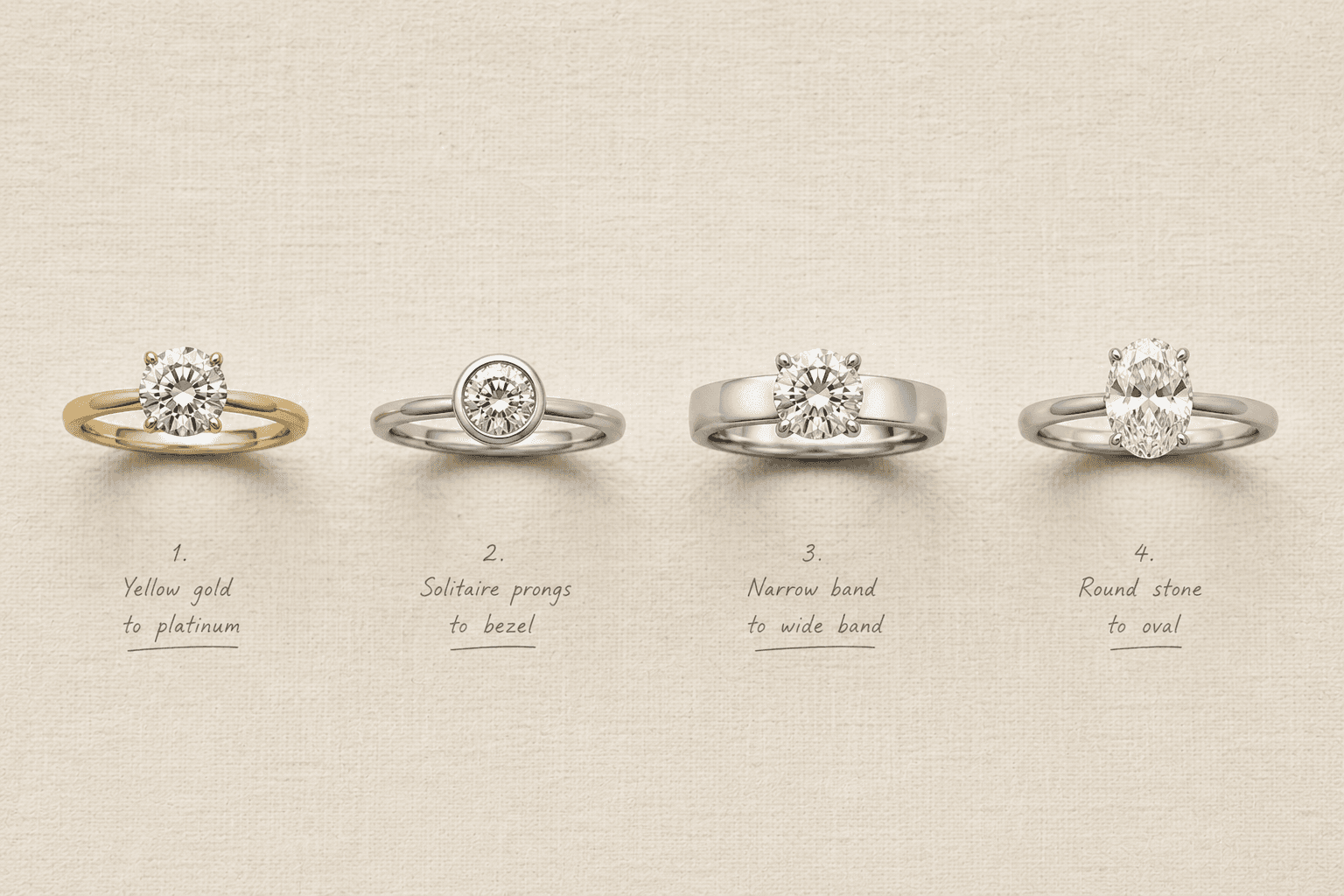
How to Communicate Your Vision to a Jewelry Designer
Learn effective techniques for communicating your jewelry design vision to a professional designer. From mood boards and vocabulary tips to feedback strategies, ensure your custom piece matches your dream.
Turning Your Jewelry Vision Into Reality Through Clear Communication
Effectively communicating your jewelry design vision requires a combination of visual references, descriptive vocabulary, honest feedback, and clear priorities, transforming abstract ideas in your mind into specific guidance that a designer can translate into a stunning custom piece. Mastering this communication is the single most important factor in custom jewelry satisfaction.
The gap between what you imagine and what a designer creates is entirely a communication gap. Your jeweler is skilled at turning clear direction into beautiful jewelry. Your job is to provide that clear direction, and this guide will show you exactly how to do it.
Why Communication Matters More Than You Think
Studies of custom jewelry client satisfaction consistently show that the design outcome correlates more strongly with the quality of client communication than with the jeweler's technical skill level. An excellent jeweler working from vague instructions will produce a less satisfying result than a good jeweler working from clear, detailed guidance.
This is not about being demanding or controlling. It is about being a collaborative partner in the creative process. The best custom jewelry experiences are genuine collaborations where both parties contribute their expertise, yours in knowing what you want and the designer's in knowing how to create it.
Building a Visual Reference Library
Words alone are insufficient for communicating jewelry design. You need images, and lots of them. Start collecting visual references weeks or even months before your consultation.
Creating an Effective Mood Board
Build a dedicated Pinterest board or image folder for your project. Include not just jewelry images, but anything that captures the feeling you want. Architecture, fashion, nature, art, and textile patterns can all communicate aesthetic preferences that words struggle to convey.
Organize your references into categories. Group images by what they represent, such as overall style, specific design elements, metal color preferences, stone arrangement ideas, and things you explicitly do not want. Yes, including examples of what you dislike is just as valuable as showing what you love.
For each image, note specifically what draws you to it. Is it the proportions? The texture? The way light plays off the surface? A photo of a ring might inspire you because of its band width, not its stone, and your designer needs to know that distinction.
Using Existing Jewelry as Reference
If you own pieces you love, bring them to your consultation. Being able to point to a physical object and say "I love the weight of this ring" or "this is the exact gold color I want" eliminates ambiguity in ways that photos cannot.
Also bring pieces that are close but not quite right. "I love this pendant but wish it were slightly smaller and in rose gold" gives your designer a concrete starting point with specific modifications, which is far more useful than starting from a blank canvas.
Developing Your Jewelry Vocabulary
You do not need to become a gemologist, but learning a few key terms dramatically improves communication.
Metal and Finish Terms
Understanding the difference between polished, brushed, matte, hammered, and satin finishes helps you describe the surface quality you envision. Knowing terms like rose gold, yellow gold, and white gold along with their respective warmth and appearance helps you specify metal preferences accurately.
Setting and Design Terms
Familiarize yourself with basic setting types like prong, bezel, pave, channel, and tension. Understanding terms like filigree, milgrain, cathedral, and split shank helps you describe structural elements. If you want a vintage feel, knowing terms like art deco, art nouveau, and Victorian helps your designer pinpoint the era you are referencing.
Proportion and Scale Language
Use comparative language to describe proportions. Phrases like "delicate rather than substantial," "statement-sized rather than understated," or "about the width of a matchstick" communicate scale effectively. Referencing coin sizes or everyday objects provides helpful scale context.
The Art of Giving Feedback
The design revision process is where communication skills matter most. How you respond to initial concepts shapes the entire trajectory of your project.
Be Specific, Not General
"I don't like it" tells your designer nothing actionable. "The band feels too wide for my finger, and I was hoping for more vintage detail around the center stone" gives them exact targets for improvement. Always identify the specific elements that are not working and articulate why.
Use Comparative Language
"Make the diamond bigger" is less useful than "I want the center stone to be more visually dominant relative to the setting, similar to image #3 in my reference folder." Comparisons to your reference images create a shared visual language that reduces misinterpretation.
Prioritize Your Feedback
If you have multiple concerns about a design concept, rank them. Your designer needs to know which issues are deal-breakers and which are minor preferences. This prevents situations where a designer spends hours perfecting a minor detail while a fundamental proportion issue goes unaddressed.
Acknowledge What Works
When reviewing a design, start by identifying what you love. This is not just about being polite, though that matters too. Confirming the elements that are working ensures your designer preserves them while modifying other aspects. Without this positive feedback, a designer might inadvertently change something you loved while trying to fix something you did not.
Common Communication Pitfalls
Several communication mistakes consistently lead to disappointing outcomes in custom jewelry.
Sending too many contradictory references without explanation confuses designers. If your mood board includes both minimalist modern pieces and ornate vintage designs, clarify which aesthetic you prefer or explain which specific elements you are drawn to in each style.
Assuming your designer can read your mind is surprisingly common. Details that seem obvious to you, like your preference for yellow gold over rose gold, or your expectation of a matte finish, may not be obvious to your designer unless explicitly stated.
Avoiding conflict during the design phase out of politeness is counterproductive. It is far better to voice concerns when changes are easy and inexpensive than to accept a design you are not fully happy with.
Changing direction repeatedly without acknowledging the shift frustrates designers and inflates costs. If your preferences evolve during the process, own that change openly rather than framing it as the designer missing the mark.
Communicating Budget Constraints
Be transparent about your budget from the first conversation. A skilled designer can create something beautiful at almost any price point, but they need to know the parameters upfront to suggest appropriate materials and techniques.
If your vision exceeds your budget, ask your designer for creative solutions. They might suggest alternative gemstones, a simpler setting that achieves a similar effect, or phased additions where you start with the core piece and add elements later.
How Tashvi AI Transforms Design Communication
Tashvi AI solves the biggest communication challenge in custom jewelry by letting you generate visual representations of your ideas before ever contacting a designer. Instead of struggling to describe "a vintage-inspired ring with a cushion-cut center stone and delicate filigree details," you type that description and receive a photorealistic rendering.
You can iterate endlessly, refining your vision until the AI-generated design matches what you see in your mind's eye. Then you bring that image to your designer as the foundation of your consultation. This approach eliminates the most frustrating communication barriers and gets your project on the right track from day one.
Try designing on Tashvi AI free
Setting Up for a Successful Partnership
Remember that custom jewelry creation is a partnership. Your designer brings technical skill, material knowledge, and creative expertise. You bring the vision, the emotional context, and the personal significance. When both parties communicate openly and respect each other's contributions, the result is a piece that exceeds what either could have created alone.
Frequently Asked Questions
Quick answers to the questions readers ask most about this guide.
What should I bring to a jewelry design consultation?
Bring inspiration images, a Pinterest board or mood board, any heirloom pieces to incorporate, your budget range, timeline requirements, and notes about specific design elements you want or want to avoid. The more prepared you are, the more productive the consultation will be.
How do I describe a jewelry style I cannot name?
Use comparison references rather than technical terms. Point to images and describe what you like about each one. Phrases like 'similar to this but with a thinner band' or 'this shape but in a warmer gold tone' help designers understand your preferences without requiring specialized vocabulary.
What if I do not like my jeweler's initial design concept?
Be honest and specific about what is not working. Instead of saying 'I don't like it,' identify exactly what feels wrong, whether it is the proportions, the style, or a specific element. Constructive, specific feedback helps your designer make targeted improvements.
How many reference images should I share with my jeweler?
Share 5 to 15 curated images that represent different aspects of your vision. Too few images may not convey enough detail, while too many can confuse the direction. Annotate each image to highlight which specific element you are drawn to in each one.
Can I change my mind during the custom jewelry design process?
Yes, changes are expected during the design phase. However, the further along the process, the more costly changes become. Major direction changes after production begins can significantly increase costs and delay timelines. Try to finalize your vision during the digital design stage.