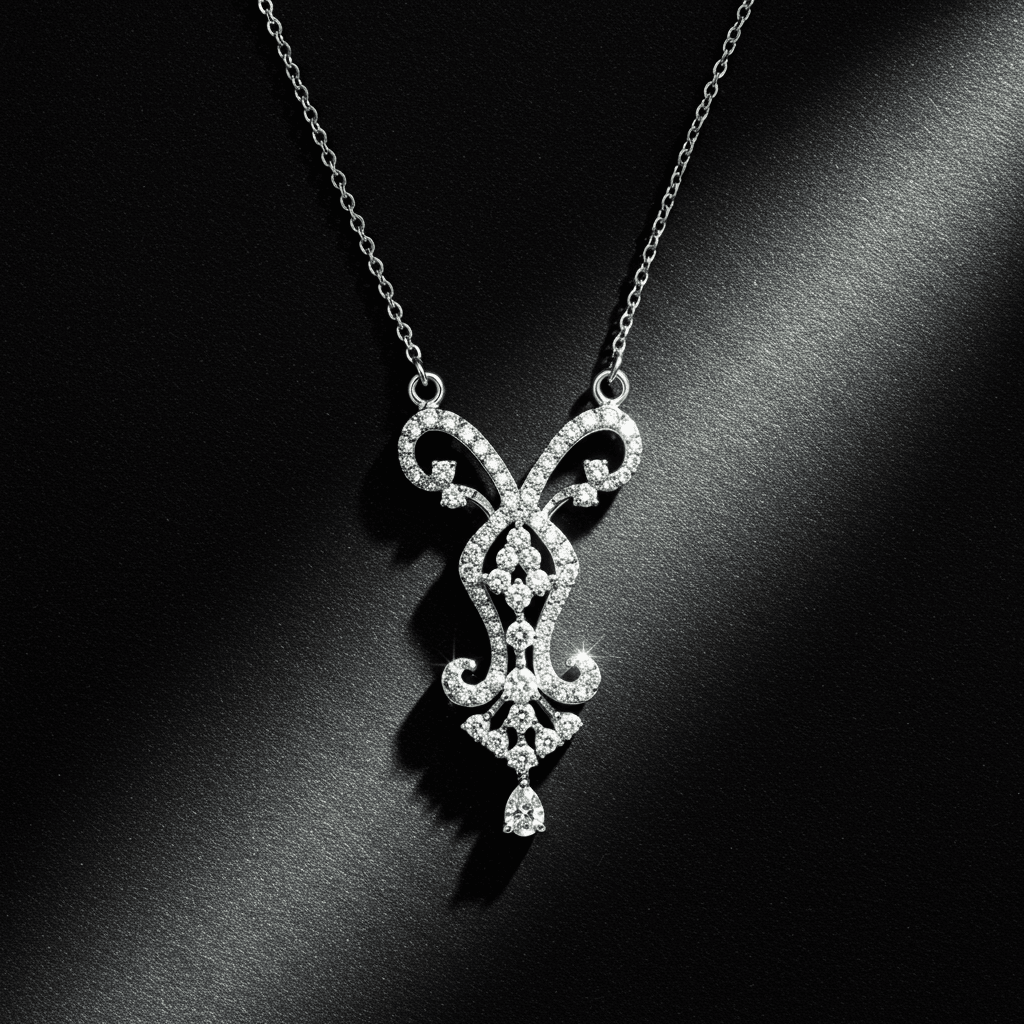
How Neural Networks Understand Gemstone Placement and Symmetry
Neural networks trained on jewelry design data learn the rules of gemstone placement, visual symmetry, and balanced composition. Explore the technology behind AI systems that create harmonious, structurally sound jewelry designs.
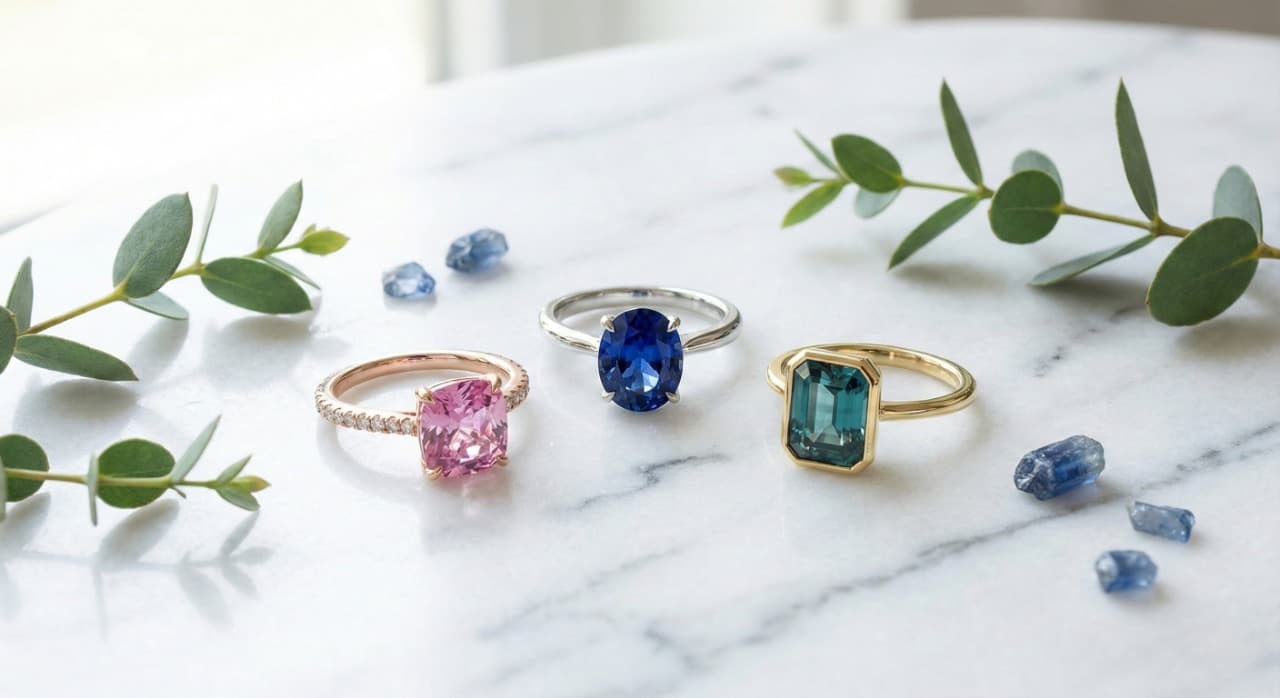
Neural networks understand gemstone placement and symmetry by learning from thousands of professionally designed jewelry pieces during training. These AI models internalize the visual rules of stone arrangement, proportional relationships, and compositional balance, enabling them to generate jewelry designs where every gemstone sits in a position that is both aesthetically harmonious and structurally sound.
What Neural Networks See in Jewelry
When a neural network analyzes a jewelry image during training, it does not see "a ring with diamonds." It processes the image as a complex pattern of spatial relationships, color contrasts, light behaviors, and geometric structures.
Through thousands of training examples, the network develops an internal model of how these elements relate to each other in well-designed jewelry. It learns that center stones in halo settings are surrounded by smaller stones at consistent spacing, that three-stone arrangements follow specific size graduation rules, and that pavé bands require even distribution within particular dimensional constraints.
This learning is implicit rather than explicit. Nobody programs the rules of gemstone placement into the network. The network discovers these rules by observing patterns across the training data, much like a jewelry apprentice learns by studying hundreds of finished pieces.
Bilateral Symmetry in Ring Design
Most traditional ring designs rely on bilateral symmetry, meaning the design is mirrored along a central axis running from the top of the ring through the center stone and down to the bottom of the band.
Neural networks trained on ring data learn this symmetry principle deeply. When generating a design with side stones, the network automatically places matching stones at equal distances from the center. When creating a halo, the surrounding stones are distributed with even angular spacing. When adding pavé on the band, the stone placement mirrors across the center line.
This symmetrical placement is not just aesthetic. It is structural. Symmetrical stone distribution balances the weight of the ring, ensures even pressure on the setting, and prevents the ring from sitting unevenly on the finger.
| Symmetry Type | Common Applications | AI Learning Difficulty |
|---|---|---|
| Bilateral (mirror) | Most ring designs, earring pairs | Low (strong training signal) |
| Radial (rotational) | Flower settings, starburst designs | Moderate |
| Translational (repeating) | Eternity bands, tennis bracelets | Low (pattern repetition) |
| Asymmetrical (intentional) | Modern art jewelry, organic designs | High (fewer examples in training) |
How Size Relationships Are Learned
Gemstone size relationships in jewelry follow conventions that neural networks internalize during training.
Center to Accent Stone Ratios
In a three-stone ring, the center stone is typically larger than the side stones, but the size relationship follows proportional rules. The side stones are usually 50 to 70 percent of the center stone's diameter. Too small, and they look insignificant. Too large, and they compete with the center stone.
Neural networks learn these ratios from thousands of examples. When generating a three-stone design, the model automatically produces side stones within the appropriate proportional range, even when the designer has not specified exact sizes.
Halo Stone Sizing
Halo stones must be small enough to form a continuous border without overwhelming the center stone, but large enough to contribute visual impact. The typical halo stone diameter is 8 to 15 percent of the center stone's width, depending on the desired effect.
AI models trained on halo designs reproduce these proportions consistently. The generated concepts show halos where the stones are appropriately sized relative to the center, with spacing that allows for secure setting construction.
Graduated Stone Arrangements
Designs featuring graduated stone sizes, like a necklace where stones decrease in size from center to ends, follow mathematical progressions. Neural networks learn these progressions and apply them naturally when generating graduated arrangements.
Spatial Relationships and Spacing
Even Distribution
The spacing between stones is as important as their size. Uneven spacing in a pavé band or a channel setting looks like a mistake, even if every individual stone is perfectly placed.
Neural networks are exceptionally good at learning consistent spacing patterns because regularity is a strong signal in training data. The difference between professional and amateur jewelry design is often visible in spacing consistency, and AI models capture this distinction well.
Clearance and Construction Space
Beyond visual spacing, gemstone placement must account for physical construction requirements. Each stone needs a seat, a setting mechanism (prongs, bezels, channels), and enough metal between stones for structural integrity.
Jewelry-specific AI models trained on large jewelry image sets tend to reproduce these clearance conventions. A general image generator might place stones impossibly close together, creating a beautiful but unbuildable design. A jewelry-trained model maintains realistic spacing that allows for physical stone setting methods.
Negative Space
Sophisticated jewelry design uses negative space, the empty areas around and between gemstones, as a deliberate compositional element. Neural networks that have been exposed to high-quality training data learn to use negative space effectively, creating designs where the gaps between stones contribute to the overall aesthetic rather than looking like mistakes.
Color and Optical Considerations
Light Performance
Neural networks learn how gemstones interact with light. They understand that certain placements allow light to enter and exit stones at angles that maximize brilliance and fire. While the AI is not performing optical physics calculations, it reproduces the placement patterns that experienced designers use to optimize light performance.
For example, the network learns that elevating a center stone above the band (as in a cathedral setting) allows more light to reach the pavilion, enhancing brilliance. It learns that closed-back settings reduce light performance compared to open-back designs.
Color Harmony
When generating designs with multiple colored gemstones, neural networks apply color harmony principles learned from training data. Complementary colors, analogous palettes, and accent contrasts are produced in patterns that reflect established jewelry color-matching conventions.
A design featuring a blue sapphire center stone might include diamond accents (complementary sparkle) rather than colored stones that would compete with the center. These decisions emerge from pattern recognition, not programmed rules.
Symmetry Breaking as a Design Tool
Not all jewelry is symmetrical, and the best neural networks learn when asymmetry is intentional and desirable.
Nature-inspired designs, modern art jewelry, and organic forms use deliberate asymmetry as a design principle. The neural network learns that asymmetrical stone placement in these contexts follows its own rules, including visual weight balance, dynamic tension, and intentional contrast.
However, asymmetrical design is harder for AI to learn because it appears less frequently in training data and the "rules" are more subjective. This is one area where human creative direction remains especially important, guiding the AI toward the right kind of asymmetry rather than random placement.
Practical Implications for Designers
Faster Pavé Design
Laying out pavé stones is tedious work in traditional CAD. The consistent spacing and sizing requirements make it a perfect task for AI automation. Neural networks produce pavé layouts with even distribution, appropriate stone sizing, and realistic construction clearances, saving hours of manual CAD work.
Confident Multi-Stone Arrangements
Complex multi-stone designs, such as cluster rings, flower settings, and intricate vintage pieces, require careful placement of many elements. AI-generated concepts provide a reliable starting point where stone sizes, positions, and spacing are already proportionally balanced.
Design Validation
Even experienced designers can use AI as a second opinion on stone placement. Generate an AI version of your concept and compare it to your manual design. Differences in spacing, proportion, or symmetry might reveal opportunities for improvement.
How Tashvi AI Applies These Principles
Tashvi AI's neural networks are trained exclusively on professional jewelry imagery, giving them deep understanding of gemstone placement, symmetry, and proportion. Every design generated on the platform reflects these learned principles, producing concepts where stones are placed with appropriate sizing, spacing, and visual balance.
This jewelry-specific intelligence is what separates Tashvi AI from general image generators. When you describe a "halo engagement ring with pavé band," the platform knows exactly what proportional relationships that description implies, down to the relative sizes of halo stones, the spacing of pavé elements, and the structural clearances needed for real-world construction. The result is a design that a skilled jeweler recognizes as buildable and balanced.
Try designing on Tashvi AI free
The Technical Frontier
Research in 2026 is pushing neural network capabilities further. Models are being trained to understand 3D spatial relationships from 2D images, predict optical performance of gemstone arrangements, and generate placement layouts that optimize for both beauty and manufacturability simultaneously. The intersection of computational geometry and learned aesthetics is producing jewelry design AI that is increasingly indistinguishable from expert human placement.
Frequently Asked Questions
Quick answers to the questions readers ask most about this guide.
How do neural networks learn about gemstone placement?
Neural networks learn by analyzing thousands of professionally designed jewelry pieces. Through training, they internalize patterns of stone placement, spacing, size relationships, and visual balance. The network develops an implicit understanding of what makes gemstone arrangements look harmonious and structurally viable.
Can AI create symmetrical jewelry designs?
Yes. AI models trained on jewelry data produce designs with high degrees of bilateral and radial symmetry when appropriate. They also understand when asymmetrical arrangements are aesthetically desirable, such as in organic or modern design styles.
How accurate is AI gemstone placement compared to human designers?
For standard arrangements like halo settings, three-stone configurations, and channel-set bands, AI achieves placement accuracy comparable to experienced designers. For complex or unconventional arrangements, human oversight remains important to ensure both aesthetic quality and manufacturing feasibility.
Does AI understand different types of gemstone settings?
Advanced jewelry AI models distinguish between prong, bezel, channel, flush, pavé, bar, tension, and other setting types. They understand the visual and structural characteristics of each, placing stones appropriately for the specified setting style.
Can AI help with pavé stone layout?
Yes. AI models are particularly effective at pavé layout because the regular spacing and sizing patterns are well-suited to computational analysis. AI can generate consistent pavé arrangements that maintain even spacing, appropriate stone sizes, and balanced visual density.