Jewelry Design Basics: Elements & Principles Explained Simply
Every beautiful jewelry piece follows a few basic design rules. Learn the 6 elements (line, shape, color, texture, size, space) and 4 principles (balance, proportion, contrast, harmony) that make designs work.
Why Design Rules Matter in Jewelry
Every beautiful jewelry piece follows a few basic design rules, even if you don't notice them at first.
When a ring catches your eye or a necklace feels "just right," that reaction isn't accidental. Behind every well-designed piece are fundamental elements and principles working together. Understanding these basics helps you create jewelry that looks intentional and refined rather than random.
Whether you're a professional jeweler, a hobbyist, or someone designing their first custom piece with Tashvi AI, these fundamentals will sharpen your eye and improve your designs immediately.
Part 1: The 6 Elements of Jewelry Design
Design elements are the building blocks of any jewelry piece. They define how a piece looks and feels.
Line
Lines are the most fundamental element. They create movement, define shapes, and guide the viewer's eye across a piece.
| Line Type | Effect | Jewelry Example |
|---|---|---|
| Straight | Stability, strength | Geometric art deco rings |
| Curved | Softness, elegance | Bypass rings, wave bangles |
| Diagonal | Energy, dynamism | Twisted rope chains |
| Spiral | Movement, growth | Coiled wire pendants |
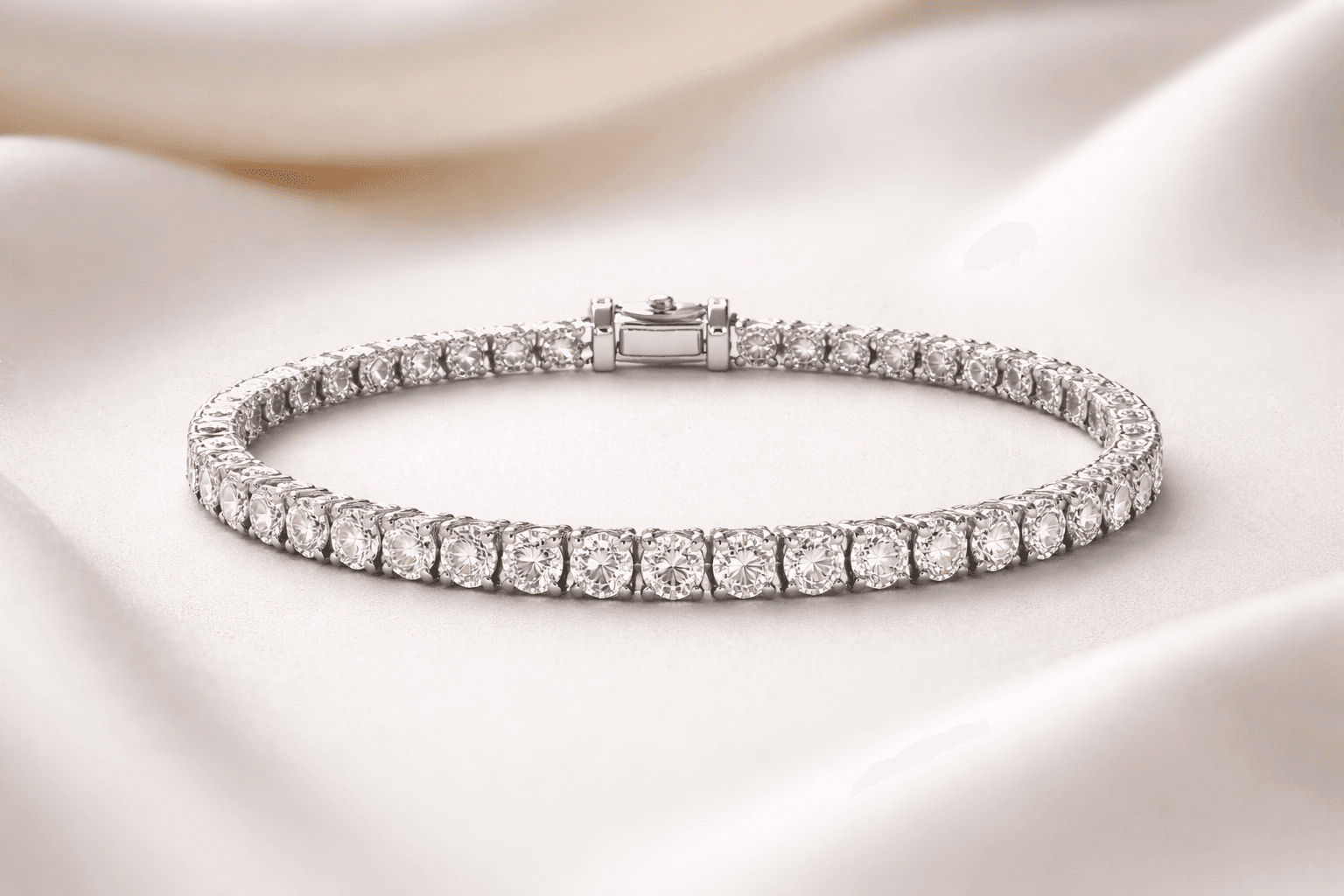
A cathedral ring setting uses vertical lines to draw the eye upward toward the center stone. A tennis bracelet uses repeated horizontal lines to create flow around the wrist.
Shape
Shapes are self-contained areas defined by lines. In jewelry, shapes work in both two dimensions (the silhouette) and three dimensions (the form you can hold).
Common shapes in jewelry design:
- Geometric — circles, squares, triangles, hexagons (modern, structured)
- Organic — freeform, nature-inspired curves (bohemian, artistic)
- Abstract — stylized or symbolic forms (unique, contemporary)
The overall silhouette of a piece is often what catches attention first. A round halo ring reads differently from an angular emerald-cut solitaire, even before you notice the stone itself.
Color
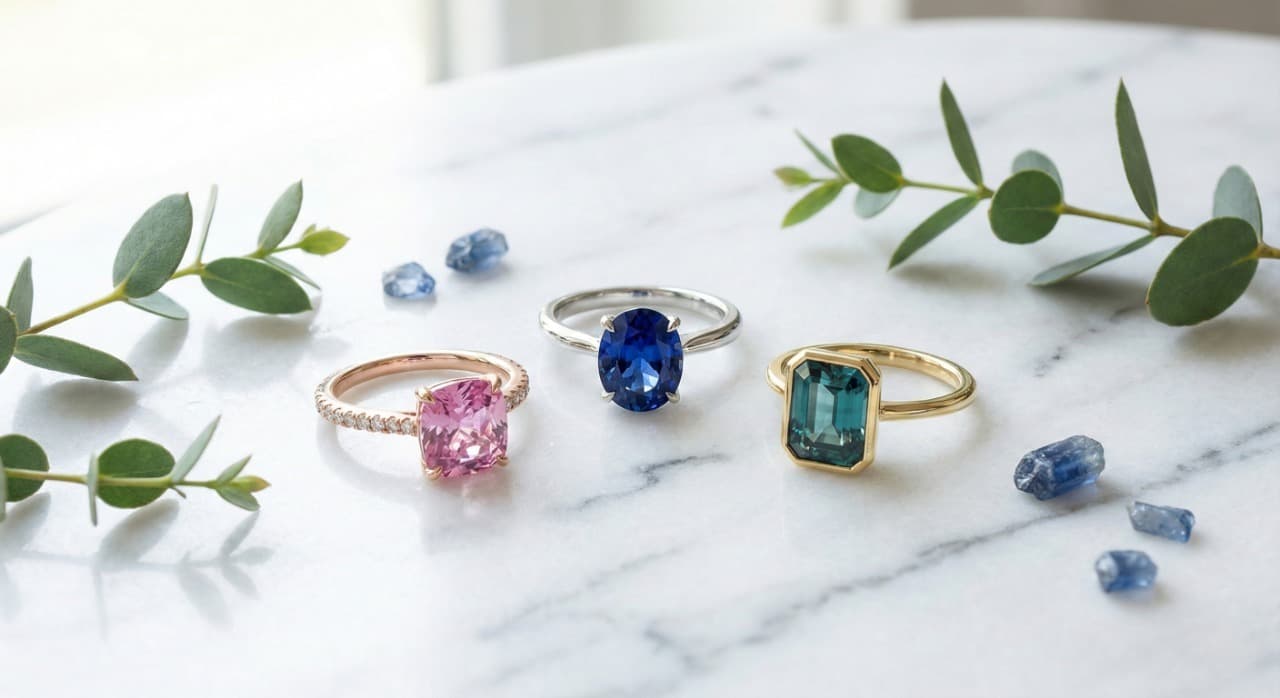
Color is one of the most powerful elements because it triggers immediate emotional responses.
| Color | Emotion | Common Gems |
|---|---|---|
| Red | Passion, energy | Ruby, garnet, red spinel |
| Blue | Trust, calm | Sapphire, tanzanite, aquamarine |
| Green | Nature, renewal | Emerald, tsavorite, peridot |
| White/Clear | Purity, brilliance | Diamond, white sapphire |
| Yellow/Gold | Warmth, luxury | Citrine, yellow sapphire, gold |
| Black | Sophistication, edge | Black diamond, onyx |
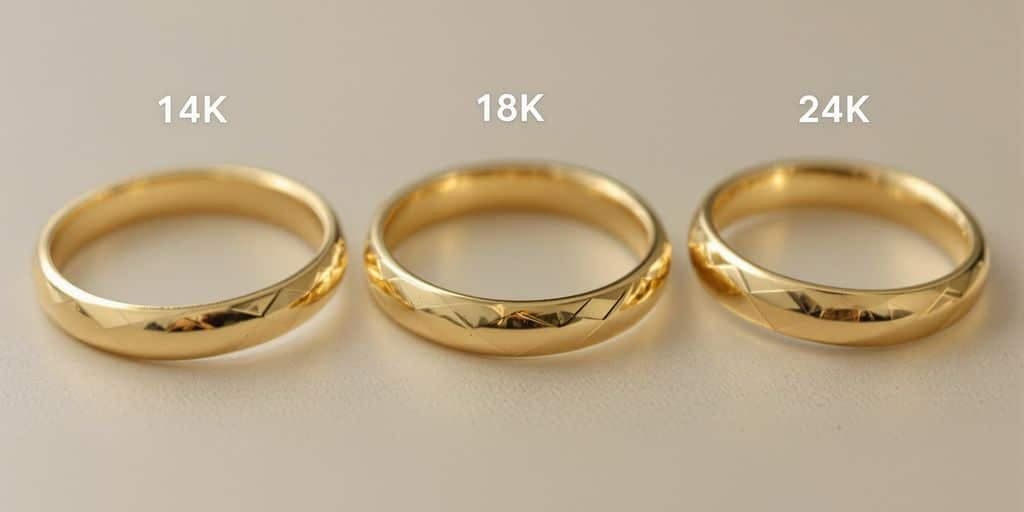
Color also applies to metals: warm rose gold vs. cool white gold vs. classic yellow gold. The metal-to-gemstone color relationship is a key design decision.
Texture
Texture adds depth and tactile interest. It transforms a flat surface into something that interacts with light in unique ways.
Common jewelry textures:
- Polished — mirror-smooth, high reflectivity
- Matte/Brushed — soft, understated, modern
- Hammered — organic dimpled surface, artisanal feel
- Engraved — carved patterns, decorative detail
- Sandblasted — fine, even graininess
- Florentine — crosshatched lines, vintage appeal
Mixing textures within a single piece creates visual richness. A matte band with a polished bezel setting creates subtle contrast without adding color.
Size
Size creates visual weight and hierarchy. Larger elements demand attention; smaller elements provide support and detail.
Size decisions in jewelry:
- Stone size relative to band width
- Pendant size relative to chain thickness
- Accent stones relative to center stone
- Overall piece size relative to the wearer
A 2-carat center stone surrounded by 1mm melee diamonds creates a clear size hierarchy that tells your eye exactly where to look.
Space
Space (sometimes called "negative space") is the empty area between and around design elements. It's just as important as the elements themselves.
Space gives the eye room to rest and prevents a design from feeling cluttered. An open-work ring that reveals skin between metal curves uses space as an active design choice. A tightly packed pavé band uses minimal space to create density and sparkle.
Part 2: The 4 Core Principles of Jewelry Design
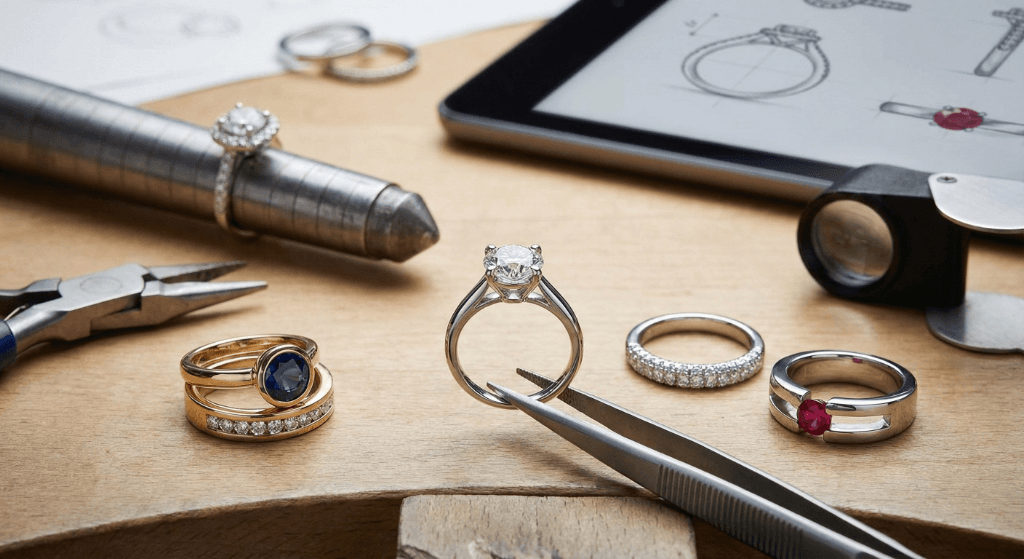
Design principles guide how elements work together. They're the rules that make a collection of elements feel like a unified piece rather than a random assembly.
Balance
Balance is the distribution of visual weight across a piece. When balance is right, a design feels stable and intentional. When it's off, something feels wrong even if you can't pinpoint why.
Three types of balance:
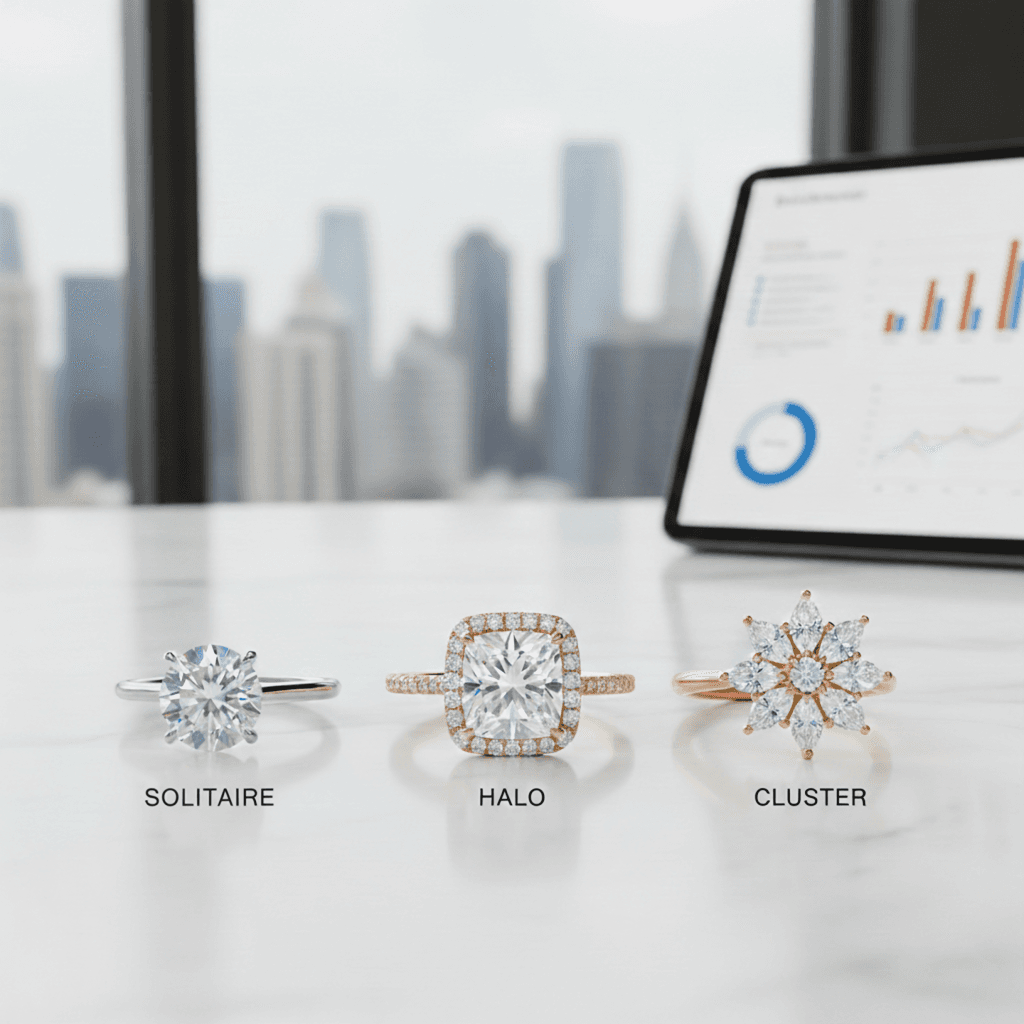
- Symmetrical — mirror image on both sides of a center axis. Classic solitaire engagement rings, traditional drop earrings.
- Asymmetrical — different elements on each side that still feel equal in visual weight. A large stone on one side balanced by a cluster of smaller stones on the other. Bypass rings are a classic example of asymmetrical balance.
- Radial — elements radiating from a central point. Starburst pendants, flower-motif rings, halo settings.
Practical example: A large gemstone needs a thicker band for balance. A 3-carat center stone on a 1mm wire band looks top-heavy and unstable. Matching it with a 2.5-3mm band creates visual and structural balance.
Proportion
Proportion is the size relationship between parts. It creates a sense of "rightness" when all elements relate well to each other.
Key proportion relationships:
| Element 1 | Element 2 | Good Proportion |
|---|---|---|
| Center stone | Band width | 3-carat stone = 2.5-3mm band |
| Pendant | Chain | Large pendant = thicker chain |
| Accent stones | Center stone | Accents = 1/5 to 1/10 of center |
| Earring length | Face shape | Longer earrings for round faces |
Proportion also applies to the wearer. A delicate 0.3-carat solitaire may feel lost on a larger hand, while a chunky cocktail ring might overwhelm a petite finger.
Contrast
Contrast creates visual interest by placing different qualities next to each other. Without contrast, a piece can feel flat and forgettable.
Ways to create contrast in jewelry:
- Texture contrast — matte band + polished stone setting
- Color contrast — warm rose gold + cool blue sapphire
- Size contrast — one large center stone + tiny pavé accents
- Material contrast — smooth metal + rough raw diamond
- Finish contrast — high-polish surfaces + sandblasted sections
- Shape contrast — round stone in angular, geometric mounting
The key: contrast should highlight your focal point, not compete with it. Too much contrast in every direction creates chaos rather than interest.
Harmony
Harmony ties everything together into a cohesive whole. While contrast creates interest, harmony ensures the piece still reads as one unified design rather than a collection of competing elements.
Ways to achieve harmony:
- Repetition — repeating shapes, colors, or textures throughout a piece
- Continuity — lines that flow smoothly from one element to the next
- Consistent theme — all elements supporting the same aesthetic (art deco, nature-inspired, minimalist)
- Color family — staying within related tones (warm metals + warm stones)
Practical example: A nature-inspired ring might repeat organic curves in the band, the prong shapes, and the gallery (underside) design. Even though each element is different, the repeated curve motif creates harmony.
How Elements and Principles Work Together
Here's how these concepts combine in real jewelry design decisions:
| Design Choice | Elements Used | Principles Applied |
|---|---|---|
| Large sapphire on thick gold band | Color, size | Balance, proportion |
| Matte band with polished bezel | Texture | Contrast |
| Repeating leaf shapes in a ring | Shape, line | Harmony |
| Open-work pendant with negative space | Space, shape | Balance |
| Pavé halo around center diamond | Size, space | Proportion, emphasis |
| Rose gold + morganite + pink sapphire accents | Color | Harmony |
Common Design Mistakes (and How to Fix Them)
| Mistake | Why It Fails | Fix |
|---|---|---|
| Thin band + huge stone | No balance | Increase band width to match stone weight |
| All same-size elements | No emphasis | Create a clear focal point with size contrast |
| Too many colors/textures | No harmony | Limit to 2-3 related elements |
| Everything symmetrical | Can feel static | Add one asymmetrical detail for interest |
| No negative space | Feels cluttered | Let some areas breathe |
Apply These Principles With Tashvi AI
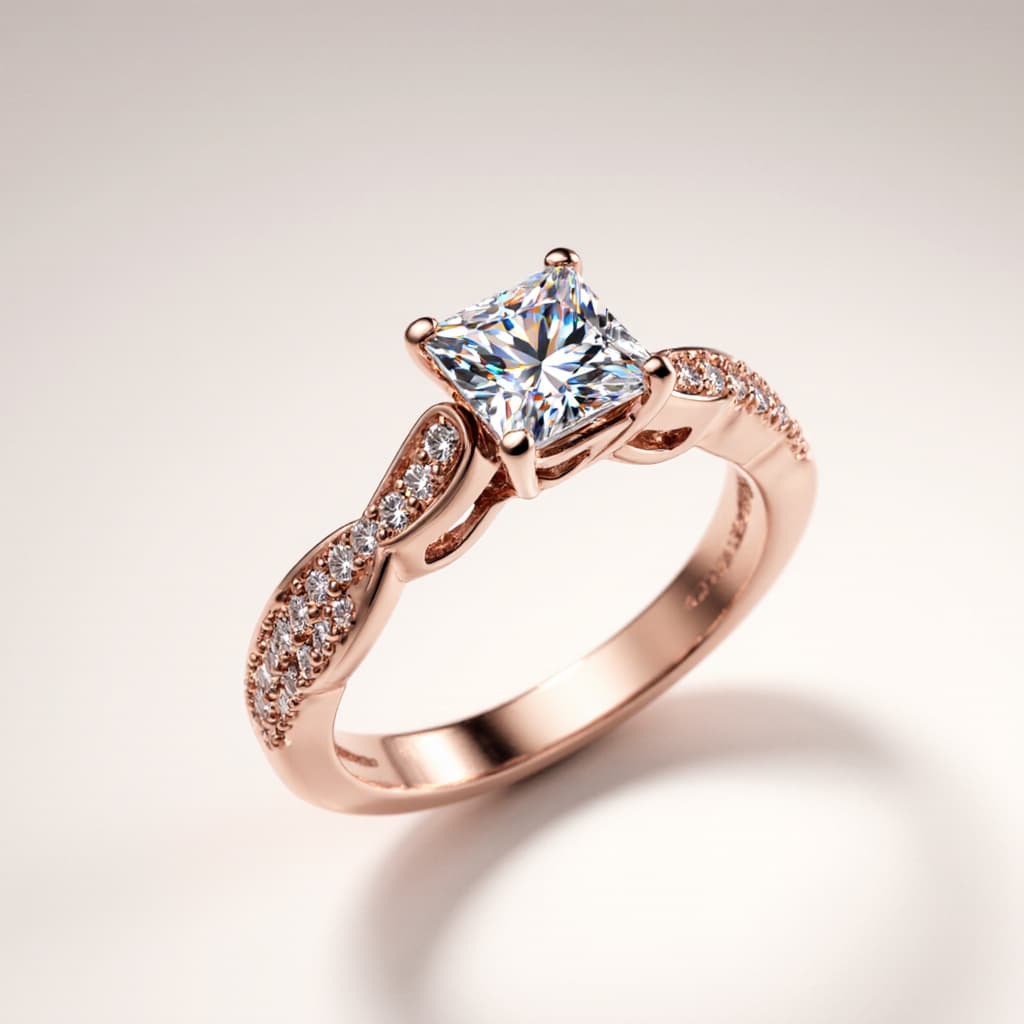
Good jewelry design isn't accidental. It's thoughtful, intentional, and refined. The good news: you don't need years of training or expensive CAD software to start applying these principles.
Tashvi AI lets you put elements and principles into practice instantly:
- Experiment with proportion — Try different stone sizes against different band widths and see what feels balanced. Generate variations in seconds rather than spending hours in CAD.
- Explore color combinations — Test how different gemstones look in rose gold vs. white gold vs. yellow gold. See warm-on-warm harmony or bold cool-on-warm contrast.
- Play with shape and line — Switch between curved organic designs and sharp geometric silhouettes. See how the same stone looks in a flowing bypass setting vs. a structured cathedral mount.
- Compare contrast levels — Generate a matte-finish version alongside a high-polish version of the same design. See which creates more visual interest for your concept.
- Find the right balance — Try symmetrical halo designs against asymmetrical toi-et-moi arrangements. Discover which approach suits your style.
Whether you're a professional jeweler prototyping a new collection or someone designing their first custom engagement ring, understanding these fundamentals gives you the vocabulary to describe what you want — and Tashvi AI gives you the tool to see it come to life.
Start designing your own jewelry with Tashvi AI →
Related Reads
- Ring Settings Guide: 10 Types Explained — See how design principles apply to real ring settings
- Solitaire vs Halo vs Cluster: Which Style? — Compare balance and proportion across setting types
- Diamond Shapes Guide — How shape affects the overall design of your ring
- Types of Gold: 10K vs 14K vs 18K vs 24K — Understanding color and material choices in jewelry design
- Free AI Jewelry Design Software — Put these design principles into practice with AI tools
Frequently Asked Questions
Quick answers to the questions readers ask most about this guide.
What are the basic elements of jewelry design?
The basic elements of jewelry design are line, shape, color, texture, size, and space. These are the visual building blocks that define how a piece looks and feels. Line creates movement and structure, shape defines silhouettes, color evokes emotion, texture adds tactile interest, size creates visual weight, and space gives the eye room to rest.
What are the principles of jewelry design?
The core principles of jewelry design are balance, proportion, contrast, and harmony. Balance distributes visual weight evenly. Proportion ensures elements relate well to each other in size. Contrast creates visual interest through differences in texture, color, or shape. Harmony ties all elements together into a cohesive, unified piece.
Why does balance matter in jewelry design?
Balance matters because it determines whether a piece feels stable and comfortable or visually 'off.' A large gemstone on a thin, delicate band looks top-heavy and unbalanced. Matching the band width to the stone size creates visual stability. Balance can be symmetrical (mirror image), asymmetrical (different but equal weight), or radial (elements radiating from a center point).
How do I use contrast in jewelry design?
Use contrast by pairing opposite qualities: matte metal with polished surfaces, rough-cut stones with smooth bezels, warm gold with cool sapphires, or large focal stones with tiny accent diamonds. Contrast prevents monotony and draws the eye to your focal point. Too little contrast makes a piece boring; too much makes it chaotic.
Can beginners learn jewelry design without formal training?
Yes. Understanding the basic elements and principles gives beginners a solid foundation. Tools like Tashvi AI let you experiment with different design combinations instantly, seeing how changes in proportion, color, and balance affect the final piece without needing years of CAD training or expensive software.
What is proportion in jewelry design?
Proportion is the size relationship between different parts of a piece. A 3-carat center stone needs a band width of 2.5-3mm to look balanced, while a 0.5-carat stone suits a 1.5-2mm band. Proportion also applies to the wearer: larger pieces suit larger hands, and necklace pendant size should relate to chain thickness.