Oval Engagement Rings: The Complete 2026 Buying Guide
Among the most popular engagement ring shapes today. Learn ideal ratios (1.35-1.50), avoid the bow-tie effect, see celebrity rings (Hailey Bieber, Blake Lively), and find your perfect oval.
Oval Engagement Rings: Quick Overview
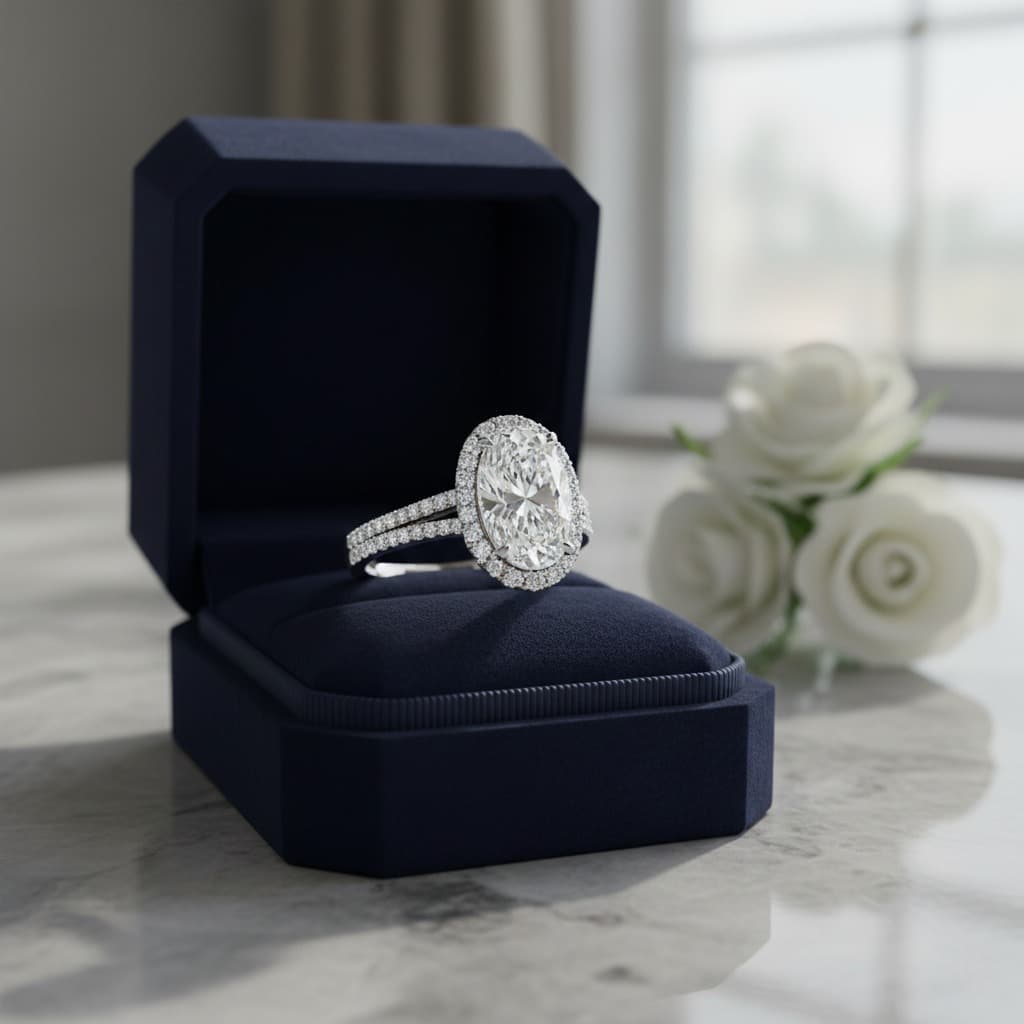
Among the most popular engagement ring shapes for several consecutive years. Oval diamonds combine the brilliance of round cuts with an elongated silhouette that flatters every finger. Made iconic by Hailey Bieber and Blake Lively, ovals can appear up to 10-15% larger than rounds of the same carat weight.
| Factor | Details |
|---|---|
| Popularity Rank | Among top shapes (trending) |
| Ideal Ratio | 1.35:1 to 1.50:1 |
| Ideal Depth | 58% - 62% |
| Ideal Table | 56% - 60% |
| Size Advantage | Appears 10-15% larger than round |
| Price vs Round | 10-25% less expensive |
| Key Concern | Bow-tie effect (check visually) |
| Best Settings | Solitaire, Halo, Three-Stone, Hidden Halo |
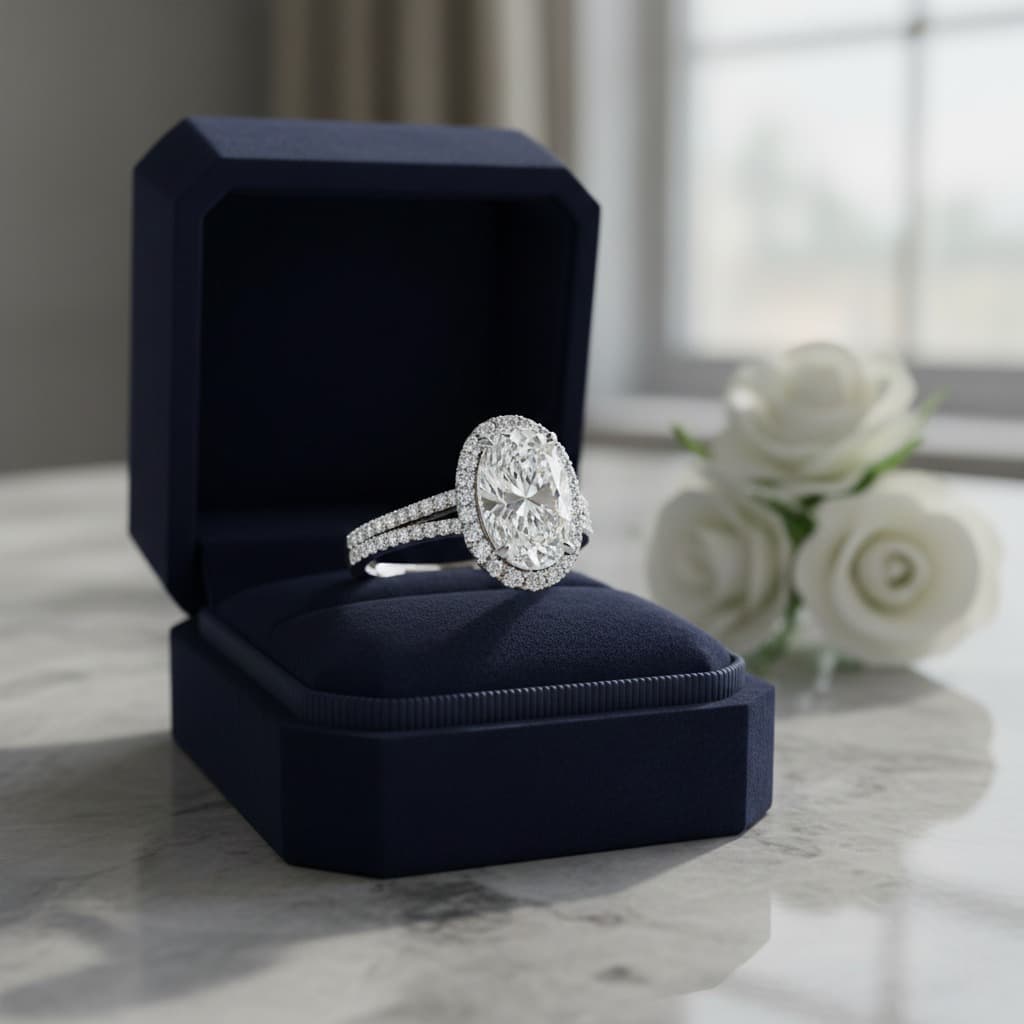
Why Oval Engagement Rings Dominate 2026
Oval cut engagement rings have been the most popular style for three years running, and 2026 shows no signs of slowing down. According to The Knot's Jewelry Study, oval diamonds grew from just 2% of engagement rings in 2015 to over 25% today. Here's why:
1. The Finger-Flattering Effect
The elongated silhouette of oval diamonds creates an illusion that makes fingers appear longer, slimmer, and more elegant. Unlike round diamonds that sit compactly, ovals stretch gracefully across the finger, creating a sophisticated presence that works beautifully on every hand shape. This is similar to other elongated shapes like pear-shaped diamonds, but ovals offer a softer, more symmetrical appearance.
2. More Diamond for Your Money
Oval diamonds appear 10-15% larger than round diamonds of the same carat weight. Their elongated shape distributes weight across a larger surface area, giving you more visual impact without increasing your budget. A well-cut 1.5-carat oval often looks comparable to a 2-carat round on the finger—making them exceptional value for budget-conscious buyers.
3. Brilliant Sparkle
Despite their fancy shape, oval diamonds are cut to maximize light reflection, delivering fire and brilliance similar to round brilliant cuts. The 58 facets catch and reflect light beautifully, creating the sparkle that makes diamond engagement rings so captivating. For a comprehensive comparison of diamond shapes and their brilliance, see our Diamond Shapes Guide.
4. Versatile Style
Ovals work beautifully in virtually every ring setting style—from minimalist solitaires to glamorous halos, vintage-inspired designs to modern east-west orientations. This versatility means you can achieve any aesthetic while enjoying the benefits of the oval shape.
5. Celebrity Influence
When Hailey Bieber and Blake Lively both wear oval diamonds, the world takes notice. Their stunning rings have inspired millions of brides-to-be to choose ovals over traditional rounds. The celebrity effect on engagement ring trends is undeniable—similar to how Toi et Moi rings surged after Ariana Grande and Megan Fox showed off their two-stone designs.
Celebrity Oval Engagement Rings
The modern oval engagement ring boom can be traced directly to a handful of iconic celebrity rings:
Hailey Bieber: The Trendsetter
Hailey Bieber's engagement ring from Justin Bieber is credited with making the yellow gold solitaire oval diamond ring the most popular engagement ring style of the past several years.
The Ring:
- Stone: 8-10 carat oval diamond
- Setting: Classic solitaire on yellow gold
- Style: Modern minimalist
- Reported Value: Estimated at $500,000+
Why It Matters: Hailey's ring proved that simple can be stunning. The clean yellow gold band with a perfectly proportioned oval diamond became the template that launched thousands of similar designs.
Blake Lively: The Original
While Hailey Bieber popularized the trend, Blake Lively actually started it when Ryan Reynolds proposed in 2012. Her ring helped drive oval popularity from just 2% of engagement rings in 2015 to over 21% by 2022.
The Ring:
- Stone: Rare oval-cut pink diamond (estimated 12 carats)
- Setting: Rose gold pavé band
- Designer: Lorraine Schwartz
- Reported Value: Estimated in the millions
Why It Matters: Pink diamonds are among the rarest in the world. Blake's ring demonstrated that ovals could be truly extraordinary statement pieces.
Kourtney Kardashian
Travis Barker proposed to Kourtney Kardashian with a stunning oval diamond that continued the celebrity oval trend.
The Ring:
- Stone: Estimated 15-carat oval diamond
- Setting: Pavé band
- Reported Value: Estimated at $1,000,000+
Georgina Rodriguez: The Showstopper
Cristiano Ronaldo's proposal to Georgina Rodriguez featured one of the most talked-about rings of 2025.
The Ring:
- Stone: Reported 25-30 carat oval diamond
- Setting: Classic solitaire
- Reported Value: Estimated at several million
Why It Matters: This ring proves that when it comes to ovals, size definitely makes a statement.
How to Choose the Perfect Oval Diamond
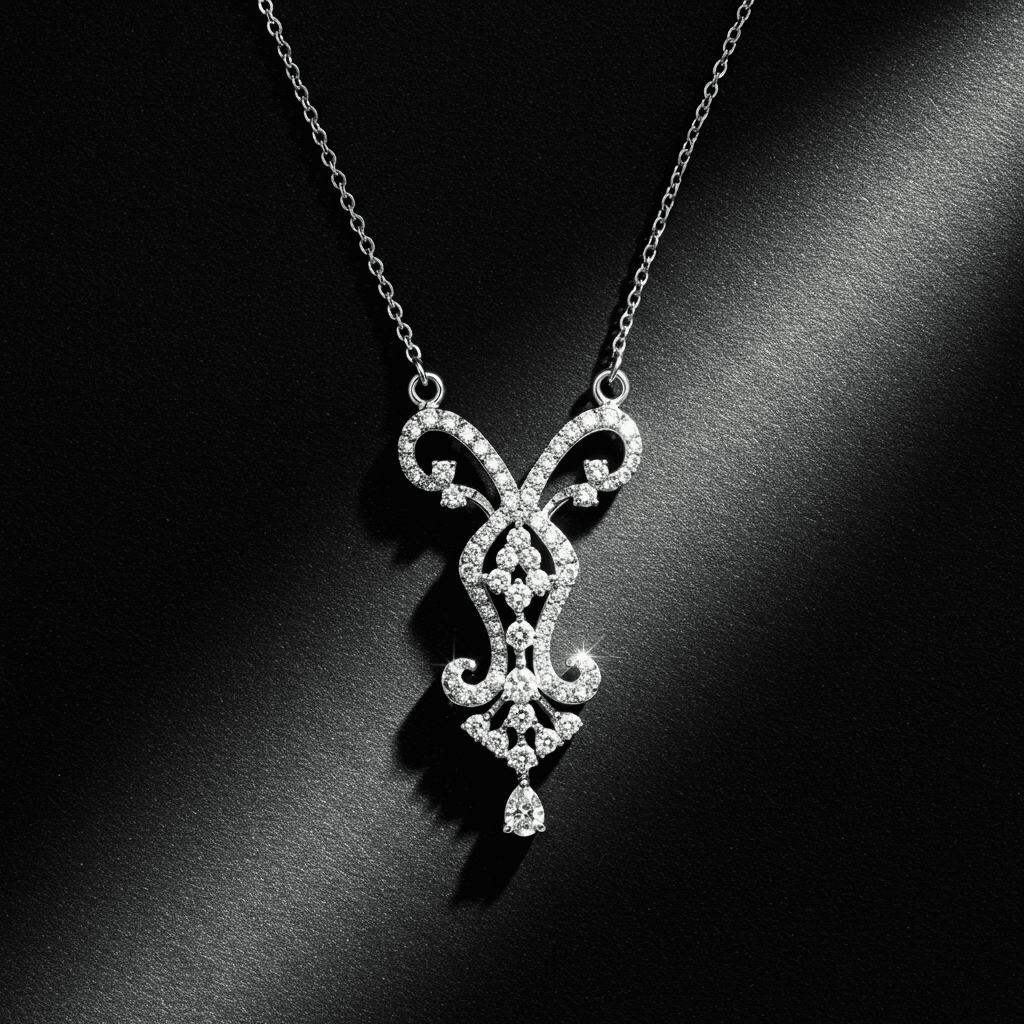
Choosing the perfect oval diamond requires understanding several key factors that aren't always obvious from a certificate. Unlike round brilliants, which receive a GIA cut grade, fancy shapes like ovals don't have standardized cut grading—making your own evaluation critical.
Step 1: Understand Length-to-Width Ratio
The length-to-width ratio determines how elongated your oval appears. This is perhaps the most important factor in choosing an oval diamond.
| Ratio | Appearance | Best For |
|---|---|---|
| 1.30 - 1.35 | Rounded, almost egg-shaped | Maximum brilliance, softer look |
| 1.35 - 1.40 | Classic oval | Balanced elegance |
| 1.40 - 1.45 | Sweet spot | Ideal balance of length and brilliance |
| 1.45 - 1.50 | Elegantly elongated | Finger-lengthening effect |
| 1.50 - 1.60 | Very elongated | Dramatic, slimming effect |
| 1.60+ | Extra elongated | Bold statement, may show more bow-tie |
Recommendation: Most experts recommend the 1.35-1.50 range as the sweet spot. Ratios of 1.40-1.45 tend to balance beauty and wearability perfectly.
Step 2: Minimize the Bow-Tie Effect
The bow-tie effect is a dark shadow that appears across the center of oval diamonds, caused by light leakage. Nearly all oval diamonds display some bow-tie, but well-cut stones minimize it significantly.
How to Avoid a Bad Bow-Tie:
- Always view the diamond - Bow-tie severity isn't noted on GIA certificates
- Check 360° videos - Online retailers like James Allen and Blue Nile offer these
- View under multiple lighting - A diamond may look perfect under jewelry store spotlights but show bow-tie in natural light
- Look for balanced proportions - Depth 58-62% and table 56-60% typically minimize bow-tie
- Prioritize symmetry - Asymmetrical ovals often have worse bow-tie
The Truth: A subtle bow-tie can actually enhance an oval's appeal by adding contrast and depth. You're looking to avoid a pronounced, distracting bow-tie that dominates the diamond's appearance.
Step 3: Ideal Proportions
While GIA doesn't grade cut quality for oval diamonds (only round brilliants), certain proportions consistently produce beautiful stones:
| Parameter | Ideal Range | Notes |
|---|---|---|
| Depth % | 58% - 62% | Too deep = smaller face-up appearance |
| Table % | 56% - 60% | Affects brilliance and fire |
| Length-to-Width | 1.35 - 1.50 | Personal preference |
| Symmetry | Excellent or Very Good | Critical for light performance |
| Polish | Excellent or Very Good | Affects surface smoothness |
Step 4: Choose Color and Clarity
Oval diamonds can show color more readily than round brilliants due to their larger surface area and the way light travels through the stone. Understanding gold types and how they interact with diamond color can help you make smarter choices.
Color Recommendations:
- Platinum/White Gold: G-H color minimum (some prefer F)
- Yellow Gold: I-J color acceptable (warmth masks lower grades)
- Rose Gold: H-I color works well
Clarity Recommendations:
- VS2 or higher for eye-clean appearance
- SI1 can work if inclusions are positioned under prongs
- Always check the inclusion plot on the GIA report
For detailed guidance on diamond grading and certifications, see our IGI vs GIA Lab Diamonds Guide.
Step 5: Consider the Setting
The setting dramatically affects how your oval diamond appears:
Prong Count Matters:
- 4 prongs: More diamond visible, slightly less secure
- 6 prongs: More secure, can slightly shorten the oval's appearance
- Claw prongs: Elegant, minimalist look
East-West vs North-South:
- North-South (traditional): Elongates the finger
- East-West (trending): Modern, unique, maximizes finger coverage width
Oval Diamond Size Guide
Carat Weight to MM Dimensions
| Carat | Length (mm) | Width (mm) | Approximate Look |
|---|---|---|---|
| 0.50ct | 6.0 | 4.0 | Delicate, subtle |
| 0.75ct | 7.0 | 5.0 | Noticeable sparkle |
| 1.00ct | 8.0 | 5.5 | Classic size |
| 1.25ct | 8.5 | 5.8 | Substantial presence |
| 1.50ct | 9.0 | 6.0 | Popular "sweet spot" |
| 2.00ct | 10.0 | 7.0 | Statement size |
| 2.50ct | 10.5 | 7.5 | Impressive |
| 3.00ct | 11.0 | 8.0 | Showstopper |
Dimensions vary based on cut proportions and ratio
Finger Coverage Guide
For a balanced look, aim for a diamond covering 40-50% of your finger width:
| Ring Size | Recommended Carat Range |
|---|---|
| 4 - 5 | 0.75ct - 1.50ct |
| 5 - 6 | 1.00ct - 2.00ct |
| 6 - 7 | 1.25ct - 2.50ct |
| 7 - 8 | 1.50ct - 3.00ct |
| 8+ | 2.00ct+ |
The 1.5-Carat Sweet Spot: A 1.5-carat oval is often called the sweet spot because it typically looks like a 2-carat round on the finger—giving you more presence and sparkle without the price jump that comes with larger sizes.
Best Settings for Oval Engagement Rings
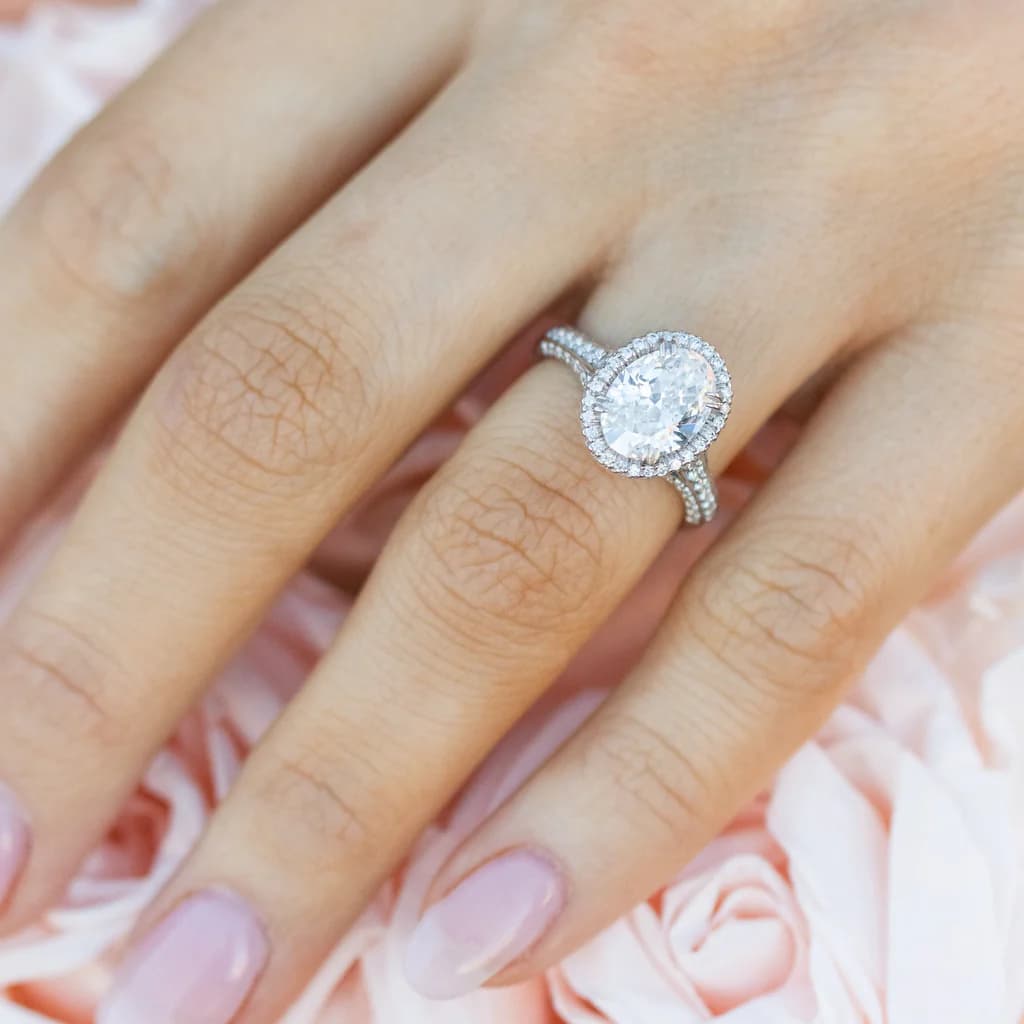
The right setting can enhance your oval diamond's beauty and protect it for a lifetime. For a comprehensive overview of all setting types, see our Visual Guide to Ring Settings and Complete Guide to Ring Settings.
Solitaire Setting
The most famous and sought-after setting, a solitaire lets your oval diamond take center stage without distraction.
Pros:
- Timeless, never goes out of style
- Maximizes focus on the center diamond
- Easy to pair with wedding bands
- Lower cost (no side stones)
Cons:
- No additional sparkle from accent stones
- Requires a high-quality center diamond
Best For: Those who appreciate minimalist elegance (like Hailey Bieber's iconic ring)
Halo Setting
A halo of smaller diamonds surrounding the center stone makes the diamond appear larger and adds substantial sparkle.
Pros:
- Makes center stone appear 0.25-0.50ct larger
- Adds significant sparkle
- Can incorporate vintage-inspired details
- Protects edges of the center diamond
Cons:
- More difficult to resize
- Requires regular cleaning between small stones
- Can look dated if trends shift
Best For: Maximum sparkle seekers and those wanting a larger appearance on a budget
Hidden Halo Setting
A modern twist that tucks accent diamonds beneath the top view. From above, you see a solitaire; from the side, you get a ring of sparkle.
Pros:
- Best of both worlds: clean top view + hidden sparkle
- Modern and unique
- More secure setting for center stone
- Beautiful in photos from different angles
Cons:
- Slightly higher cost than plain solitaire
- Less visible sparkle than traditional halo
Best For: Those who want solitaire simplicity with a secret detail
Three-Stone Setting
Features a center oval flanked by two smaller stones, representing past, present, and future.
Pros:
- Deep symbolic meaning
- Substantial finger coverage
- Versatile (match or contrast side stones)
- Classic, romantic aesthetic
Cons:
- Higher cost (three quality stones)
- Can overwhelm smaller fingers
- More complex to clean
Best For: Romantic couples who value symbolism
East-West Setting
A trending 2026 style that positions the oval horizontally across the finger rather than vertically. This modern orientation is part of the broader 2026 jewelry design trends we're seeing across the industry.
Pros:
- Unique and modern
- Maximizes finger coverage width
- Stands out from traditional designs
- Can be more comfortable (lower profile possible)
Cons:
- Less finger-elongating effect
- More unique = may not suit all tastes
- Fewer wedding band pairing options
Best For: Those seeking something different and modern
Oval Engagement Ring Price Guide (2026)
Natural Diamond Oval Rings
| Carat | Color/Clarity | Estimated Price Range |
|---|---|---|
| 0.75ct | G-H / VS2 | $2,000 - $3,500 |
| 1.00ct | G-H / VS2 | $3,500 - $6,000 |
| 1.25ct | F-G / VS1-VS2 | $5,000 - $9,000 |
| 1.50ct | F-G / VS1-VS2 | $7,000 - $13,000 |
| 2.00ct | E-G / VVS2-VS1 | $12,000 - $22,000 |
| 2.50ct | E-G / VVS2-VS1 | $18,000 - $35,000 |
| 3.00ct | D-F / VVS2-VS1 | $30,000 - $55,000 |
Lab-Grown Diamond Oval Rings
| Carat | Color/Clarity | Estimated Price Range |
|---|---|---|
| 1.00ct | G-H / VS2 | $800 - $1,500 |
| 1.50ct | F-G / VS1-VS2 | $1,200 - $2,200 |
| 2.00ct | E-G / VVS2-VS1 | $1,800 - $3,500 |
| 2.50ct | E-G / VVS2-VS1 | $2,500 - $4,500 |
| 3.00ct | D-F / VVS2 | $3,500 - $6,000 |
Key Insight: Lab-grown diamonds cost 60-80% less than natural diamonds of equivalent quality. Recent industry data shows over half of engagement rings now feature lab-grown diamonds, a trend expected to continue through 2026. For a detailed comparison, read our Lab-Grown vs Natural Diamonds Complete Guide.
Oval vs Round Pricing
Oval diamonds typically cost 10-25% less than round brilliants of equivalent specifications because:
- Higher yield from rough diamonds (less waste)
- Lower demand historically (though this is changing)
- No standardized cut grade means more price variation
Combined with their larger appearance, ovals offer exceptional value for budget-conscious buyers.
Oval vs Round: Which Should You Choose?
| Factor | Oval | Round |
|---|---|---|
| Visual Size | Appears 10-15% larger | Baseline comparison |
| Price | 10-25% less expensive | Most expensive shape |
| Brilliance | Excellent (58 facets) | Maximum (standardized cut) |
| Finger Effect | Elongates and slims | Neutral |
| Cut Grading | Not graded by GIA | GIA grades cut quality |
| Bow-Tie | Present (varies) | None |
| Popularity | #1 (trending) | #2 (classic) |
| Resale | Strong and growing | Historically strongest |
Choose Oval If:
- You want maximum visual size per carat
- You prefer an elongated, finger-flattering shape
- You're inspired by celebrity styles
- Budget matters but you want impressive presence
Choose Round If:
- You want guaranteed cut quality (GIA graded)
- You prefer classic, traditional aesthetics
- Maximum brilliance is your top priority
- You don't want to evaluate bow-tie effect
Design Your Own Oval Engagement Ring with Tashvi AI
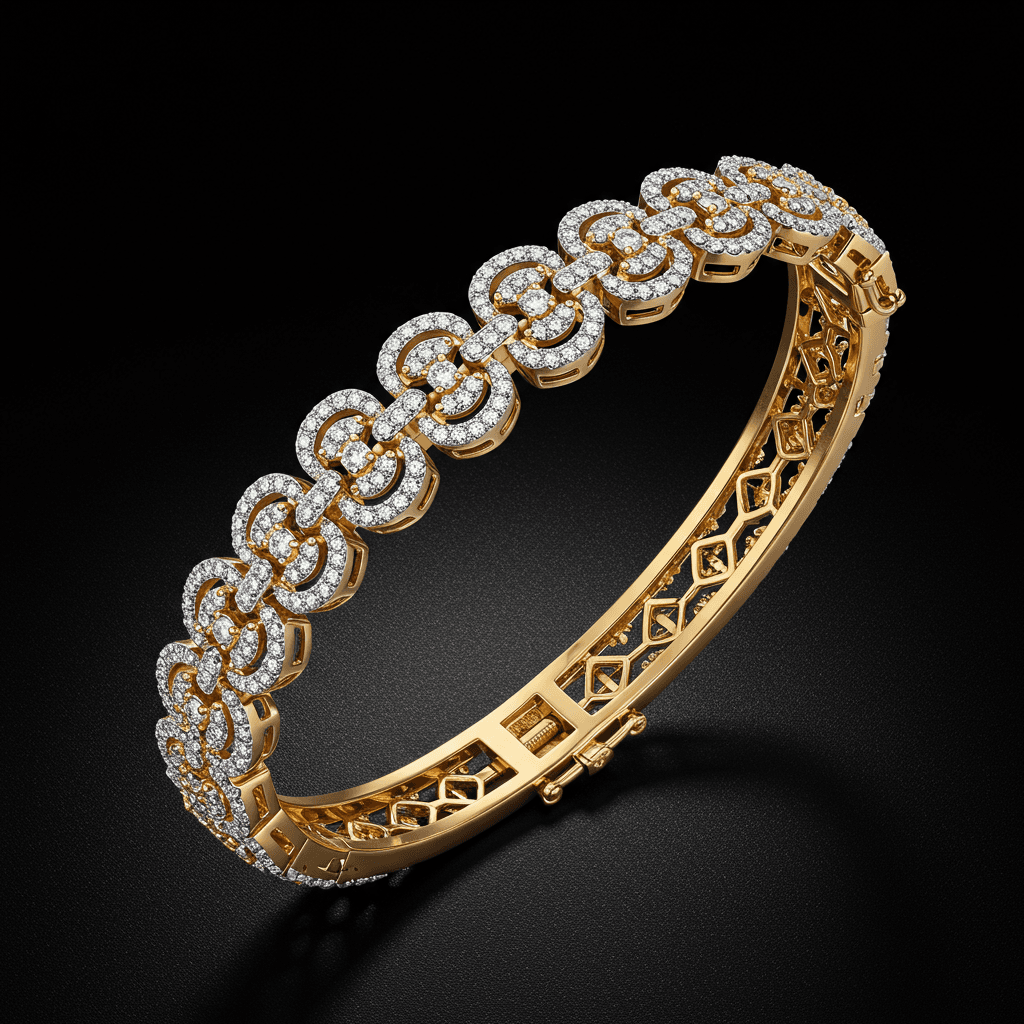
Not sure which setting, metal, or ratio best suits your vision? Tashvi AI lets you visualize custom oval engagement ring designs before making any purchase decisions—no jewelry expertise required.
Why Visualize Before Buying
Deciding between a solitaire and a halo, or choosing between an elongated 1.50 ratio versus a rounder 1.35 ratio, can feel overwhelming. Tashvi AI generates photorealistic jewelry designs based on your preferences, allowing you to experiment freely:
- Compare ratios to see how 1.35 looks vs 1.50 before you buy
- Test different settings from solitaire to halo to hidden halo
- Experiment with metals against your skin tone (yellow gold, white gold, rose gold, platinum)
- Create reference images to share with jewelers for accurate quotes
- Explore east-west orientations to see if horizontal settings suit your style
How It Works
- Describe your vision - Tell the AI what you want in natural language
- Generate designs - See photorealistic renderings instantly
- Refine and iterate - Adjust size, setting, metal until perfect
- Take to your jeweler - Use your designs for custom quotes
Example Prompts to Try
Oval solitaire engagement ring with 2 carat elongated oval diamond, simple yellow gold band, classic four-prong setting, modern minimalist style like Hailey Bieber
Oval halo engagement ring with 1.5 carat oval center diamond surrounded by round brilliant halo, platinum pavé band, vintage-inspired elegance
Oval engagement ring with hidden halo underneath, 2 carat oval diamond, thin rose gold band, modern romantic design with secret sparkle detail
Oval three-stone engagement ring with center oval diamond flanked by two pear-shaped side stones, white gold setting, past present future symbolism
East-west oval engagement ring with horizontally set oval diamond, bezel setting, yellow gold band, modern unique horizontal orientation
Vintage-inspired oval engagement ring with milgrain details, art deco geometric band pattern, oval diamond in platinum setting with side baguettes
Why Use AI for Oval Ring Design?
Visualize ratios - See how a 1.35 ratio looks vs 1.50 before you buy
Experiment with settings - Try solitaire, halo, and three-stone on the same oval shape
Test metals - Compare yellow gold, white gold, rose gold, and platinum instantly
Save money - Come to your jeweler with a clear vision instead of paying for multiple custom renders
Get inspired - Browse our best AI jewelry design tools comparison to see how Tashvi AI compares
Start designing your oval engagement ring free →
Generate 10+ concepts in under a minute and shortlist your favorites to show your jeweler.
Common Mistakes to Avoid
1. Ignoring the Bow-Tie Effect
The Mistake: Buying an oval diamond based solely on the certificate without seeing it.
The Fix: Always view 360° video or see the diamond in person. A severe bow-tie can ruin an otherwise beautiful stone.
2. Choosing the Wrong Ratio
The Mistake: Assuming all ovals look the same.
The Fix: Compare different ratios (1.35 vs 1.45 vs 1.55) to find what flatters your finger and matches your style.
3. Overpaying for Color
The Mistake: Buying D-E color when setting in yellow gold.
The Fix: For yellow gold settings, I-J color often looks identical and costs significantly less.
4. Ignoring the Setting
The Mistake: Focusing only on the diamond without considering how the setting affects appearance.
The Fix: A well-designed setting can make a 1.5ct oval look as impressive as a 2ct in a basic mounting.
5. Not Considering East-West
The Mistake: Assuming ovals must be set vertically.
The Fix: East-west settings are trending and offer a unique, modern look that maximizes finger coverage differently.
Caring for Your Oval Engagement Ring
Daily Care
- Remove when applying lotions, cleaning, or exercising
- The curved ends of ovals can occasionally catch on fabric—be mindful
- Store separately from other jewelry to prevent scratching
Cleaning
- Clean weekly with mild soap, warm water, and soft brush
- Pay attention to the underside where dirt accumulates
- Professional cleaning every 6-12 months
Maintenance
- Check prongs every 6 months—prongs at the ends secure the diamond
- The ends are slightly more vulnerable to wear than the sides
- Consider a bezel or half-bezel setting if you're hard on jewelry
Frequently Asked Questions
How do I know if an oval diamond has a bad bow-tie?
The only way to assess bow-tie severity is through visual inspection—it's not noted on GIA certificates. Request 360° video from online retailers or view in person. A slight bow-tie is normal and can add depth; avoid ovals where the bow-tie dominates the stone's appearance.
What's the most popular oval engagement ring style in 2026?
The yellow gold solitaire (Hailey Bieber style) remains the most popular, followed by hidden halo designs and east-west settings. Classic pavé bands and three-stone settings are also strong choices.
Can I make my oval diamond look bigger?
Yes! Choose a halo setting (adds 0.25-0.50ct apparent size), select a higher ratio (more elongated = more coverage), opt for a thin band (makes diamond appear larger by contrast), and ensure excellent cut proportions for maximum light performance.
Are oval diamonds good for everyday wear?
Yes, ovals are durable for daily wear. However, the curved ends are slightly more vulnerable to wear than round diamonds. Protective settings like bezel or half-bezel can shield these areas. With normal care, oval diamonds last a lifetime.
The Bottom Line
Oval engagement rings have earned their position as one of the most sought-after diamond shapes through a perfect combination of beauty, value, and celebrity influence. Their ability to appear larger than equivalent round diamonds while flattering every finger shape makes them an exceptional choice for 2026 brides.
Whether you're drawn to Hailey Bieber's minimalist yellow gold solitaire, Blake Lively's rare pink diamond, or your own unique vision, an oval diamond offers versatility that works with virtually any setting and style.
Key Takeaways:
- Ideal ratio: 1.35-1.50 (1.40-1.45 sweet spot)
- Always check for bow-tie effect visually
- Ovals appear 10-15% larger than rounds
- Cost 10-25% less than equivalent round diamonds
- The 1.5-carat size offers exceptional value
Ready to design your perfect oval engagement ring? Try Tashvi AI free to visualize your ideal ring, then take your design to a trusted jeweler.
Sources: GIA Oval Cut Diamond Guide, Brilliant Earth, The Knot, With Clarity, Lumera Diamonds, Ken & Dana Design
Frequently Asked Questions
Quick answers to the questions readers ask most about this guide.
Why are oval engagement rings so popular?
Oval diamonds have become one of the most sought-after engagement ring shapes in recent years. Their elongated silhouette makes fingers appear longer and slimmer, they can appear 10-15% larger than round diamonds of the same carat weight, and celebrity influence (Hailey Bieber, Blake Lively) has driven significant demand since 2018.
What is the ideal ratio for an oval diamond?
The ideal length-to-width ratio for oval diamonds is between 1.35:1 and 1.50:1. Ratios of 1.40-1.45 are considered the 'sweet spot' balancing elegance and brilliance. More elongated ovals (1.50+) make fingers appear longer but may show more bow-tie effect. Rounder ovals (1.30-1.35) maximize brilliance.
What is the bow-tie effect in oval diamonds?
The bow-tie effect is a dark shadow that appears across the center of oval diamonds, resembling a bow tie. It's caused by light leakage when you look at the diamond. Nearly all oval diamonds have some bow-tie, but well-cut stones minimize it. Since bow-tie severity isn't on certificates, always view the diamond in person or via 360° video before buying.
How much does an oval engagement ring cost?
Oval engagement rings range from $1,500 to $50,000+ depending on the diamond. A 1-carat natural oval diamond costs $3,500-$6,000, while lab-grown versions cost $800-$1,500. A 2-carat natural oval costs $12,000-$20,000 vs $1,800-$3,000 for lab-grown. Ovals typically cost 10-25% less than equivalent round diamonds.
Do oval diamonds look bigger than round diamonds?
Yes, oval diamonds appear 10-15% larger than round diamonds of the same carat weight due to their elongated shape and larger surface area. A 1.5-carat oval often looks similar to a 2-carat round on the finger, making ovals an excellent choice for maximizing visual impact per dollar spent.
What settings work best for oval engagement rings?
The most popular settings for oval diamonds are: solitaire (timeless, emphasizes the stone), halo (adds sparkle and makes the diamond appear larger), three-stone (symbolic past-present-future meaning), and hidden halo (modern twist with subtle sparkle underneath). East-west settings with horizontal ovals are trending in 2026.
Which celebrities have oval engagement rings?
Famous oval engagement rings include Hailey Bieber (8-10ct oval on yellow gold, credited with starting the modern oval trend), Blake Lively ($2M pink oval diamond from Ryan Reynolds), Kourtney Kardashian, Jasmine Tookes, and Georgina Rodriguez (25-30ct oval from Cristiano Ronaldo). These celebrity rings drove oval popularity from 2% in 2015 to over 25% today.
Are oval diamonds more affordable than round diamonds?
Yes, oval diamonds typically cost 10-25% less than round brilliant diamonds of equivalent quality. This is because round cuts are most popular and command premium pricing, while ovals have better yield from rough diamonds. Combined with their larger appearance, ovals offer exceptional value.
What carat size oval diamond should I get?
For balanced finger coverage, aim for a diamond covering 40-50% of your finger width. For ring sizes 4-5.5, 1.2-1.8ct ovals work well. The 1.5-carat oval is considered a 'sweet spot' - it looks like a 2-carat round on the finger without the price jump. For ring sizes 6-8, consider 1.5-2.5ct for proportional coverage.
Should I get a lab-grown or natural oval diamond?
Lab-grown oval diamonds cost 60-80% less than natural diamonds with identical appearance. A 2-carat lab-grown oval costs $1,800-$3,000 vs $12,000-$20,000 for natural. Recent data shows over half of engagement rings now feature lab-grown diamonds. Choose natural for tradition/resale value, lab-grown for budget/size.