AI Material Estimation: How to Get Accurate Gold Weight From a 2D Image
Learn how AI material estimation technology analyzes 2D jewelry images to predict gold weight, stone sizes, and production costs. A technical guide for jewelers seeking faster quoting and smarter material planning.
AI material estimation analyzes a 2D jewelry image to predict gold weight, stone carat sizes, and approximate production costs without requiring a 3D CAD model. This technology gives jewelers the ability to generate rough quotes in seconds rather than hours, transforming the speed and efficiency of the custom jewelry business from initial inquiry to client commitment.
Why Material Estimation Matters
In the custom jewelry business, one of the most time-consuming steps is quoting. A client sends a reference image or describes what they want, and the jeweler must estimate how much gold, platinum, or silver the piece will require, what size stones are needed, and what the total production cost will be.
Traditionally, this process requires either extensive experience (an expert goldsmith who can eyeball a design and estimate weight) or preliminary CAD work (building a rough 3D model to calculate volume and weight). Both approaches are slow and expensive. Expert estimation depends on a single person's availability and judgment. Preliminary CAD work ties up skilled resources before a client has even committed to the project.
AI material estimation offers a third option. Upload a 2D image, and receive an approximate material breakdown in seconds. This is not a replacement for detailed CAD-based calculations, but it provides a reliable starting point that dramatically accelerates the quoting process.
How the Technology Works
Visual Feature Extraction
The AI model begins by identifying key structural elements in the jewelry image. For a ring, it detects the band width, apparent thickness, setting type, head construction, and any decorative elements like pavé stones or milgrain borders.
These visual features are measured in relative terms. Even without knowing the exact ring size, the AI can determine proportional relationships. A band that appears to be roughly one-third the width of the center stone gives the model useful dimensional data.
Proportional Analysis
Once features are extracted, the AI applies proportional analysis using known reference points. For rings, common reference points include standard finger widths and popular center stone dimensions. For pendants, the bail size and chain attachment point provide scale cues.
The model compares these proportions against a training dataset of thousands of jewelry pieces with known weights and dimensions. This comparison allows it to infer absolute measurements from relative visual data.
Volume and Weight Calculation
With estimated dimensions in hand, the AI constructs an approximate 3D volume model of the piece. This model does not need to be perfectly detailed. It needs to capture the major mass contributors, specifically the band cross-section, the setting head, and any significant decorative elements.
Metal weight is calculated using the estimated volume multiplied by the density of the specified metal.
| Metal | Density (g/cm3) | Relative Weight |
|---|---|---|
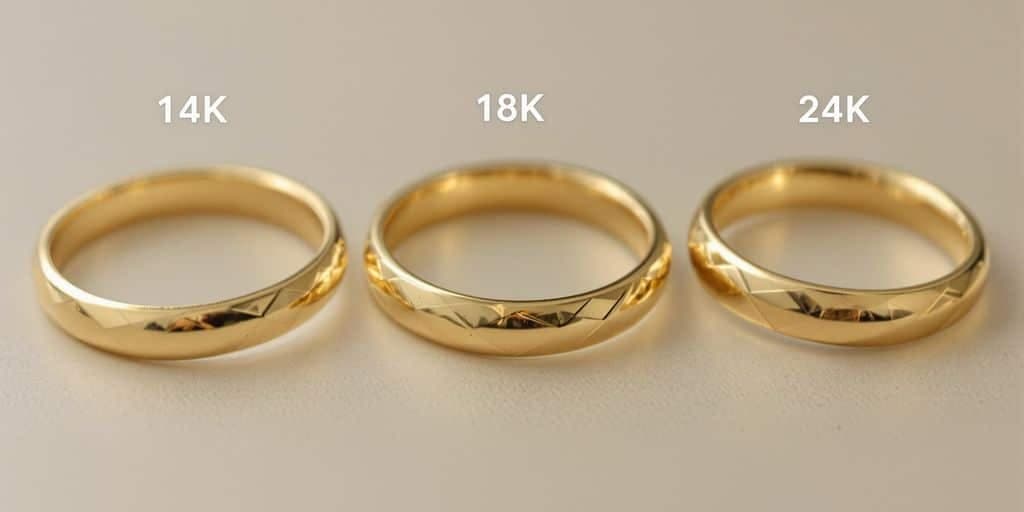
| 24K Yellow Gold | 19.3 | Heaviest |
| 18K Yellow Gold | 15.6 | Heavy |
| 14K Yellow Gold | 13.1 | Moderate |
| Platinum (950) | 20.1 | Heaviest common |
| Sterling Silver | 10.4 | Light |
| Palladium | 12.0 | Moderate |
The density difference between metals means that the same design weighs significantly more in platinum than in 14K gold. AI models account for this automatically when you specify the target metal.
Stone Size Estimation
Gemstone estimation follows a similar proportional approach. The AI identifies the apparent stone shape (round, oval, cushion, emerald-cut, pear, marquise) and estimates dimensions based on its proportion relative to the metal setting.
Standard stone dimension-to-carat-weight conversion tables are then applied. A round brilliant diamond measuring approximately 6.5mm across is roughly 1 carat. An oval stone at 8mm by 6mm is roughly 1.2 to 1.5 carats depending on depth.
Accuracy and Limitations
What AI Gets Right
AI material estimation performs best with standard jewelry designs where proportional relationships follow established conventions. A classic solitaire engagement ring, a traditional halo pendant, or a straightforward tennis bracelet all have well-understood geometries that the AI model has seen thousands of times.
For these standard designs, accuracy is impressive. Testing across common ring styles shows estimates within 10 to 20 percent of actual production weights.
| Design Type | Weight Accuracy | Stone Size Accuracy | Confidence Level |
|---|---|---|---|
| Solitaire engagement ring | Plus or minus 12% | Plus or minus 15% | High |
| Halo setting ring | Plus or minus 15% | Plus or minus 18% | High |
| Simple band (no stones) | Plus or minus 8% | N/A | Very high |
| Pavé eternity band | Plus or minus 18% | Plus or minus 20% | Moderate |
| Complex multi-stone design | Plus or minus 25% | Plus or minus 25% | Lower |
Where AI Struggles
Accuracy decreases with unusual or highly complex designs. Avant-garde pieces with unconventional geometries, hollow construction, or hidden internal structures present challenges because the AI cannot see what is inside the piece.
Image quality also matters. A crisp, well-lit photograph from a standard angle produces better estimates than a blurry, angled, or poorly lit image. Lifestyle photographs with hands, fabrics, and backgrounds introduce additional complexity.
Certain construction techniques are invisible in 2D images. A ring that appears solid might actually be hollow inside, and a seemingly thin band might have hidden reinforcement. These internal details affect weight significantly but cannot be detected from a surface image alone.
Practical Applications
Instant Custom Order Quoting
The most immediate application is faster quoting. When a client emails a reference image asking "how much would something like this cost," AI material estimation provides a rough answer in seconds. This rapid response can mean the difference between winning and losing the order in a competitive market.
The estimate does not need to be perfect for this purpose. A range (for example, "approximately $1,800 to $2,400 in 18K gold") gives the client enough information to decide whether to proceed. The detailed cost calculation happens during CAD development after the client commits.
Budget-Aligned Design
Designers can use material estimation to ensure concepts stay within budget from the start. Rather than designing a beautiful piece and then discovering it requires $3,000 in gold for a client with a $2,000 budget, AI-assisted design tools can flag cost issues during the concept phase.
Inventory and Purchasing Planning
For businesses producing collections, AI material estimation helps forecast material needs before committing to production. Estimate the gold requirements for an entire 20-piece collection from concept renders, and plan your metal purchases accordingly.
Insurance and Appraisal Support
While not a replacement for professional appraisal, AI material estimation can provide supplementary data points for insurance purposes. Clients can get a preliminary understanding of their piece's material value from a photograph.
How to Get the Best Estimates
Provide Clean, Well-Lit Images
Use product-style photography with neutral backgrounds. Ensure the piece fills most of the frame and is sharply focused. Avoid lifestyle shots, hand-worn images, or photos with complex backgrounds when seeking accurate material estimates.
Include Reference Scale
When possible, include a known reference object for scale. A standard coin, a ruler, or even specifying the ring size provides the AI with an absolute measurement anchor that dramatically improves accuracy.
Specify the Metal
Always indicate the target metal type and karat. The density difference between 14K and 18K gold means the same volume of metal has a 19 percent weight difference. Specifying platinum versus gold changes the weight calculation by more than 50 percent.
Describe Hidden Details
If you know the design is hollow, has a comfort-fit band, or uses any other construction technique that is not visible in the image, provide that information as context. The more the AI knows about what it cannot see, the more accurate its estimate becomes.
How Tashvi AI Handles Material Estimation
Tashvi AI integrates material estimation directly into the design workflow. Every design generated on the platform comes with an approximate material breakdown, including estimated metal weight, stone sizes, and a rough production cost range. This integration means you never have to leave the design environment to understand the financial implications of your creative choices.
The platform is purpose-built for jewelry, meaning its estimation models are trained exclusively on real jewelry data, not general objects. This specialization delivers more accurate predictions than general-purpose AI tools could achieve. For jewelers handling high volumes of custom inquiries, this feature alone can save hours per week in quoting time while ensuring clients receive fast, informed responses to their custom design requests.
Try designing on Tashvi AI free
The Future of Material Estimation
As AI models improve and training datasets grow, we can expect material estimation accuracy to approach the precision of CAD-based calculations. Integration with 3D reconstruction technology will eventually allow AI to infer hidden structures and internal geometries, closing the gap between what a 2D image shows and what a 3D object contains.
For now, AI material estimation is a powerful tool for speed and efficiency. It does not replace expert judgment or detailed engineering, but it accelerates the early stages of the custom jewelry workflow where speed matters most.
Frequently Asked Questions
Quick answers to the questions readers ask most about this guide.
How does AI estimate gold weight from a 2D image?
AI models analyze visual cues in a 2D jewelry image including band width, thickness proportions, setting mass, and overall dimensions. By comparing these features against trained datasets of real jewelry with known weights, the AI predicts approximate gold weight with increasing accuracy.
How accurate is AI material estimation for jewelry?
Current AI material estimation tools achieve accuracy within 10 to 20 percent of actual production weights for standard jewelry designs. Accuracy improves with jewelry-specific AI models and when additional context like ring size or chain length is provided alongside the image.
Can AI estimate stone carat weight from an image?
Yes. AI models can approximate stone sizes based on visual proportions relative to the metal setting. For common shapes like round, oval, and cushion, estimates are typically within 15 percent of actual carat weight when the image provides clear proportional references.
What types of jewelry can AI estimate materials for?
AI material estimation works best for rings, pendants, and earrings where proportional relationships are visible. Necklaces and bracelets require additional information like length. The technology handles standard designs most accurately, while highly unusual or avant-garde pieces may yield less precise estimates.
How does material estimation help jewelry businesses?
Material estimation enables instant rough quoting for custom orders, reducing the time from client inquiry to price estimate from hours to seconds. It also helps with inventory planning, material purchasing, and ensuring designs stay within budget parameters before expensive CAD work begins.