The Science Behind AI Understanding of Prong vs Bezel Settings
Learn how AI jewelry design tools distinguish between prong and bezel settings, understanding the structural, optical, and aesthetic differences that affect design generation and manufacturing recommendations.
AI jewelry design tools differentiate between prong and bezel settings by learning the structural mechanics, optical properties, and aesthetic characteristics of each approach, enabling accurate generation of designs where the setting type fundamentally affects how light interacts with the stone, how the piece wears, and how the overall design presents itself.
Why Setting Type Matters for AI
The choice between prong and bezel setting is not merely aesthetic. It determines how much light reaches the stone, how securely the stone is held, how vulnerable the stone is to damage, and how the overall ring profile appears. For AI to generate accurate and production-viable designs, it must understand these relationships deeply.
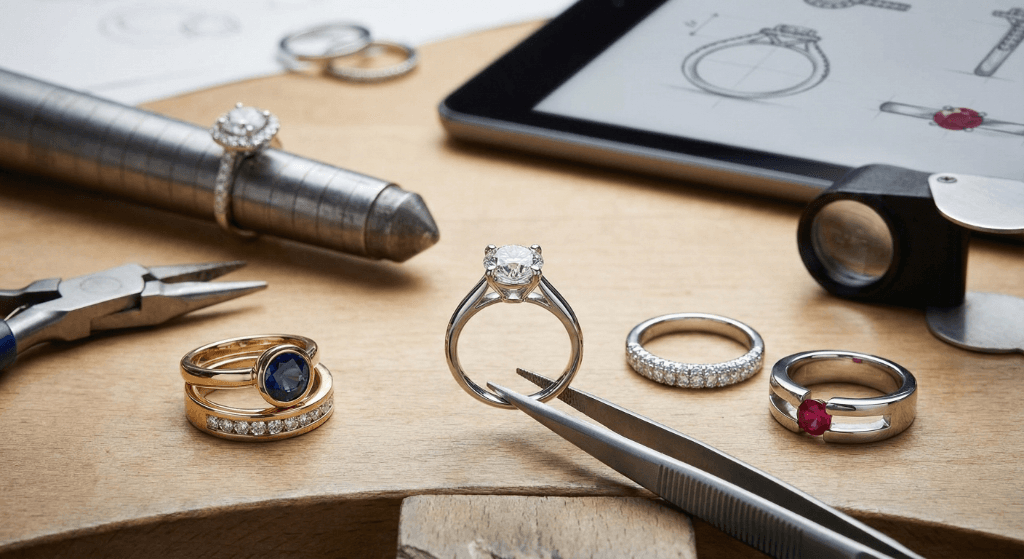
When a designer specifies a bezel-set sapphire ring, the AI must generate a continuous metal rim at the correct height relative to the stone's crown, with proportions that allow adequate light entry while providing full protection. A prong-set version of the same ring requires entirely different geometry, with individual metal posts positioned to secure the stone while maximizing the open area through which light enters and exits.
How AI Learns Setting Characteristics
Visual Pattern Recognition
AI models trained on thousands of jewelry photographs learn to identify setting types from visual cues. Prong settings display characteristic metal projections that create negative space between the stone and the mounting. Bezel settings show continuous metal borders that frame the stone completely.
This visual learning extends to subtypes within each category. The AI distinguishes four-prong from six-prong settings, full bezels from half bezels, and various other setting configurations by learning the visual signatures of each.
Structural Understanding
Beyond visual recognition, jewelry-specific AI incorporates structural knowledge about how settings function.
| Setting Property | Prong | Bezel |
|---|---|---|
| Stone visibility | Maximum (exposed) | Partially obscured by metal rim |
| Light entry | Top and sides | Top only |
| Stone protection | Moderate | High |
| Suitable stone hardness | Mohs 7+ (diamond, sapphire) | Any hardness |
| Profile height | Higher (elevated stone) | Lower (flush appearance) |
| Metal usage | Less | More |
| Ease of cleaning | Easier | Harder (debris under rim) |
This structural understanding ensures that AI-generated designs create appropriate geometry. Prongs are thick enough to hold the specified stone securely. Bezel walls are tall enough to seat the stone properly without covering too much of the crown.
Optical Property Modeling
Different settings affect how light interacts with gemstones, and AI models these effects in their rendered output.
Prong settings allow light to enter the stone from the sides as well as the top, maximizing brilliance and fire in faceted gemstones. AI renders prong-set diamonds with more visible fire patterns because the physical light paths are less restricted.
Bezel settings limit lateral light entry, producing a different brilliance pattern. AI renders bezel-set stones with slightly reduced fire but with the characteristic "framed" appearance that many designers and clients prefer for its clean, modern aesthetic.
Practical Implications for Designers
Stone-Appropriate Recommendations
When designers use AI tools, the system can flag inappropriate setting-stone combinations. A prong-set opal (Mohs 5.5 to 6.5) risks damage during daily wear. The AI might suggest a protective bezel setting for softer stones while recommending prong settings for harder gemstones where maximum light exposure enhances appearance.
Lifestyle Considerations
AI systems that understand setting properties can generate appropriate designs based on lifestyle context. Active individuals benefit from the lower profile and greater stone protection of bezel settings. Those prioritizing maximum sparkle in lower-risk wear environments may prefer prong settings.
Design Variation Generation
Understanding setting differences enables AI to generate meaningful variations. Starting from a client's preference for a round diamond engagement ring, the AI generates prong-set, bezel-set, and hybrid versions, each with proportions and aesthetics appropriate to the setting type. This gives clients an informed comparison rather than arbitrary options.
How Tashvi AI Handles Settings
Tashvi AI's training on jewelry-specific data means it generates technically accurate settings without requiring designers to specify structural details. Mention a "bezel-set oval sapphire" and the platform generates a design with appropriate bezel proportions for the stone shape, correct wall height, and realistic light behavior.
The platform's understanding of setting types and their properties ensures that generated concepts are not just visually appealing but structurally sound and production-viable.
Try designing on Tashvi AI free
The Advantage of Specialized AI
The difference between general AI tools and jewelry-specific platforms becomes particularly apparent in setting accuracy. General tools may generate beautiful images where settings defy physics or contain structural impossibilities. Specialized tools like Tashvi AI generate settings that a jeweler can actually manufacture, bridging the gap between concept visualization and production reality.
Frequently Asked Questions
Quick answers to the questions readers ask most about this guide.
How does AI distinguish between prong and bezel settings?
AI models trained on thousands of jewelry images learn the visual and structural characteristics of each setting type. Prong settings show distinct metal projections holding the stone, while bezel settings display continuous metal borders. The AI recognizes these patterns and generates appropriate geometry.
Which setting does AI render more accurately?
Both settings render well with specialized AI tools. Bezel settings are slightly easier for AI because they involve simpler geometry. Prong settings with specific counts and configurations require more precise generation but specialized jewelry AI handles both accurately.
Can AI recommend the best setting for a specific stone?
Advanced jewelry AI considers stone shape, size, hardness, and intended use when suggesting settings. Softer stones benefit from the protection of bezel settings, while harder stones can safely use prong settings that maximize light exposure.
Does AI understand the structural requirements of different settings?
Jewelry-specific AI incorporates structural knowledge about setting requirements. It generates prongs of appropriate thickness for the stone weight, bezel walls at heights suitable for the stone profile, and gallery designs that support proper stone seating.
How does setting choice affect AI-generated ring designs?
The setting type fundamentally changes the overall ring aesthetic in AI generations. Prong settings create an elevated, light-filled appearance while bezel settings produce a sleeker, more protected look. AI tools generate appropriately different proportions for each.