AI Material Estimation: Converting Pixels to Grams of Gold
AI material estimation technology converts 2D jewelry design images into accurate weight predictions for gold, silver, and platinum. Learn how machine learning models analyze visual designs to estimate metal usage, gemstone requirements, and production costs before any CAD modeling begins.
AI material estimation converts 2D jewelry design images into approximate gold, silver, or platinum weight predictions using machine learning models trained on thousands of designs and their production data. This technology enables jewelers to generate preliminary cost quotes within minutes of seeing a design concept, eliminating the traditional wait for detailed CAD modeling before discussing pricing with clients.
One of the most common frustrations in custom jewelry sales is the gap between a client's design vision and the price conversation. A customer falls in love with a concept but has to wait days or weeks for a CAD model to be built before the jeweler can provide an accurate material cost estimate. By that time, enthusiasm may have waned, or the client may have moved to a competitor. AI material estimation technology bridges this gap by providing informed cost approximations at the earliest stages of the design process.
The Science Behind Pixel-to-Gram Conversion
Converting a 2D image of a jewelry design into a material weight estimate is a complex inference problem. The AI must deduce three-dimensional volume from two-dimensional visual information, accounting for hidden surfaces, internal structures, and construction methods that are not visible in the image.
How the Models Learn
AI material estimation models are trained on paired datasets consisting of jewelry images and their corresponding production specifications, including actual measured weights after casting. By analyzing thousands of these pairs, the model learns to associate visual features with physical properties.
For a ring, the model learns that band width, band thickness, setting height, and prong structure all correlate with specific weight ranges. It recognizes that a cathedral setting adds more metal than a low-profile basket setting. It understands that a halo of pave diamonds implies a certain weight of surrounding metalwork. Each visual cue contributes to a cumulative weight estimate.
The Role of Design Feature Recognition
The AI does not simply estimate weight from the overall size of the image. It identifies specific design features and estimates their individual contributions to total weight.
| Design Feature | Visual Cue | Weight Contribution Factor |
|---|---|---|
| Band Width | Proportion relative to finger | Primary contributor (40 to 60% of ring weight) |
| Band Profile | Cross-section shape inference | Thickness variation significant |
| Setting Structure | Prong count, basket depth, halo presence | 15 to 30% of ring weight |
| Decorative Elements | Milgrain, engraving, filigree | 5 to 15% addition |
| Shank Style | Split, tapered, straight | Affects total metal volume |
Accounting for Construction Methods
An experienced jeweler knows that the same design can be constructed in different ways, each resulting in different material usage. A hollow-construction bangle weighs dramatically less than a solid one, even though they look identical from the outside. AI models learn these construction norms from training data, inferring the most likely construction method for each design type.
For designs where the construction method is ambiguous, sophisticated AI systems can provide weight ranges, for example estimating a bangle at 15 to 22 grams for solid construction or 8 to 12 grams for hollow construction. This range gives the jeweler flexibility in pricing discussions.
From Estimated Volume to Material Cost
Once the AI estimates the three-dimensional volume of metal in a design, converting to cost requires several additional calculations.
Metal Density Conversion
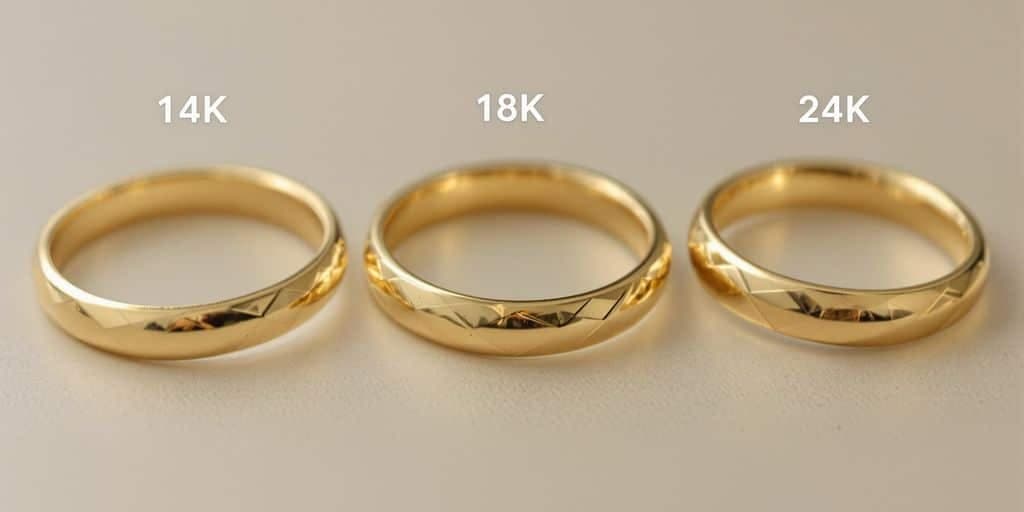
Different metals and alloys have very different densities. The same design produced in platinum will weigh nearly twice as much as the same design in 14K yellow gold. AI systems must apply the correct density factor based on the specified metal type.
| Metal | Density (g/cm3) | Relative Weight (vs 14K Gold) |
|---|---|---|
| 24K Yellow Gold | 19.3 | 1.40 |
| 18K Yellow Gold | 15.5 | 1.12 |
| 14K Yellow Gold | 13.8 | 1.00 (baseline) |
| 10K Yellow Gold | 11.6 | 0.84 |
| Platinum (950) | 20.1 | 1.46 |
| Sterling Silver | 10.4 | 0.75 |
| Palladium (950) | 12.0 | 0.87 |
Understanding these differences between gold karats is essential for accurate cost estimation and helps clients make informed decisions about metal selection.
Casting Yield Factor
Not all metal in the casting process ends up in the finished piece. Sprues, buttons, and casting defects result in metal loss. AI material estimation systems incorporate a casting yield factor, typically 85 to 95 percent efficiency, to calculate the total raw material needed. The specific yield depends on the design complexity and the manufacturer's casting process.
Spot Price Integration
The most useful AI estimation systems connect to real-time precious metal market data. Gold, platinum, and silver prices fluctuate daily, and a weight estimate is only useful if it translates to a current dollar value. By multiplying estimated weight by the current spot price (plus the typical retail markup), the system generates a material cost that reflects today's market conditions.
Practical Applications in Jewelry Business
Instant Client Quotation
The most immediate business value of AI material estimation is enabling preliminary price quotes during initial client consultations. When a customer shows a designer an inspiration image and asks "How much would something like this cost in 18K rose gold?", the designer can provide an informed estimate within minutes rather than deferring to "I will get back to you after we model it."
This responsiveness improves conversion rates because it keeps the client engaged during the peak of their interest. For jewelers working to launch or grow their business, instant quoting capability is a competitive advantage.
Design Budget Alignment
AI material estimation helps designers align creative ambitions with client budgets early in the process. If a client's budget suggests a maximum of 6 grams of 18K gold, the designer can immediately assess whether a particular design concept is feasible within that constraint or needs to be simplified. This prevents the disappointment of falling in love with a design only to discover it costs twice the budget.
Collection Cost Planning
For brand owners planning new collections, AI material estimation across an entire line of designs provides rapid cost projections that inform pricing strategy. By estimating the material cost of each piece in a collection, brands can calculate required retail prices, assess margin potential, and make data-driven decisions about which designs to produce. The connection between material optimization and lightweight gold design principles becomes particularly relevant for cost-conscious collections.
Limitations and Realistic Expectations
AI material estimation is a powerful tool, but it is important to understand its boundaries and use it appropriately.
Accuracy Limitations
Current systems achieve approximately 10 to 15 percent accuracy for standard jewelry forms. Complex, unusual, or highly detailed designs may fall outside this range. AI estimates should always be presented to clients as preliminary approximations, with the understanding that final pricing will be based on the completed CAD model.
Hidden Complexity
Some design features that significantly affect weight are difficult to assess from 2D images. Internal channel structures, hidden reinforcement elements, and complex inner gallery designs may not be visible in a concept image. Experienced jewelers can supplement AI estimates with their knowledge of typical construction requirements for specific design types.
Material Specification Assumptions
AI estimates require assumptions about the specific alloy composition, construction method, and finishing treatment. A design specified as "gold" could be anything from 10K to 24K, with weight differences of up to 40 percent. Clear communication between the AI system and the user about these assumptions is essential for reliable estimates.
How Tashvi AI Approaches Material Estimation
Tashvi AI incorporates material awareness into its design visualization process, helping jewelers and clients develop realistic expectations about the physical properties of generated designs. When designers use Tashvi AI to generate concept images, the platform's understanding of jewelry construction helps produce designs that are visually informed by real-world manufacturing constraints.
The platform's value in the estimation workflow is particularly strong during the concept phase. By generating photorealistic images that visually represent accurate proportions and construction methods, Tashvi AI gives experienced jewelers the visual information they need to make informed manual estimates. For jewelers comparing different approaches to metal selection and cost planning, Tashvi AI's visualizations serve as the visual starting point for detailed cost analysis. Try designing on Tashvi AI free to generate concept images that support your material estimation process.
The Future of AI-Driven Material Estimation
The accuracy and capabilities of AI material estimation will continue to improve as training datasets grow and models become more sophisticated. Near-term developments include integration with live metal market APIs for real-time cost updates, multi-view estimation that uses multiple images of the same design for better accuracy, and direct connection to CAD software for seamless transition from estimate to detailed model.
Longer term, we may see AI systems that not only estimate material requirements but actively suggest design modifications to optimize material usage without compromising aesthetics. A system that can say "reducing the band width by 0.3mm would save 1.2 grams of gold with minimal visual impact" would be an invaluable tool for jewelers balancing beauty, durability, and cost.
The pixel-to-gram pipeline represents one of the most practically valuable applications of AI in the jewelry industry. By collapsing the time between creative vision and commercial reality, it keeps clients engaged, helps designers work within constraints, and enables jewelry businesses to operate with greater speed and confidence.
Frequently Asked Questions
Quick answers to the questions readers ask most about this guide.
How accurate is AI material estimation for jewelry?
Current AI material estimation systems typically achieve accuracy within 10 to 15 percent of actual production weights for standard jewelry forms like rings, pendants, and earrings. Accuracy improves with more detailed input images and design specifications. These estimates are intended for preliminary quoting rather than final manufacturing calculations.
Can AI estimate material usage from a 2D image alone?
Yes, AI models trained on thousands of jewelry designs and their corresponding production data can infer approximate volume and weight from 2D images by recognizing design features, proportions, and typical construction methods. The estimates are more approximate than those from 3D CAD models but useful for early-stage cost discussions.
Does the metal type affect AI estimation accuracy?
The metal type itself does not affect the volume estimation, but converting volume to weight requires accurate density values. Different gold alloys (10K, 14K, 18K, 24K) have different densities, as do platinum, silver, and palladium. AI systems account for these density differences when converting estimated volume to grams.
Can AI estimate gemstone requirements from a design image?
AI can estimate the number, approximate size, and arrangement of gemstones visible in a design image. For center stones, it can suggest carat weight ranges based on the stone's proportion relative to the setting. For pave or accent stones, it can estimate quantity and total carat weight. These are rough estimates useful for initial pricing discussions.
How does AI material estimation help with jewelry pricing?
By providing quick, reasonably accurate material weight estimates, AI allows jewelers to generate preliminary price quotes during initial client consultations rather than waiting for detailed CAD modeling. This speeds up the sales process, sets accurate client expectations, and helps qualify projects before investing significant design time.