How CNC Machining Complements 3D Printing in Jewelry
Discover how combining CNC machining precision with 3D printing flexibility creates superior jewelry manufacturing outcomes, and learn when to use each technology or both together for optimal production results.
Combining CNC machining with 3D printing in jewelry manufacturing leverages the strengths of both technologies, using 3D printing for complex geometries and rapid prototyping while relying on CNC for superior surface finish, tight tolerances, and precision features like stone seats and prong positions. This hybrid approach produces jewelry that neither technology could achieve as effectively alone.
The debate between CNC and 3D printing in jewelry manufacturing often frames the technologies as competitors. In practice, they are complementary. Understanding when and how to use each technology, both independently and together, gives jewelry manufacturers a significant advantage in quality, efficiency, and design capability.
Subtractive Versus Additive Fundamentals
CNC machining and 3D printing represent opposite manufacturing philosophies. CNC starts with a solid block and removes material until the desired shape remains. 3D printing starts with nothing and builds the shape by adding material layer by layer. These fundamentally different approaches create different strengths and limitations.
Subtractive manufacturing (CNC) excels when you need exceptional surface quality without post-processing, tight dimensional tolerances for mechanical features, efficient production of simple to moderately complex geometries, and repeatable accuracy across multiple identical pieces.
Additive manufacturing (3D printing) excels when you need complex internal structures and lattice designs, organic freeform surfaces without machining access constraints, rapid iteration during the design phase, and cost-effective single-piece production without tooling investment.
| Characteristic | CNC Machining | 3D Printing |
|---|---|---|
| Surface Finish | Excellent (Ra 0.4 to 1.6 microns) | Good with post-processing (Ra 3 to 15 microns) |
| Dimensional Accuracy | Plus or minus 0.01 mm | Plus or minus 0.025 to 0.05 mm |
| Geometric Complexity | Limited by tool access | Nearly unlimited |
| Material Waste | 60 to 90 percent (recyclable) | 5 to 15 percent (support material) |
| Setup Time | 15 to 45 minutes | 5 to 15 minutes |
| Unit Cost (simple geometry) | Lower for quantities above 5 | Lower for 1 to 5 pieces |
| Internal Features | Limited | Full capability |
Where CNC Outperforms 3D Printing in Jewelry
Several jewelry manufacturing scenarios strongly favor CNC machining. Understanding these helps workshops allocate work to the right equipment.
Stone Seats and Setting Features
Secure stone setting requires precise dimensions. A bezel setting that is 0.03 millimeters too large will not hold the stone securely. A prong seat that is off by 0.05 millimeters changes the stone's angle noticeably. CNC machining delivers the consistent sub-0.02 millimeter accuracy these features demand.
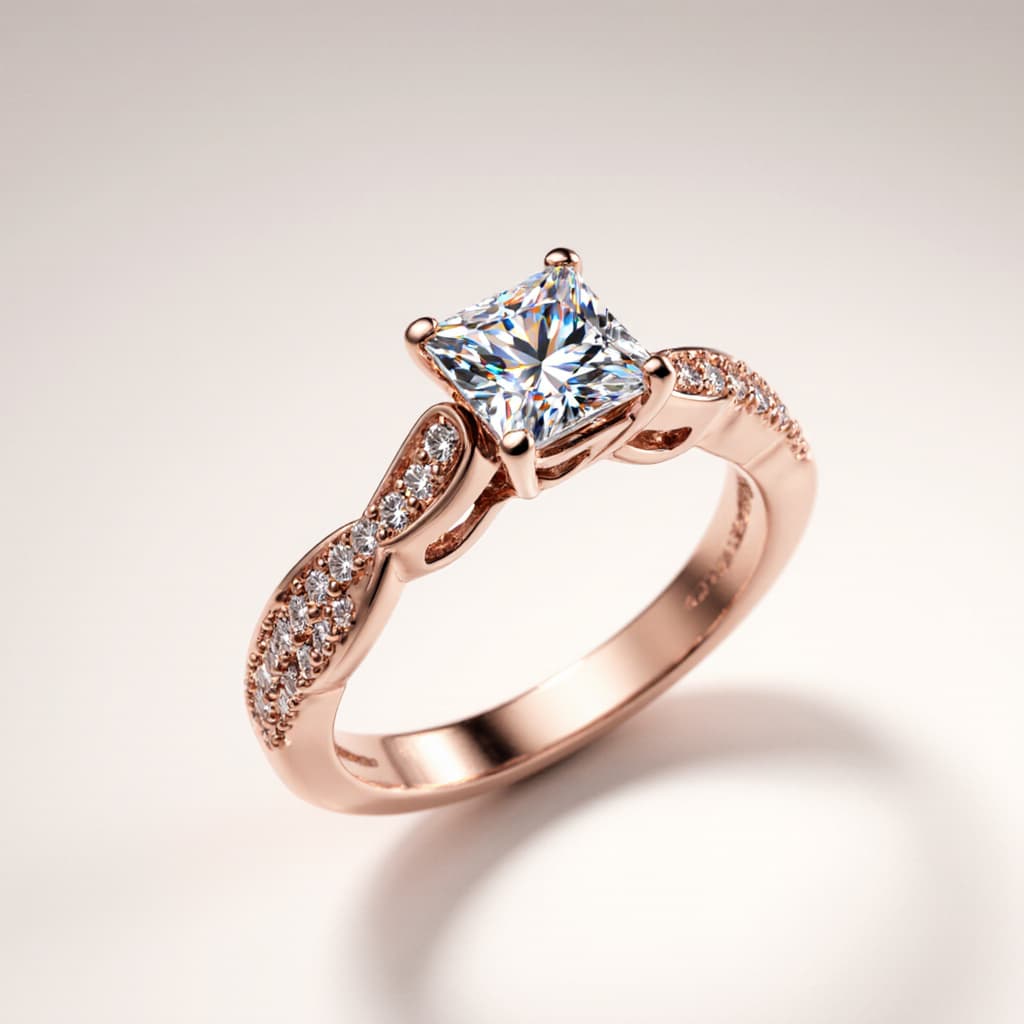
Even when the overall piece is 3D printed, stone seats are often finished on a CNC machine for guaranteed precision. A hybrid workflow might 3D print the ring body and then mount it in a CNC fixture for precision machining of prong positions and bearing surfaces.
Smooth Curved Surfaces
Ring shanks, bangle surfaces, and pendant backs require smooth, continuous curvature that feels comfortable against the skin. CNC produces these surfaces directly at near-polishing quality, while 3D printing leaves layer lines that require extensive sanding and finishing.
For pieces where surface quality is paramount, like simple wedding bands and classic bangles, CNC delivers superior results with less post-processing labor.
Production Consistency
When producing multiple copies of the same design, CNC maintains identical dimensions across every piece. This consistency is critical for matched sets (earring pairs, bridal sets) and production runs where customers expect uniformity.
Where 3D Printing Outperforms CNC in Jewelry
Equally, many jewelry manufacturing scenarios favor 3D printing for practical reasons.
Complex and Organic Forms
Art Nouveau-inspired designs, nature motifs, and sculptural contemporary pieces feature undercuts, hollow forms, and intertwined elements that CNC tools simply cannot reach. A branching tree pendant with overlapping leaves and small birds, for example, would require dozens of separate CNC setups with custom fixturing, making it impractical. The same piece prints in a single operation.
Lattice and Lightweight Structures
Modern jewelry increasingly features internal lattice structures that reduce weight while maintaining rigidity. These lightweight gold designs save material costs and improve comfort, but they are impossible to create with subtractive manufacturing. Only 3D printing can build these internal geometries.
Rapid Design Iteration
During the design phase, speed matters more than final surface quality. 3D printing produces a physical model in hours, allowing designers and clients to evaluate proportions, fit, and visual impact. Making changes and reprinting takes less time than resetting a CNC machine for a modified part.
This rapid iteration capability is especially valuable for custom pieces where client approval is needed before committing to final production. Our guide on AI-driven design workflows discusses how rapid prototyping fits into modern design processes.
The Hybrid Manufacturing Approach
The most capable jewelry workshops use both technologies strategically, assigning each production step to the technology best suited for it.
Workflow One Print Then Machine
The most common hybrid approach starts with 3D printing the overall form and then uses CNC to refine critical features. The piece is printed in castable wax or resin, mounted in a CNC fixture, and precision-machined at stone setting locations, mating surfaces, and any areas requiring superior finish quality.
This workflow captures 3D printing's geometric freedom while adding CNC's precision where it matters most. It is particularly effective for engagement rings and other stone-set pieces where the design is complex but the setting must be mechanically precise.
Workflow Two Machine Then Assemble
For pieces with both simple and complex elements, some workshops CNC machine the simple components and 3D print the complex ones, then assemble them. A ring might have a CNC-machined band joined to a 3D-printed head with intricate design details.
Workflow Three Parallel Production
In production environments, CNC and 3D printers can run simultaneously on different components of the same order. While the printer builds complex pendants overnight, the CNC machine cuts precise band stock during the day. This parallel processing significantly reduces overall production time.
| Hybrid Workflow | Best Application | Time Savings vs Single Tech |
|---|---|---|
| Print Then Machine | Complex designs with precision settings | 20 to 40 percent |
| Machine Then Assemble | Mixed-complexity pieces | 15 to 30 percent |
| Parallel Production | Multi-piece orders | 30 to 50 percent |
Equipment Selection for Hybrid Workshops
Building a hybrid jewelry workshop requires selecting equipment that works well together. Compatibility between 3D printers and CNC machines centers on workholding (how the printed piece is fixtured for machining) and file format compatibility (ensuring smooth data transfer between systems).
For CNC, jewelry workshops typically choose four or five-axis desktop mills with workspaces suited to jewelry scale. Machines from manufacturers like Roland, Datron, and Haas offer models specifically configured for jewelry wax and metal work. Spindle speeds above 40,000 RPM are preferable for the small tools used in jewelry machining.
For 3D printing, high-resolution resin printers with 25 to 50 micron XY resolution produce wax patterns and castable models with detail levels appropriate for fine jewelry. Systems from Formlabs, Asiga, and EnvisionTEC are popular in jewelry workshops for their reliability and material options.
Direct Metal Manufacturing
Both CNC and 3D printing can produce jewelry directly in precious metals, each with different characteristics.
Direct metal CNC milling works well for simple geometries in gold, silver, and platinum. The process produces excellent surface finish and precise dimensions but is limited by tool access and generates significant precious metal waste (which is recovered and recycled).
Direct metal 3D printing using laser sintering or melting technologies builds complex metal pieces layer by layer. The results require post-processing for surface finish but can achieve geometries that milling cannot. Material waste is minimal since unused powder is recycled.
As direct metal technologies mature, they are reducing the need for the traditional casting step entirely. For the latest developments in this area, our article on 3D printed jewelry from design to physical piece tracks the evolving landscape.
How Tashvi AI Designs for Hybrid Manufacturing
Tashvi AI generates jewelry concepts with production handoff in mind. When the AI creates a piece with intricate surface detail around a center stone, it produces geometry that a hybrid workflow can handle effectively. The complex decorative elements are suitable for 3D printing, while the stone setting area maintains the clean geometry that CNC can machine to exacting tolerances.
This manufacturing-conscious design approach means that pieces created on Tashvi transition more smoothly into production than designs generated by generic AI tools that do not consider fabrication constraints. For jewelers building hybrid manufacturing capabilities, Tashvi provides the ideal design front end, creating beautiful, producible concepts that take full advantage of both CNC and 3D printing strengths. Try designing on Tashvi AI free to see how AI-generated designs can be optimized for modern hybrid manufacturing workflows.
Looking Ahead
The convergence of CNC and 3D printing continues to accelerate. Hybrid machines that combine additive and subtractive capabilities in a single platform are emerging, allowing pieces to be printed and precision-machined without refixturing. These machines promise the best of both worlds, with geometric freedom and surface precision in a single setup.
As these technologies mature and AI design tools generate increasingly manufacturing-aware designs, the distinction between CNC and 3D printing will blur. The question will shift from "which technology should we use" to "how do we optimize the manufacturing path for this specific design." For jewelry manufacturers, embracing both technologies now builds the skills and workflows needed to thrive in this converging future.
Frequently Asked Questions
Quick answers to the questions readers ask most about this guide.
What is the difference between CNC machining and 3D printing for jewelry?
CNC machining is subtractive, carving material away from a solid block to create the piece. 3D printing is additive, building the piece layer by layer from raw material. CNC excels at surface quality and precision, while 3D printing handles complex internal geometries and organic forms more effectively.
Which is better for jewelry, CNC or 3D printing?
Neither is universally better. CNC delivers superior surface finish and dimensional accuracy for simpler geometries. 3D printing enables complex forms impossible to mill. The best results often come from using both, with 3D printing for complex wax patterns and CNC for finishing and precision features.
Can CNC machines work directly with precious metals for jewelry?
Yes, modern CNC machines can mill gold, silver, platinum, and their alloys directly. However, most jewelry CNC work involves milling wax models for lost-wax casting, which is more cost-effective for complex pieces. Direct metal milling is practical for simple geometries and small production runs.
How precise is CNC machining compared to 3D printing for jewelry?
CNC machining typically achieves tolerances of 0.01 to 0.02 millimeters with excellent surface finish. High-resolution 3D printing reaches 0.025 to 0.05 millimeters with visible layer lines that require post-processing. CNC wins on precision, but 3D printing wins on geometric complexity.
Is hybrid CNC and 3D printing practical for small jewelry workshops?
Yes, desktop CNC mills and benchtop 3D printers are now affordable for small workshops. A capable setup with both technologies costs between 5,000 and 15,000 dollars. Many workshops start with 3D printing and add CNC later for finishing and precision work.