Jewellery Inventory Management in India: GST, Karigar Accounts and Old Gold
Indian jewellery operations carry three requirements most inventory software has never heard of: a split GST rate, metal issued to karigars, and old gold taken in exchange. Here is how each one works and what it demands of your records.
Most inventory software sold into the Indian jewellery trade is sold on billing. That is a fair reflection of where the pain is, but it understates the problem. Three things about Indian jewellery operations are structurally different from general retail, and all three are inventory problems before they are billing problems.
They are the split tax rate, the karigar, and old gold. Each one demands something of your records that a generic system does not provide.
1. GST is split, not single
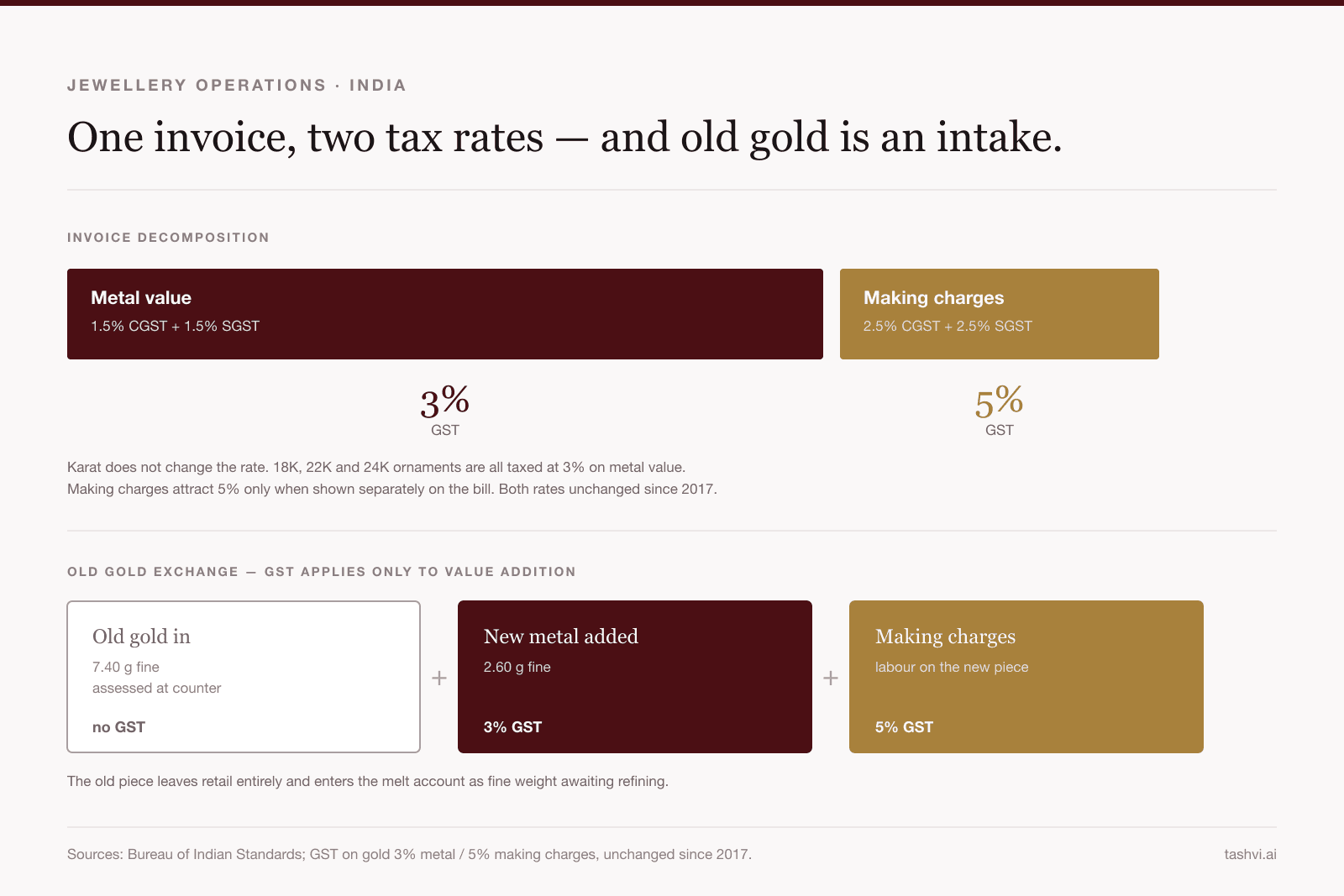
A gold jewellery invoice carries two GST rates at once, applied to different components of the same sale:
| Component | GST rate |
|---|---|
| Metal value (gold, including coins and bars) | 3% (1.5% CGST + 1.5% SGST) |
| Making charges, shown separately | 5% (2.5% CGST + 2.5% SGST) |
Both rates have stood since 2017, and the September 2025 slab reform left them unchanged. Karat is irrelevant to the rate — 18K, 22K and 24K all attract 3% on metal value, with purity affecting only the price per gram. (Razorpay's GST on gold guide sets out the current position; IIFL's invoice-rules guide covers HSN and invoice format.)
The consequence for inventory is direct. To raise a correct invoice you must be able to decompose the sale price into metal and labour at the moment of billing. That means the item record has to hold, per piece:
- Gross weight
- Stone weight (deducted before metal value is computed)
- Purity, to convert to fine weight
- Making charge, as a rate or an amount, held separately from metal value
If making charges are folded into a single price, you cannot split the tax correctly and you have no clean way to reconstruct it later. This is the most common reason Indian jewellers outgrow a general-purpose billing package: it will happily store one price, and one price is not enough information.
2. Old gold is an intake, not a discount
When a customer exchanges old ornaments against a new purchase, the instinct is to treat it as a discount on the sale. It is not. It is two transactions: a purchase of second-hand metal from the customer, and a sale of new jewellery to them.
GST reflects this. On an exchange, tax applies only to the value addition — the new metal added plus making charges — not to the value of the old gold returned. That makes the intake figures tax-relevant, not merely operational.
Which means the counter has to capture, at the moment of exchange:
- Gross weight of the old piece, weighed on your scale, not taken from the customer's account of it
- Assessed purity, by whatever your standard process is — touchstone, XRF, or acid test
- Fine weight, computed from the two
- Deductions for stones, solder or attachments that are not recoverable metal
The old piece then leaves the retail world entirely and enters the melt account. It is no longer a piece of jewellery. It is a quantity of fine metal awaiting refining, and it should be tracked as such until the refiner's recovery comes back.
Businesses that record old gold only as a rupee deduction on an invoice lose all of this. The metal enters the building without entering the books, which is precisely the kind of gap that makes a physical stock verification impossible to reconcile.
3. Karigar accounts
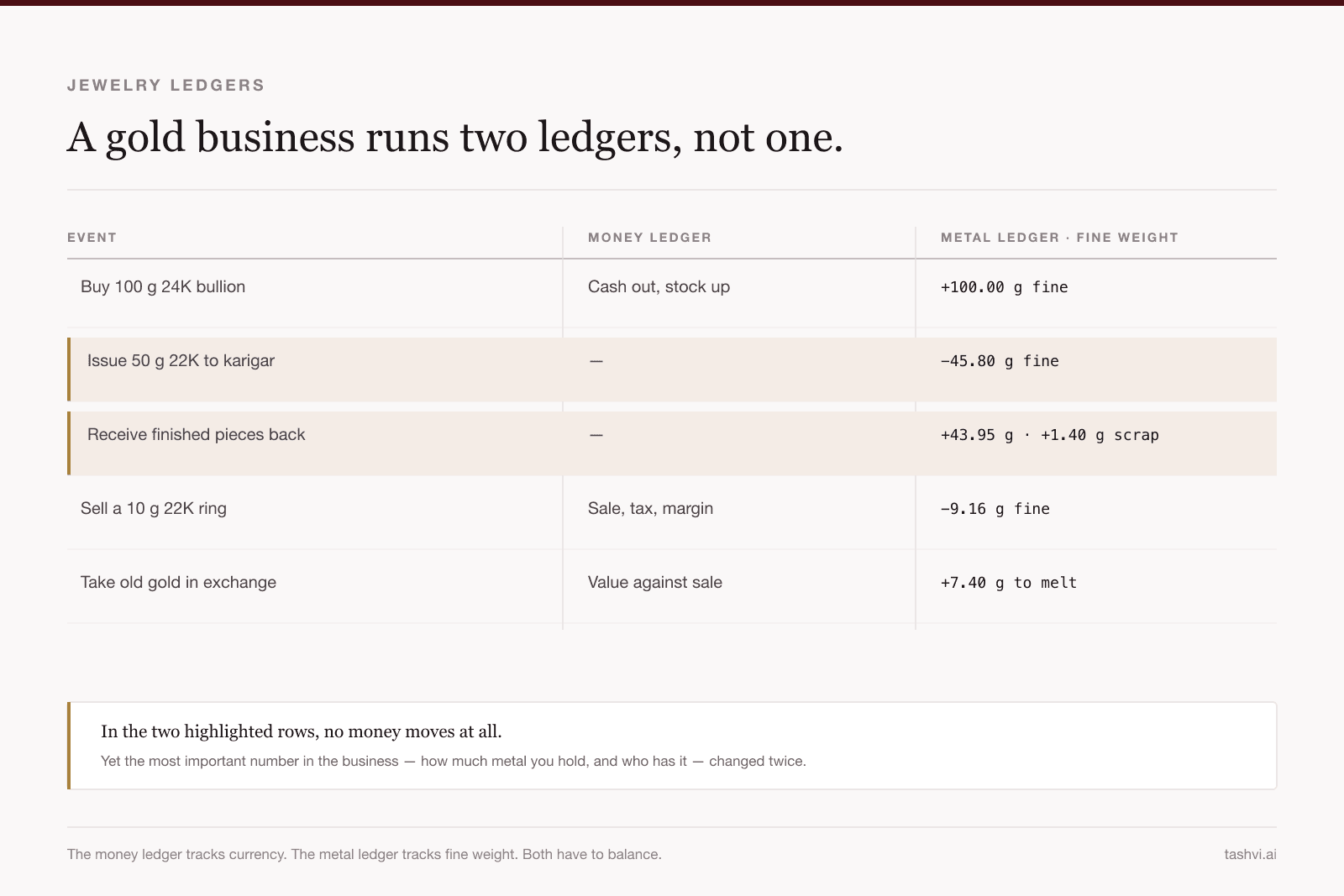
The karigar — the bench goldsmith — is the third structural difference, and the one general software handles worst. Metal leaves the premises, work happens elsewhere, and metal comes back changed. No sale occurs. Most systems have no way to represent it at all.
A karigar account is a running balance in fine weight:
- Issue — weight out against a dated job order
- Receipt — finished pieces weighed in
- Scrap return — filings and offcuts, weighed separately
- Wastage — the residual, as a percentage of weight issued
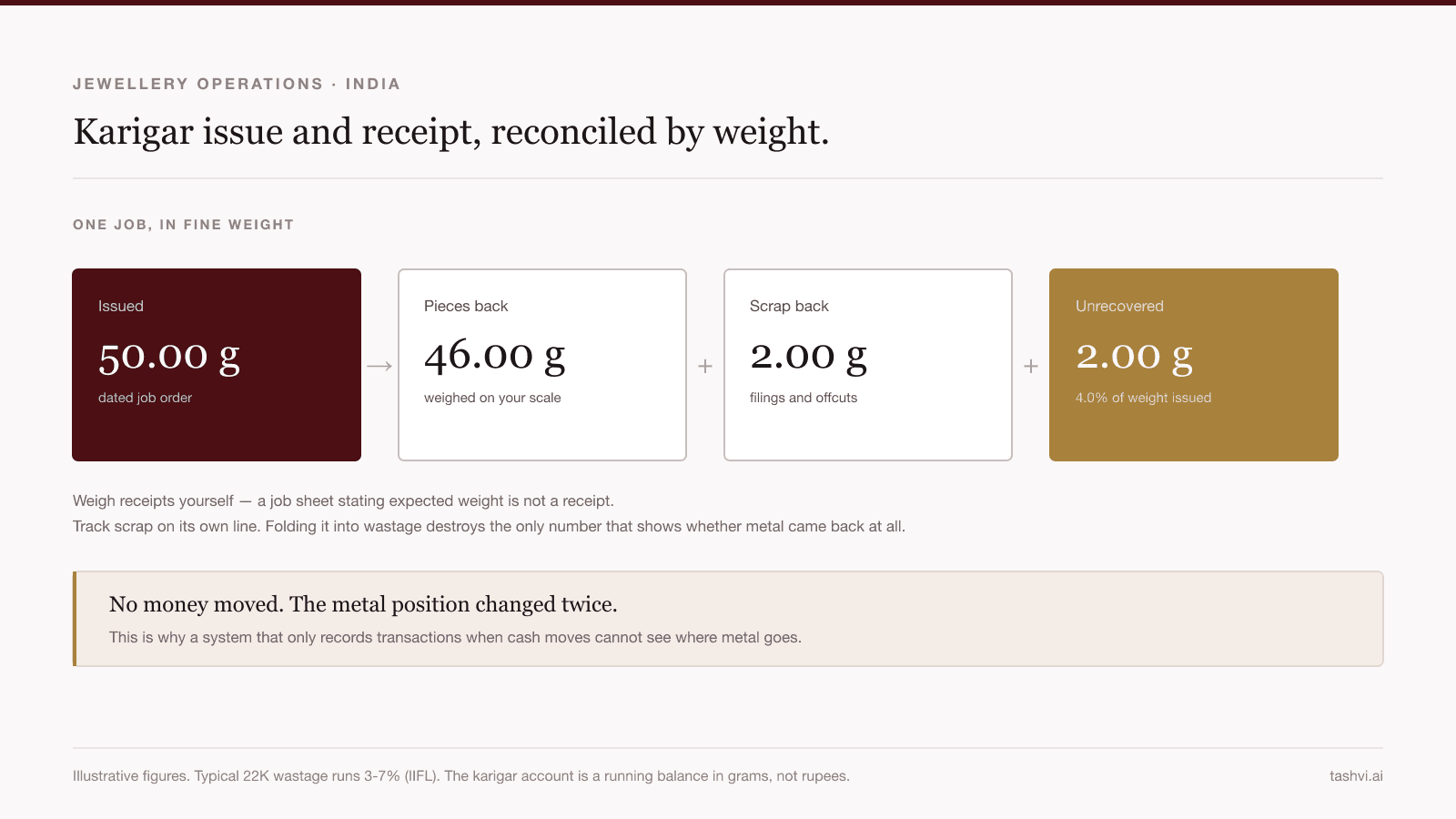
Issue 50.00 g, receive 46.00 g in pieces and 2.00 g in scrap, and unrecovered metal is 2.00 g — 4.0% of the weight issued.
That sits inside the normal range. Wastage on 22K work typically runs 3% to 7% depending on design complexity, and 6–12% on 18K. Export work is held to a much tighter standard: DGFT Public Notice 30/2024-25, effective 1 January 2025, permits 2.25% on handcrafted plain gold and platinum, 0.45% on mechanised, and 4.00% on handcrafted studded jewellery.
The value is in the trend, not the transaction. Each karigar develops a normal range, and once you have one, an abnormal figure becomes visible. Without it, a drift from 4% to 8% across two quarters reads as noise — and on meaningful volumes, that difference is a serious sum.
Two practical notes that get missed:
- Weigh receipts yourself. A job sheet stating expected weight is not a receipt. The weight that goes in the ledger is the one from your scale.
- Track scrap as a separate line. Folding scrap into wastage destroys the only number that tells you whether metal is being returned at all.
Hallmarking and HUID — get this right
Hallmarking is mandatory for gold and silver articles at the first point of sale in notified districts, with exemptions including articles under two grams, items meant for export that meet a foreign buyer's specification, and jewellers below the ₹40 lakh annual turnover threshold. Registration with BIS is free and valid for the lifetime of the business.
Each hallmarked piece carries a six-character HUID recorded in the BIS database, and a customer can verify it independently through the BIS Care app.
Now the part that is widely misreported. A great deal of jewellery-software marketing states that HUID must appear on the invoice and that jewellers must maintain HUID records. The Bureau of Indian Standards' own page for jewellers says otherwise: mentioning HUID on the invoice is voluntary at present, and maintaining HUID records is not mandatory for jewellers.
So the case for tracking HUID against the item record is commercial, not legal. A buyer can check the number; the jeweller who can produce it is in a stronger position than the one who cannot. That is a good enough reason on its own — it just is not a compliance obligation, and you should not buy software on the basis that it is.
Karat-wise stock, and why it is the report that matters
A single "total stock value" figure is close to useless in a gold business. The report that carries information is karat-wise fine weight, because that is the number that reconciles against physical stock and against your metal account.
A useful stock position separates:
- Fine weight held, by karat
- Gross weight and stone weight, so the two can be reconciled
- Value at cost, and value at today's rate
- Weight out with karigars, on approval, and at hallmarking centres
- Weight in the melt account awaiting refining
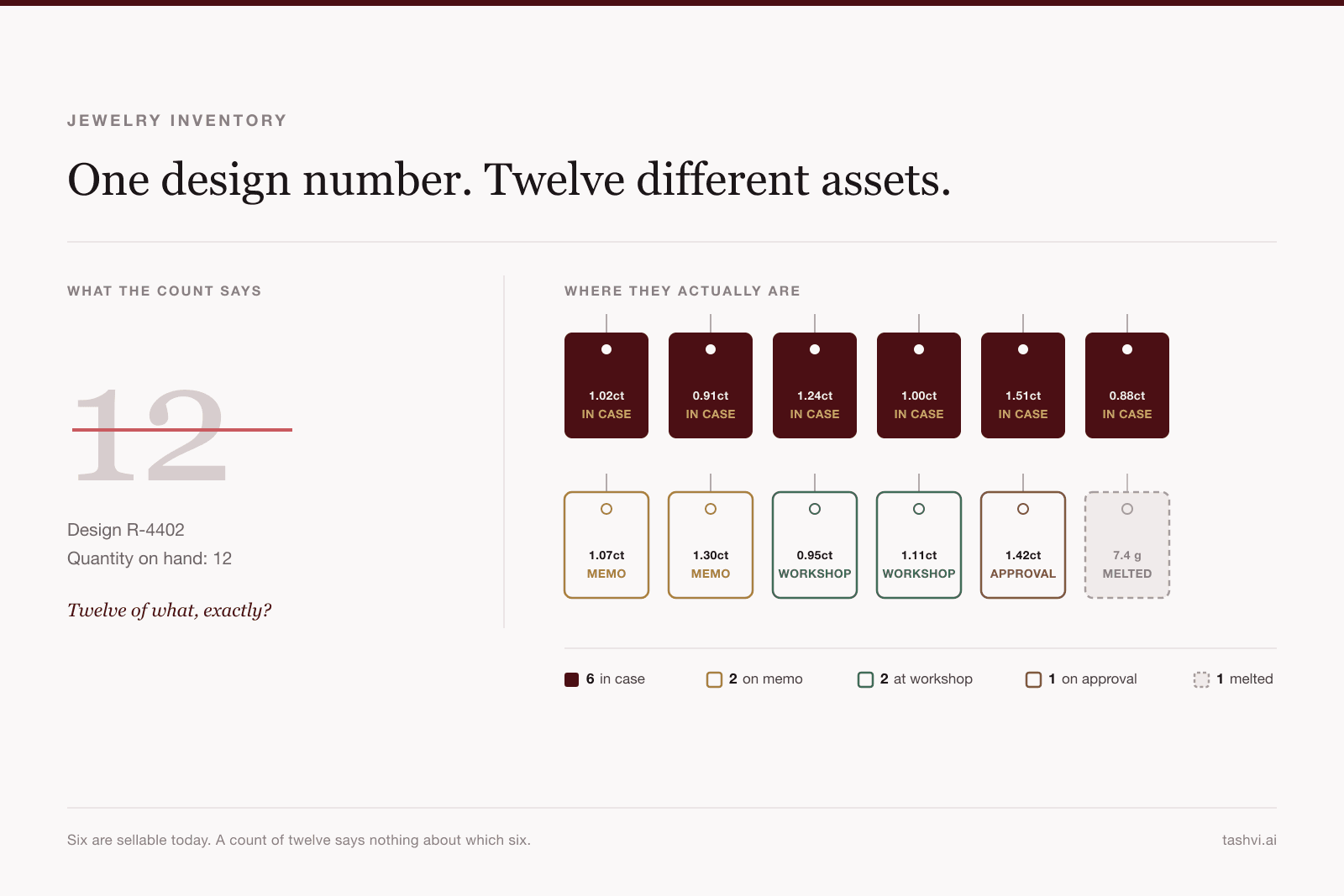
That last group matters more than it looks. Metal that is legitimately absent still belongs to you, and a stock report that omits it will appear short every time you run it.
The accounting handoff
Most Indian jewellers keep accounts in Tally or a similar package, and most of them should — there is no good reason to replace a working accounts system to solve an inventory problem.
What matters is that the handoff is clean:
- Inventory and metal accounts live in the jewellery system
- Sales, purchases, GST and receivables post through to accounts
- The two reconcile on valuation, using an explicit and consistent basis
The failure mode is duplicate entry — the same sale keyed twice, once for billing and once for accounts, drifting apart within weeks. If a system cannot post to your accounts package, that gap becomes somebody's daily job.
Where design fits
Everything here is about recording metal that already exists. The cheapest inventory problem is the piece never made — and in a business where unsold stock ends up back in the melt account, choosing what to commission is a metal decision as much as a creative one.
Tashvi AI
Test a design before the metal goes out
Explore variations and decide what's worth commissioning, before it becomes stock. Free to start, no credit card.
Sources
- Bureau of Indian Standards — Hallmarking: information for jewellers
- Razorpay — GST rates on gold in India
- IIFL — GST on gold jewellery: HSN code, rate and invoice rules
- IIFL — Gold making charges and wastage percentage
- DGFT — Public Notice 30/2024-25: revised wastage limits and input norms for jewellery exports
This article describes tax and regulatory requirements in general terms and is not tax or legal advice. Rates and thresholds change, and obligations vary by state and by the size of the business. Confirm your position with a qualified adviser.
Related reading
Frequently Asked Questions
Quick answers to the questions readers ask most about this guide.
What is the GST rate on gold jewellery in India?
GST on gold jewellery is charged at two different rates on the same invoice. The metal value attracts 3% (1.5% CGST + 1.5% SGST). Making charges, when shown separately on the bill, attract 5%. Both rates have been unchanged since 2017 and the September 2025 slab reform left them in place. Karat does not change the rate — 18K, 22K and 24K ornaments are all taxed at 3% on metal value.
How is GST calculated on old gold exchange?
When a customer exchanges old gold for new jewellery, GST applies only to the value addition — the new metal added plus making charges — not to the value of the old gold returned. This makes the intake weight and purity of the old piece a tax-relevant figure, not just an inventory one, which is why it needs to be recorded at the counter rather than reconstructed later.
What is karigar management in jewellery software?
Karigar management tracks metal issued to a goldsmith against metal received back. It records fine weight out on a job order, finished pieces in, scrap and filings returned, and the resulting wastage percentage. Over time it establishes each karigar's normal wastage range, which is what makes an abnormal figure detectable.
Is HUID record-keeping mandatory for jewellers in India?
No. Hallmarking itself is mandatory for gold and silver articles at the first point of sale in notified districts, with exemptions including articles under two grams and jewellers below the ₹40 lakh turnover threshold. But the Bureau of Indian Standards states that mentioning HUID on the invoice is voluntary at present, and that maintaining HUID records is not mandatory for jewellers. Many secondary sources report this incorrectly.