Jewelry ERP and Inventory Software: What It Actually Solves (2026)
Generic retail inventory software assumes interchangeable units and a fixed cost basis. Jewelry has neither. Here is what jewelry ERP and inventory systems actually solve — serialization, metal-rate costing, memo stock, melt reconciliation, and the compliance record.
Ask a jewelry inventory system how many of something you have and you get a number. The number is almost always wrong, and not because anyone stole anything.
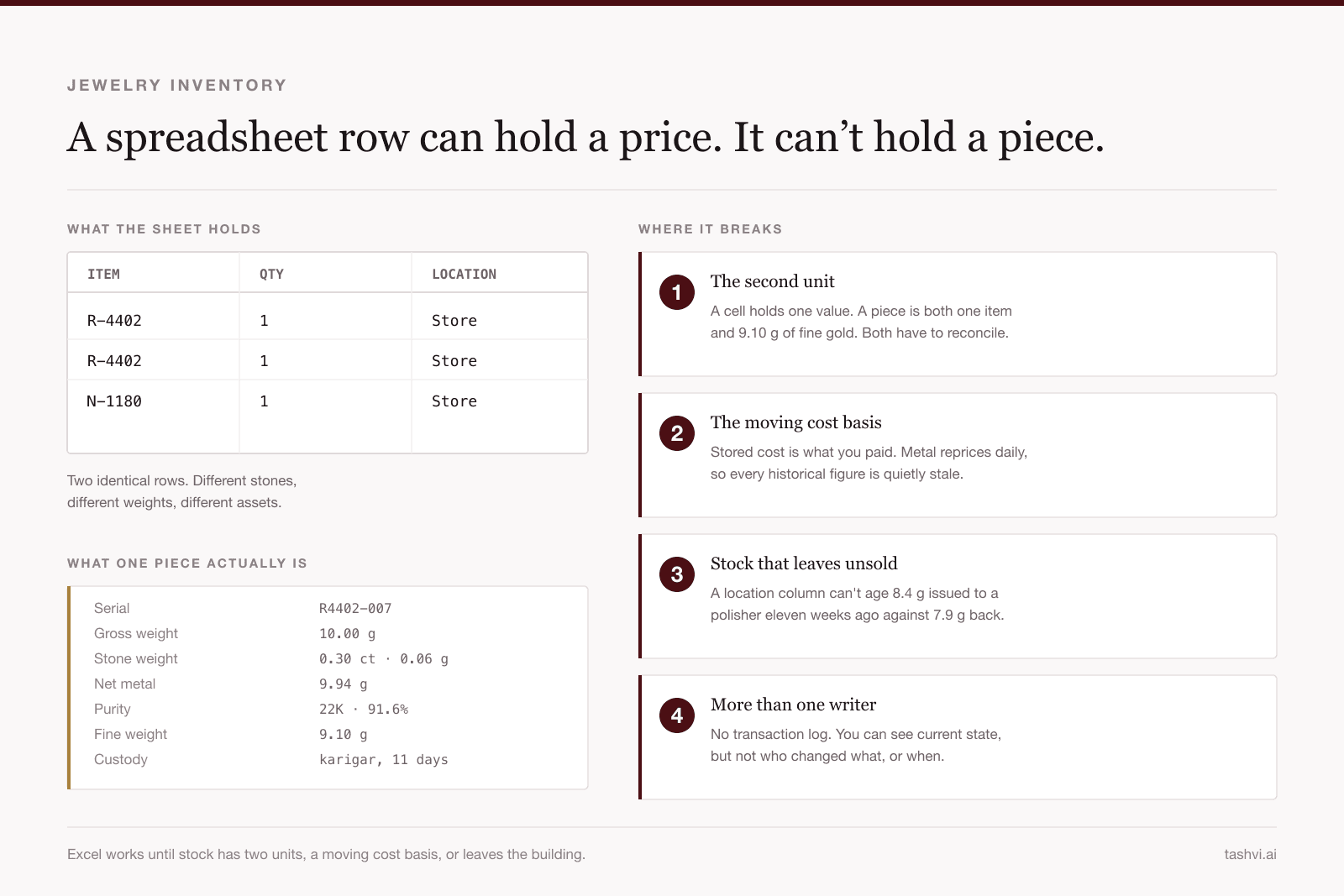
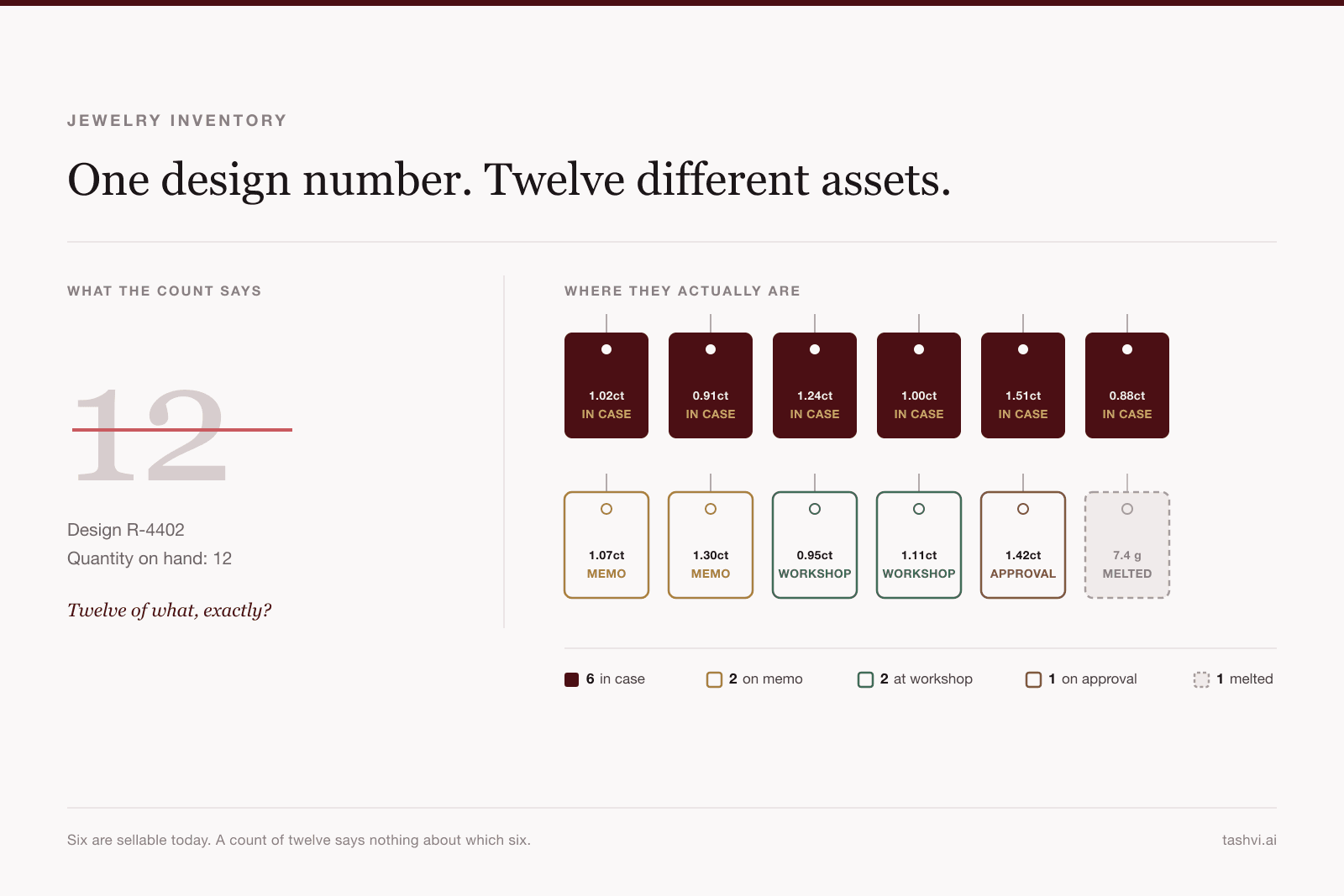
It is wrong because "quantity on hand: 12" is a sentence that means something in a clothing store and almost nothing in a jewelry business. Twelve of design number R-4402 might be twelve rings that share a design and share nothing else — different center stones, different total weights, different certificates, three of them sitting in a workshop across town, two out on approval with a customer, one already scrapped for melt last Tuesday.
Jewelry ERP software is business management software that models inventory the way the jewelry trade actually works: every piece tracked as an individually serialized item rather than an interchangeable unit of a SKU, cost split into metal value, making charge, wastage and stone value rather than one fixed number, stock tracked by custody state as well as location, and metal reconciled by fine weight through melt and scrap. General retail systems handle none of these natively, which is why jewelry inventory management so often ends up half in software and half in a spreadsheet.
What follows is what that data model has to account for, and what changes operationally when it does. No products are named — this is about the capability, not the vendor.
1. Why a SKU count fails in jewelry inventory management
The central assumption of general retail inventory is fungibility: any unit of a SKU is substitutable for any other. Sell one, decrement the count. That assumption is what makes simple quantity tracking work.
Jewelry breaks it immediately. A 1.02ct G/VS2 round in a solitaire setting and a 1.04ct H/VS1 in the same setting are the same design and different assets. They have different costs, different prices, different certificates, and different buyers.
Jewelry inventory management software therefore has to be serialized at the item level: every physical piece gets its own record and its own identity, with the design acting as a template above it rather than a bucket that pieces disappear into.
What this changes in practice:
- A physical count becomes a reconciliation of identities, not a tally. You find out which piece is missing, not that the count is off by one.
- Pricing can follow the individual stone rather than a design-level average.
- You can answer "where did this exact ring come from and what did it cost us" months later, which matters for returns, insurance claims, and disputes.
This is not only an operational preference. IAS 2 Inventories, the international accounting standard, requires specific identification of cost for items that are not ordinarily interchangeable, reserving FIFO and weighted-average formulas for goods that are. Jewelry sits squarely in the first category, so per-piece cost tracking is what the standard actually contemplates.
If a system cannot tell two pieces of the same design apart, nothing downstream of it will be reliable.
2. Jewelry inventory software has to cost by weight and purity
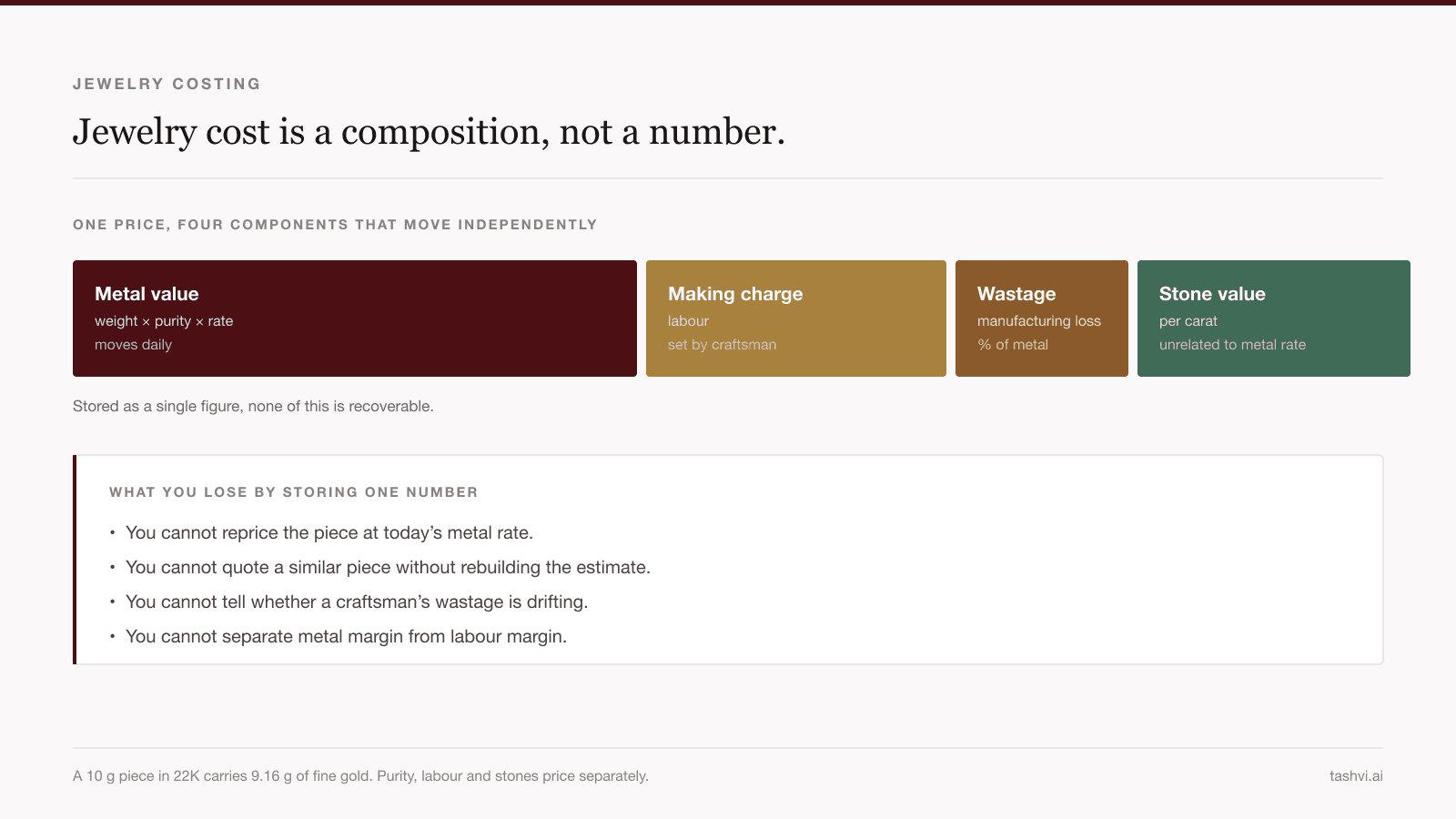
Retail software generally models cost as a single number attached to a unit. Jewelry cost is a composition, and the parts behave differently.
For a gold piece, the invoice usually decomposes into roughly:
- Metal value — weight × purity × prevailing rate. A 10 g piece in 22K carries 9.16 g of fine gold (22K is 91.6% pure); in 18K, 7.5 g.
- Making charge — the labor, quoted as a percentage of metal value, a flat rate, or a per-gram charge depending on the market.
- Wastage — the metal lost in manufacturing, recovered by charging against a slightly higher weight than the finished piece.
- Stone value — priced entirely separately, often per carat, and not related to metal rate at all.
A system that stores only a single total cost figure has thrown away the information you need to reprice the piece tomorrow, to quote a similar piece, or to work out whether a given craftsman's wastage percentage is drifting.
Purity matters structurally, not just descriptively. Two pieces of identical gross weight in 22K and 14K are different quantities of the same commodity. Inventory that tracks gross weight without fine weight cannot be reconciled against metal accounts.
3. Why your cost basis moves after you buy
This is the one that surprises people arriving from general retail. In most categories, you buy a thing for a price and that price is historical fact until you sell it. In jewelry, a substantial share of the item's value is a traded commodity that reprices continuously.
The ring you made at one gold rate has a different replacement cost this morning. That affects:
- Margin measurement. Margin against original cost and margin against replacement cost can tell opposite stories during a sustained price move.
- Reordering. Restocking a sold piece costs what metal costs now, not what it cost then.
- Old stock. Aged inventory in a rising market may be carrying unrealized gain; in a falling one, the reverse.
Jewellery ERP systems built for the trade hold metal rate as a live input and can revalue stock against it, rather than treating cost as a frozen field. Systems that cannot do this force the revaluation into a spreadsheet, which is where it stops happening consistently.
4. Jewelry stock management when stock isn't in the building
General inventory conflates two things that jewelry has to keep separate: ownership and custody.
At any moment a piece may be:
- On memo or consignment with another retailer — your asset, their showcase.
- Out for job work at a workshop — setting, polishing, rhodium plating, engraving.
- Out on approval with a customer.
- At an assaying and hallmarking centre.
- With a lab for certification.
- In for repair, which means it is a customer's property in your possession — the mirror image, and the one most often mishandled.
For jewelry stock management, each of these is a distinct state with a distinct risk, a distinct aging clock, and a distinct set of questions ("what have we had sitting at the polisher for six weeks?"). A system with one location field and a binary in-stock flag cannot represent any of it, and the practical result is that memo stock ages invisibly and repair items get lost.
Custody tracking is consistently the feature most underestimated during evaluation and most relied on once a system is live.
5. Melt and scrap: jewelry inventory as a closed loop
Jewelry has a property almost no other retail category has: unsold stock can be converted back into raw material. Old designs get melted. Customer trade-ins get melted. Scrap and filings and polishing sweeps get refined and recovered.
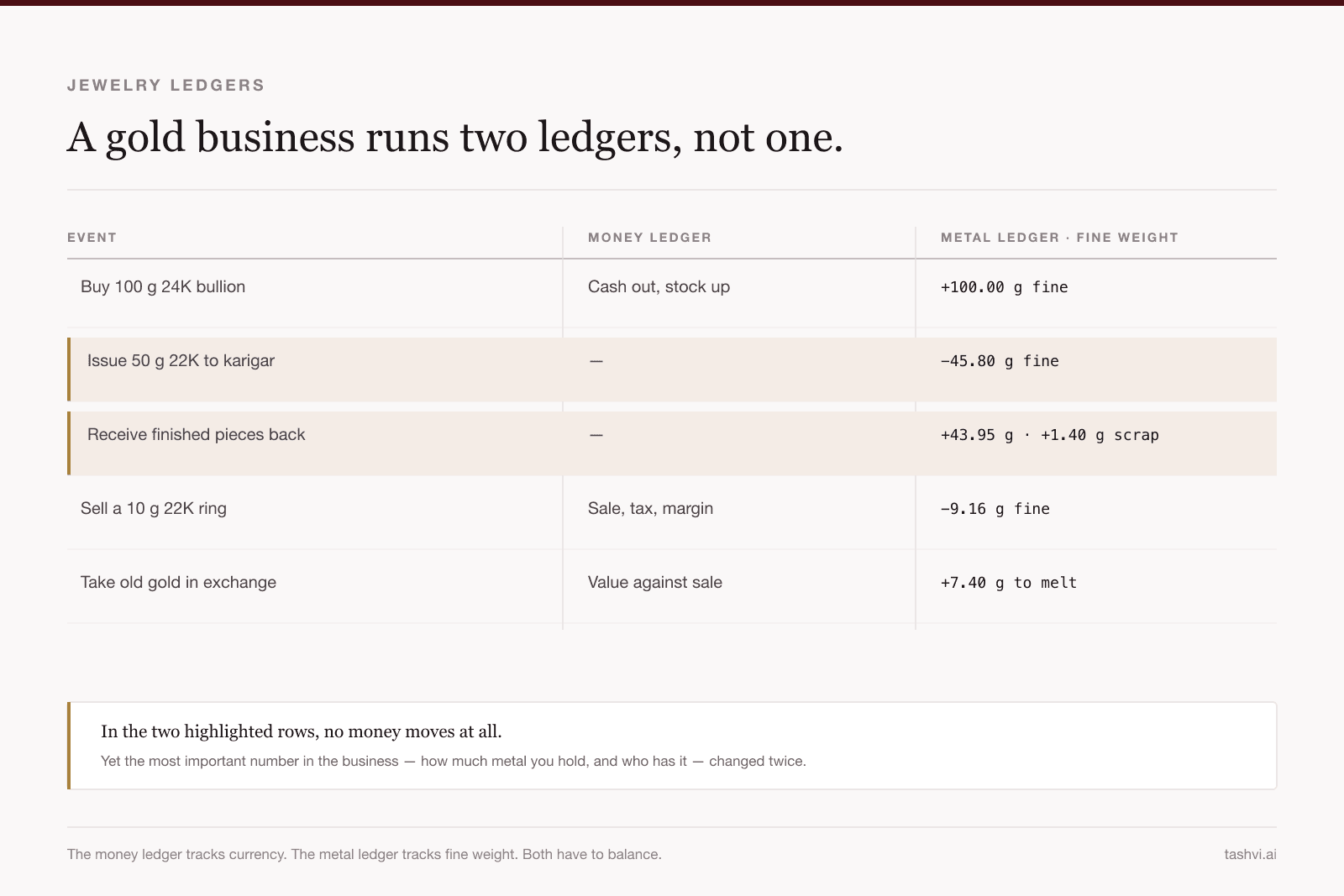
This makes inventory a partially closed loop, and it means the system has to reconcile in two currencies at once: pieces and fine weight. When a ring is melted, one item record ends and some quantity of fine gold enters raw stock — less the refining loss.
The operational payoff of getting this right is that metal is conserved on paper the way it is in physics. You can ask whether the fine weight issued to a workshop came back as finished pieces plus scrap plus a plausible loss percentage, and get an answer. Persistent unexplained gaps are a genuine signal. Without loop reconciliation, that signal does not exist and losses look like rounding.
6. Certificates and hallmarks belong on the item record
For a significant share of jewelry inventory, the documentation is not metadata about the item — it is a component of the item's value. A certified stone without its report is worth measurably less than the same stone with it.
The item record therefore needs to carry, and keep attached through every movement:
- Grading report numbers and issuing laboratory
- Hallmark identifiers where applicable
- Origin and treatment disclosures
- Prior repair and modification history
Hallmarking regimes make this concrete. Under India's BIS hallmarking scheme, hallmarking applies to gold and silver articles at the first point of sale, with exemptions including articles under two grams and jewellers below the ₹40 lakh turnover threshold, and each hallmarked piece carries a six-character HUID recorded in the BIS database. Worth noting precisely, because it is widely misreported: BIS currently states that mentioning HUID on the invoice is voluntary, and that maintaining HUID records is not mandatory for jewellers. Registration itself is free and valid for the lifetime of the business.
So the argument for tracking hallmark identifiers is not "the law requires it." It is that a buyer can verify a HUID independently through the BIS Care app, which means the jeweler who can produce the record is in a stronger position than the one who cannot.
7. Compliance a jewelry inventory system has to support
Three regimes shape what a jewelry business needs to be able to retrieve on request. None of them are satisfied by software alone — but all of them are much harder to satisfy when the underlying records cannot be reconstructed.
Anti-money laundering. In the United States, dealers in precious metals, stones, or jewels must implement a written AML program under 31 CFR § 1027.210. The rule requires policies and internal controls based on the dealer's own risk assessment, a designated compliance officer, ongoing staff training, and independent testing. Retailers whose purchases from non-dealer sources exceed $50,000 in a year must bring those purchases within the program's scope — which is to say that buying gold over the counter from the public is precisely the activity the rule is aimed at, and it needs a record.
Disclosure. The FTC's Guides for the Jewelry, Precious Metals, and Pewter Industries (16 CFR Part 23) govern how products may be described. Laboratory-created stones must be disclosed clearly and conspicuously, and an unqualified species name is not acceptable for material that is not of natural origin. The FTC has written directly about what qualifies as adequate disclosure. If the origin of a stone is not a reliable field on the item record, the description that reaches the customer is a guess.
Hallmarking, as above, where applicable in your market.
The common thread: each of these turns on being able to say what a specific item is and where it came from, months or years later. That is an inventory-system property.
8. Why shrink costs more in a jewelry business
The National Retail Federation's 2023 National Retail Security Survey put the average retail shrink rate at 1.6% of sales in FY 2022, up from 1.4% the prior year, representing about $112.1 billion in losses across US retail.
That figure is an all-retail average, not a jewelry number, and the comparison is worth drawing carefully. Jewelry generally has better physical controls than open-floor retail — locked cases, smaller staff, higher scrutiny. What jewelry has instead is severity. A 1.6% shrink rate on a $30 item is a rounding error per incident. The same rate applied against jewelry's average unit value means a single unexplained absence can exceed a general retailer's entire monthly shrink budget.
The operational implication is that in jewelry, detection speed matters more than detection rate. Finding out at the annual count that something went missing at some point during the year is nearly useless. Finding out within a day, with a custody trail showing who last held the piece, is the difference between an incident and a loss.
9. What to look for in jewelry ERP software
Set aside product names and evaluate jewelry inventory software against capability. A system that fits the trade will handle all of these; most general systems handle the first two and none of the rest.
First, though, be clear about which purchase you are making. A jewelry store inventory system and a jewelry manufacturing ERP overlap but are not the same thing, and buying the wrong one is a common and expensive mistake:
- Retail. The centre of gravity is the sales floor — point of sale, customer history, repairs intake, memo in and out, and multi-location stock visibility. Inventory management for jewelers on the retail side lives or dies on custody states and fast physical counts.
- Manufacturing. The centre of gravity is the bench — job orders, issue and receipt of metal by fine weight, wastage per craftsman, work-in-progress valuation, and melt recovery. Here the system is really a metal accounting system that happens to track pieces.
- Both. Businesses that make and sell need the loop closed between them, which is the hardest and least common capability to find.
If you are searching in British spelling, the same category is usually listed as jewellery inventory management software or jewellery ERP; the market is the same, the terminology splits mostly along US and Commonwealth lines.
| Capability | Why it matters | Failure mode without it |
|---|---|---|
| Item-level serialization | Pieces are not interchangeable | Counts reconcile but identity is lost |
| Weight and purity as native fields | Metal is the underlying commodity | Cannot reconcile against metal accounts |
| Split costing: metal / making / wastage / stone | Components move independently | Cannot reprice or benchmark craftsmen |
| Live metal-rate revaluation | Cost basis moves daily | Margin reporting quietly drifts |
| Custody states (memo, job work, approval, repair) | Ownership ≠ possession | Memo ages invisibly; repairs go missing |
| Melt and scrap reconciliation by fine weight | Inventory is a closed loop | Losses look like rounding |
| Certificate and hallmark attachment | Documentation is part of value | Value is unprovable at resale |
| Retrievable item history | Compliance and disputes | Cannot reconstruct on request |
One caution worth stating plainly: failed jewelry ERP implementations are usually a data problem, not a software problem. Migrating from design-level counts to item-level serialization means someone physically identifies and records every piece in the building. Businesses that skip that step start with a clean system and dirty data, and conclude within a year that the software does not work.
Where design fits
Inventory systems record what exists. The decision about what should exist happens earlier — at design and merchandising — and it is where most stock problems originate. Pieces that never sell were commissioned before anyone tested whether there was appetite for them.
Shortening the loop between concept and a visual you can react to is a merchandising control as much as a creative one. Generating and reviewing variations before committing metal to a design is cheaper than discovering the answer through aged inventory, and the pieces you decide not to make are the ones that never show up in a stock report.
Tashvi AI
Test a design before you commit metal to it
Explore variations of a piece in seconds and see what it looks like before it becomes inventory. Free to start, no credit card.
References
- Bureau of Indian Standards — Hallmarking: information for jewellers
- Cornell Legal Information Institute — 31 CFR § 1027.210: AML programs for dealers in precious metals, stones, or jewels
- Federal Trade Commission — Guides for the Jewelry, Precious Metals, and Pewter Industries (16 CFR Part 23)
- Federal Trade Commission — The many facets of advertising diamonds with clarity
- National Retail Federation — 2023 National Retail Security Survey
- IFRS Foundation — IAS 2 Inventories
Related reading
- Where a jewelry inventory spreadsheet actually breaks — Excel, Shopify and QuickBooks, and the four points they stop working
- Jewelry ledger software: why a gold business runs two ledgers — money and metal accounts, karigar balances, the melt loop
- Jewellery inventory management in India — split GST, karigar accounts, old gold and HUID
- How to run a jewelry stocktake without closing the store — cycle counting, reconciling in two units, investigating variance
This article describes categories of business software and regulatory obligations in general terms. It is not legal or compliance advice, and requirements vary by jurisdiction and by the size and activity of the business. Confirm your own obligations with a qualified adviser.
Frequently Asked Questions
Quick answers to the questions readers ask most about this guide.
What is jewelry ERP software?
Jewelry ERP is business management software built around how the jewelry trade actually works: individual pieces tracked as serialized items rather than interchangeable SKUs, costing that separates metal value from making charge and wastage, stock that sits with workshops or other retailers on memo, and inventory that can be melted back into raw material. General retail ERP handles none of these natively.
Why can't jewelers use normal retail inventory software?
Normal retail inventory assumes units of a SKU are interchangeable and that an item's cost is fixed at purchase. In jewelry, two rings with the same design number can hold different stones, weigh different amounts, and carry different certificates — so quantity on hand is meaningless without item-level identity. Metal cost also moves daily after you buy, so the cost basis is a moving number rather than a fixed one.
What should jewelers look for in an inventory system?
Item-level serialization, weight and purity as first-class fields, costing that separates metal value from labor and wastage, custody tracking for memo and job work, melt and scrap reconciliation by weight, and the ability to attach certificates and hallmark identifiers to the item record. Anything that treats a piece as an anonymous unit of a SKU will fail at the first physical count.
Does inventory software help with jewelry compliance?
It helps by making the underlying records exist and be retrievable. U.S. dealers over the covered-goods threshold must maintain a written anti-money laundering program under 31 CFR Part 1027, disclosure obligations for laboratory-created stones fall under the FTC Jewelry Guides, and hallmarking regimes such as India's BIS scheme attach a unique identifier to individual pieces. Software does not create compliance, but a system that cannot retrieve an item's history makes it much harder to demonstrate.