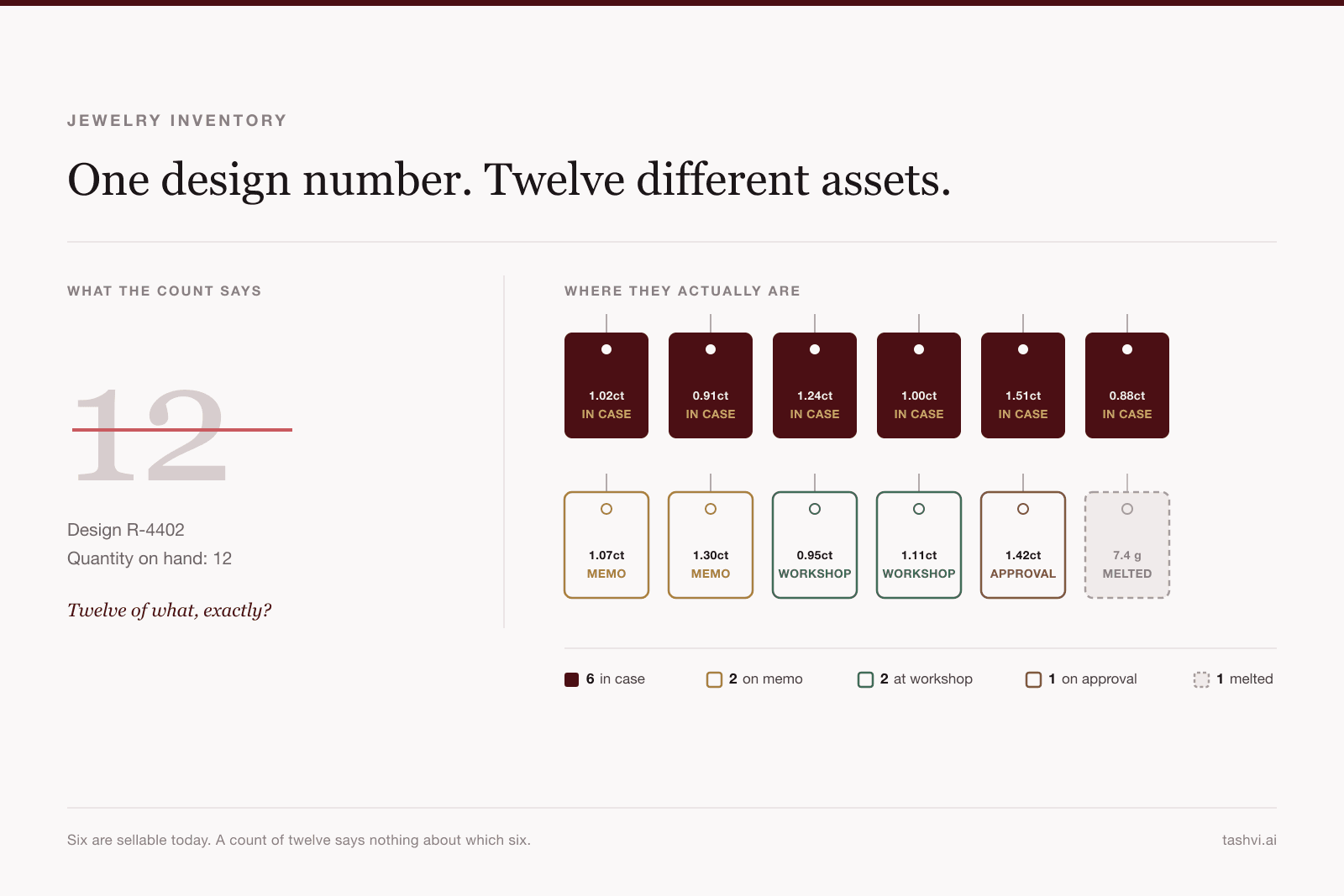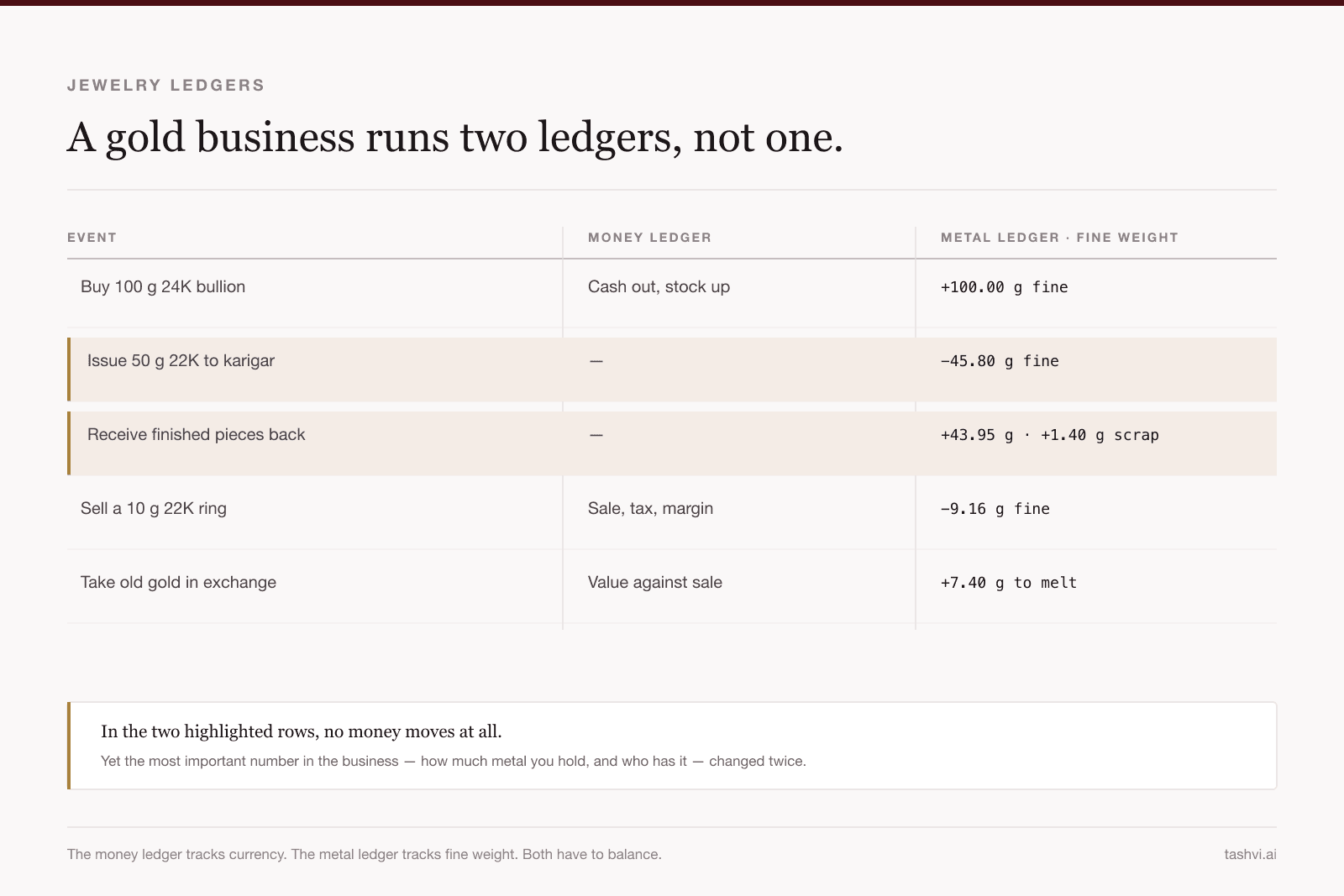
Jewelry Inventory in Excel: Where the Spreadsheet Actually Breaks
A jewelry inventory spreadsheet works fine until it doesn't. Here are the four specific points where Excel, Google Sheets, Shopify and QuickBooks stop being able to represent jewelry — and the test for whether you've hit them yet.
Most jewelry businesses start in a spreadsheet, and most of them should. A jewelry inventory Excel template is free, immediate, and for a certain shape of business it is genuinely sufficient. Advice that opens with "spreadsheets are unprofessional" is selling something.
The useful question is narrower: what exactly does a spreadsheet stop being able to represent, and how do you know when you have hit that point? There are four failure points. They are specific, they are testable, and none of them is about how many rows you have.
Where a spreadsheet still works
Be honest about the base case first. A jewelry inventory spreadsheet is fine when all of the following hold:
- One location, one person writing to it.
- You buy finished pieces and sell finished pieces. Nothing is manufactured.
- Nothing leaves the premises except by being sold.
- You price on a markup over what you paid, not on today's metal rate.
- Stones are part of the piece, not separately tracked stock.
That describes a lot of real businesses, particularly retailers of silver and fashion jewelry. If that is you, a free jewelry inventory spreadsheet will hold for years, and the rest of this article is about problems you do not have.
Breaking point 1: the second unit
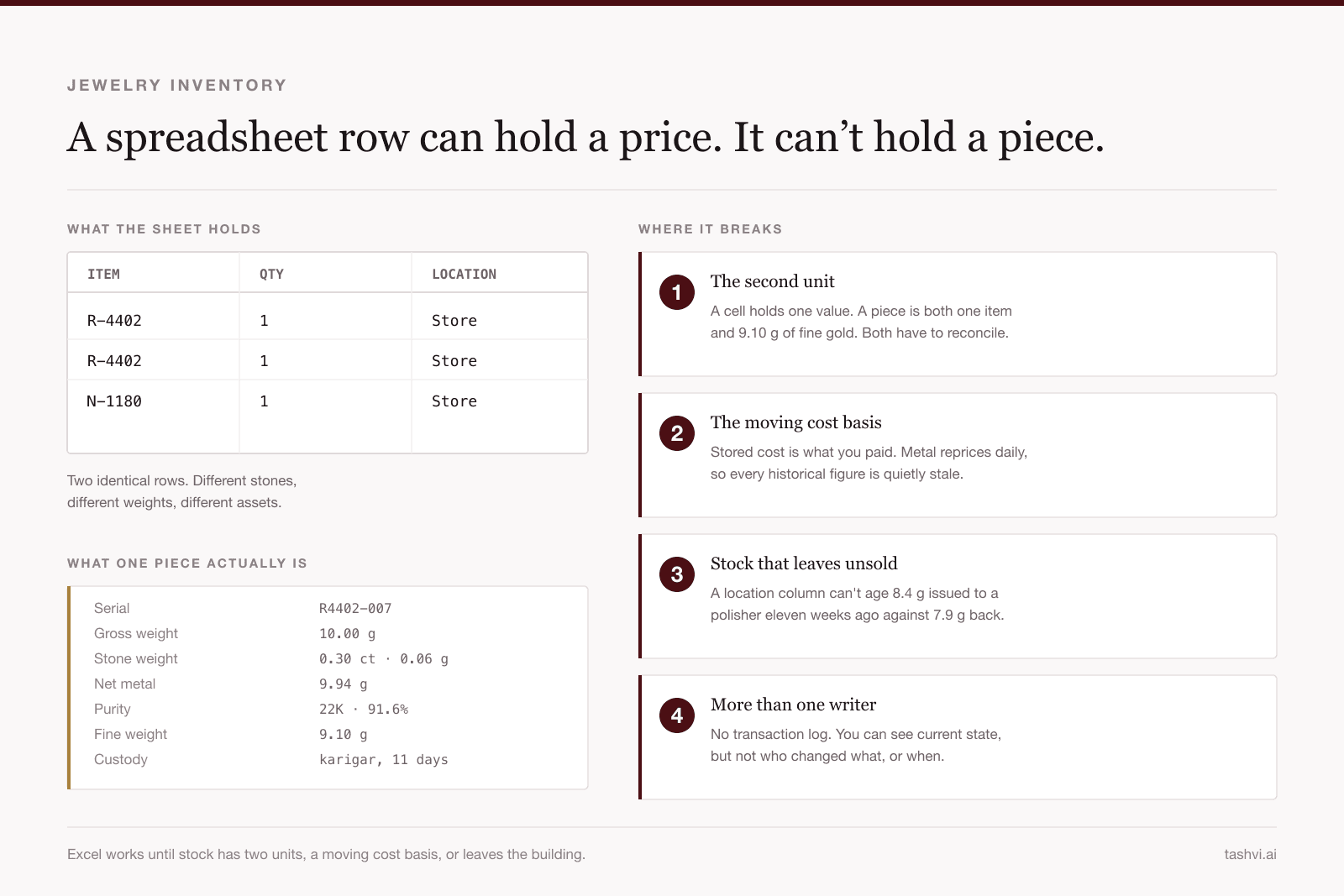
A spreadsheet cell holds one value. A piece of gold jewelry has to be counted in two units at once — as a piece, and as a quantity of fine metal.
Take a 10 g ring in 22K. It is one item of stock. It is also 9.16 g of fine gold, because 22K is 91.6% pure. Sell it and both facts change: the piece count drops by one, and your metal position drops by 9.16 g. Those two numbers reconcile against different things — the count against a physical inventory, the fine weight against your metal account and your refiner.
You can add columns for gross weight, purity, net weight and stone weight. People do. What you cannot easily do is make the sheet enforce that they stay consistent, because:
- Stones have to come out of gross weight to get metal weight, and stone weight is often estimated.
- Purity varies by piece, so fine weight is a per-row calculation, not a column-level one.
- Any manual edit to one column silently invalidates the others.
The test: can you produce your total fine gold holding, by karat, in under a minute, and would you bet the business on the number? If you would rather physically weigh everything than trust the sheet, the sheet has already stopped being your inventory record.
Breaking point 2: the cost basis that moves
This is the one people underestimate. In most retail, cost is a historical fact — you paid what you paid. In jewelry, a large share of the item's value is a commodity that reprices every day.
A spreadsheet stores what you paid. It cannot easily tell you:
- What that stock is worth at this morning's rate.
- Whether a piece from eighteen months ago is carrying unrealised gain or sitting below replacement cost.
- What it will cost to restock a piece you just sold.
You can build it — a rate cell, a VLOOKUP, a revaluation column. The problem is not that it's impossible, it's that it's manual, and manual revaluation is the first thing to stop happening when the shop is busy. A stale rate cell is worse than no rate cell, because it looks like an answer.
The test: when gold moved last month, did your margin reporting change? If it did not, you are reporting margin against a number that no longer means anything.
Breaking point 3: stock that leaves without being sold
Spreadsheets have a "location" column. Jewelry needs a custody state, which is a different thing — it carries a counterparty, a date, an expected return, and a weight out that has to be matched against a weight back.
At any moment pieces are legitimately absent because they are:
- Out with a karigar or workshop for setting, polishing or repair
- On memo or consignment with another retailer
- Out on approval with a customer
- At a hallmarking centre or grading lab
The "location" column collapses all of these into a text string. What it cannot do is age them. Nobody has ever opened a spreadsheet and been told that 8.4 g went to a polisher eleven weeks ago and 7.9 g came back. That is exactly the gap where metal quietly leaves a business, and it is invisible by construction.
The test: if you already keep a second sheet — a separate tab or a notebook — for what is out with karigars or on memo, the spreadsheet has already failed. You have built a shadow system to work around it.
Breaking point 4: more than one writer
This one is mundane and it is usually what actually forces the change. It is also the failure mode with the most research behind it: Raymond Panko's survey of the field, Spreadsheet Errors: What We Know, concludes that fifteen years of studies agree spreadsheet errors are both common and non-trivial, and that of the many proposed remedies only cell-by-cell code inspection has been demonstrated to work. Nobody inspects an inventory sheet cell by cell. A shared file with two people in it produces overwritten edits, conflicted copies, and a version everyone distrusts. Cloud sheets soften it but do not solve the underlying issue, which is that there is no transaction log — you can see the current state but not who changed what, when, or why.
For jewelry that matters more than for most categories, because the audit trail is the loss-prevention mechanism. A count that is short is only actionable if you can reconstruct custody.
Why Shopify and QuickBooks don't close the gap
These are the two most common next steps, and both solve a different problem than the one you have.
Shopify tracks units. Fulfil an order and a SKU count drops by one. It has no bill of materials in weight, so it does not deduct gold, silver or stones from a raw-material stock. For a retailer selling finished pieces this is fine. For anyone who makes jewelry it means finished-goods counts stay right while material stock drifts, which is why so many makers run a spreadsheet alongside Shopify rather than instead of it.
QuickBooks tracks inventory in units and values it in currency. Gold reconciles in fine weight. You can approximate karat handling with separate items per purity, but the metal account will not reconcile against a physical weigh-in without something sitting on top. QuickBooks is an accounting system that happens to hold inventory, not an inventory system.
There is an accounting dimension to this too. IAS 2 Inventories reserves FIFO and weighted-average cost formulas for goods that are ordinarily interchangeable, and requires specific identification of cost for those that are not. Tools that can only model interchangeable units are, by construction, modelling something jewelry is not.
Neither is a bad product. They are built on the assumption that a unit of a SKU is interchangeable with any other unit — which is the assumption jewelry breaks first.
The honest upgrade path
Moving off a spreadsheet is not one decision, and jumping straight to a full jewelry ERP is often premature. In rough order of cost and disruption:
- Fix the spreadsheet properly. One row per physical piece, never per design. Separate gross weight, stone weight, net weight and purity into their own columns. Add a custody column with a counterparty and a date out. This alone resolves a surprising number of problems.
- Add a dedicated register for what's out. If custody is your failure point and nothing else is, a disciplined issue-and-receipt register against karigars and memo partners fixes the actual leak.
- Move inventory to a system, keep accounting where it is. Most jewelry inventory software will hand off to your existing accounts package.
- Full ERP. Worth it when manufacturing, multiple locations, or a real metal ledger are in play.
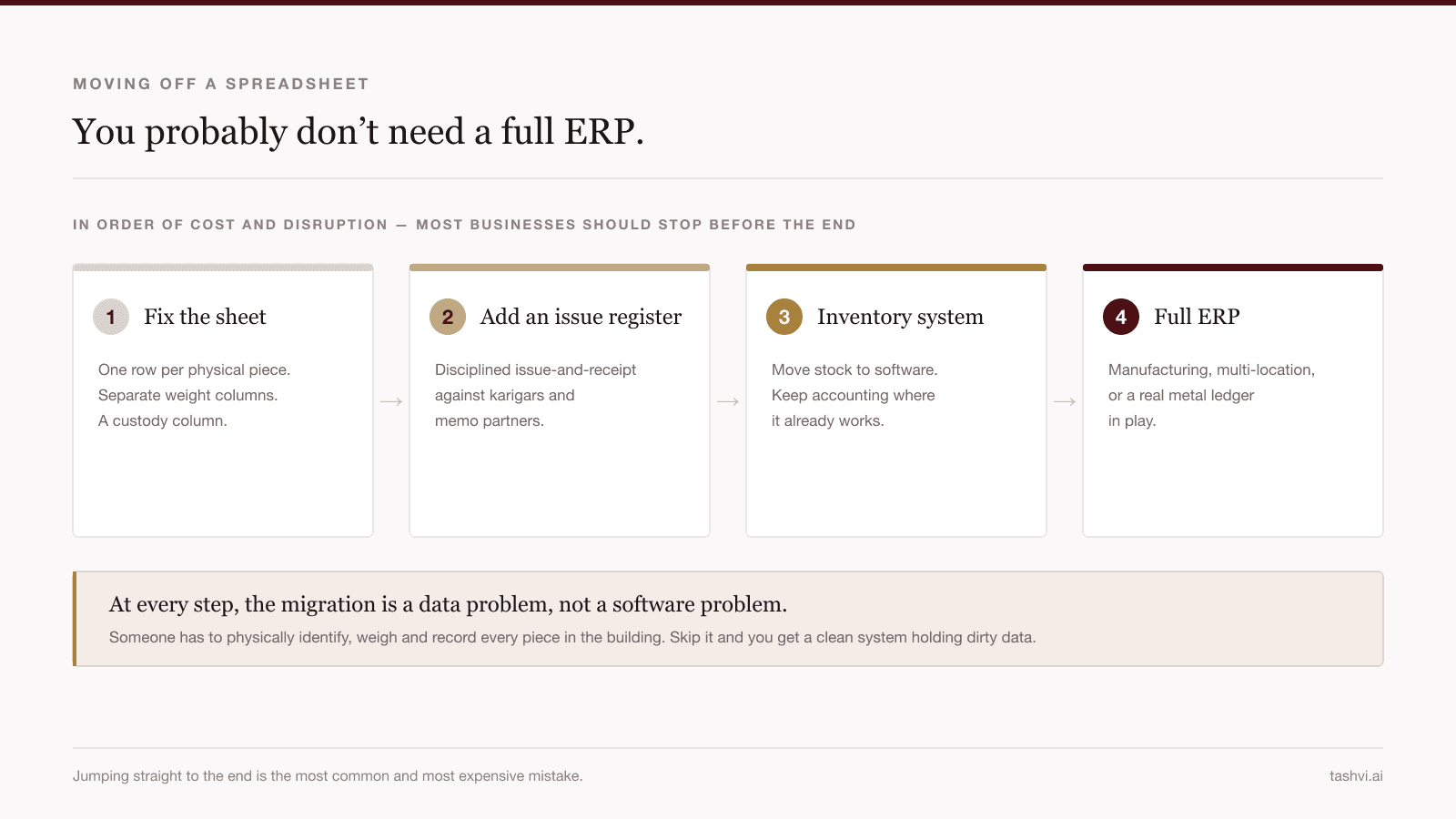
One caution that applies at every step: the migration is a data problem, not a software problem. Going from design-level counts to one record per physical piece means somebody physically identifies, weighs and records every item in the building. Businesses that skip that step arrive at a clean system holding dirty data and conclude, a year later, that the software does not work.
Where design fits
Everything above is about recording what already exists. The cheapest inventory problem is the piece you never made — stock that ages because it was commissioned before anyone tested whether there was demand for it.
Being able to see a design before committing metal to it is a merchandising control, not just a creative one.
Tashvi AI
See a piece before it becomes stock
Explore design variations in seconds and decide what's worth making. Free to start, no credit card.
Sources
- Raymond R. Panko — Spreadsheet Errors: What We Know. What We Think We Can Do
- IFRS Foundation — IAS 2 Inventories
Related reading
Frequently Asked Questions
Quick answers to the questions readers ask most about this guide.
Can I use Excel for jewelry inventory?
Yes, up to a point. A spreadsheet handles a single-location business with finished pieces bought in and sold out, no manufacturing, and no consignment. It stops working when you need to track the same stock in two units at once (pieces and fine weight), when metal rate movement makes every stored cost stale, when pieces leave your possession without being sold, or when more than one person needs to write to the file at the same time.
Why doesn't Shopify inventory work for jewelry?
Shopify decrements a SKU count when an order is fulfilled. It does not deduct the gold weight or the stones from a raw-material stock, because it has no concept of a bill of materials in weight. For a maker or manufacturer this means finished-goods counts stay correct while material stock silently drifts, which is why most jewelry sellers end up running a spreadsheet alongside Shopify.
Can QuickBooks track jewelry inventory by weight?
Not natively. QuickBooks tracks inventory in units and values it in currency. Gold is bought and reconciled in fine weight, and purity converts gross weight to fine weight differently for every karat. You can approximate it with separate items per karat, but the metal account will not reconcile against physical weight without a layer on top.
When should a jeweler move off a spreadsheet?
Practical signals: you have started keeping a second sheet to track what is out with karigars or on memo, you cannot answer what your stock is worth at today's metal rate without rebuilding a column, your physical count and your sheet disagree by an amount you cannot explain, or two people have overwritten each other's edits. Any one of these means the spreadsheet has stopped being the record.