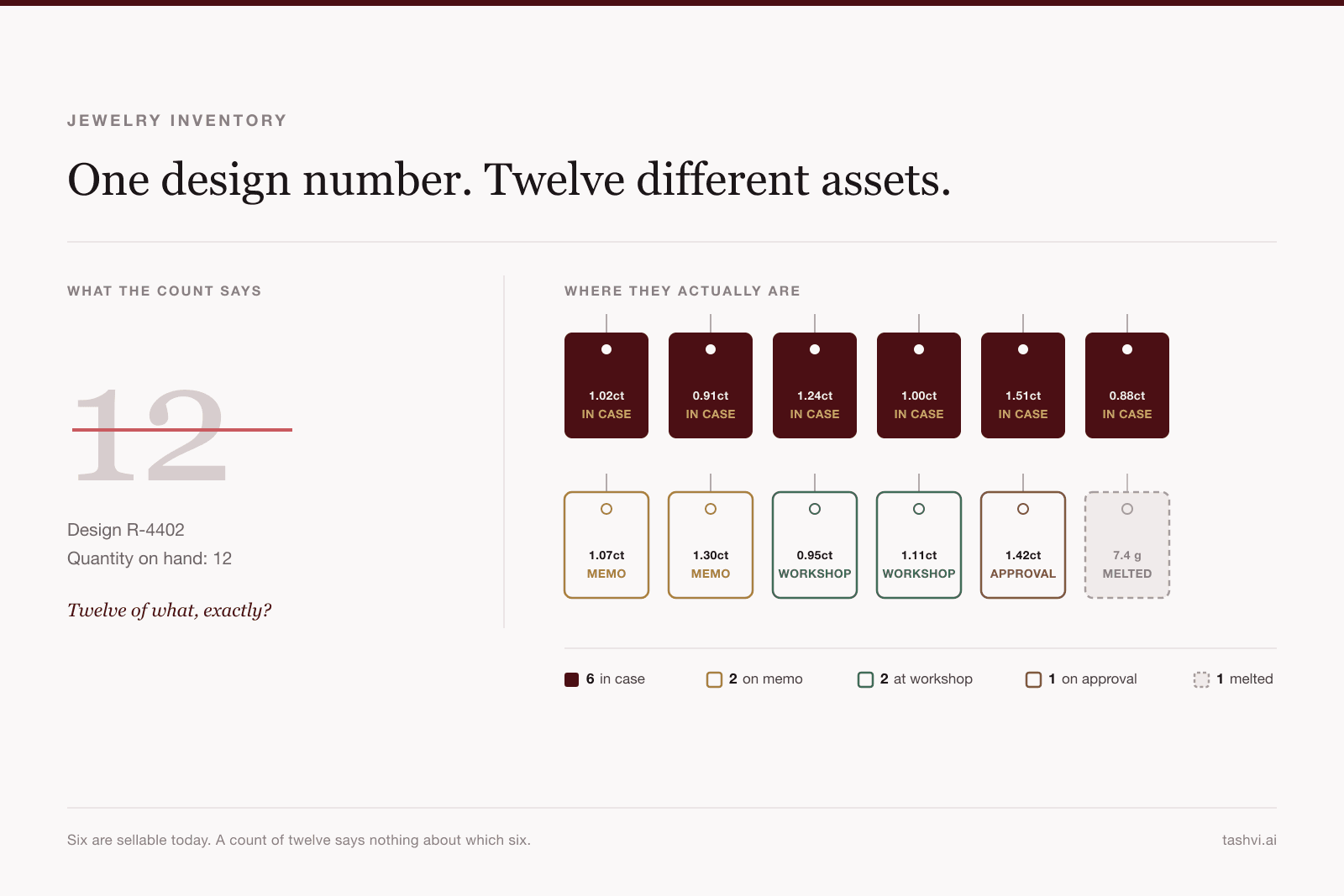
Jewelry Ledger Software: Why a Gold Business Runs Two Ledgers, Not One
Every jewelry business keeps a money ledger. The ones that stay solvent also keep a metal ledger, denominated in fine weight. Here is how the two work, where karigar and customer accounts sit, and what goes wrong when only one of them exists.
Ask a jeweler whether the books balance and you will usually get an answer about money. Ask whether the metal balances and the conversation changes, because that is a separate question with a separate answer, and it is the one that tends to reveal where a business is losing value.
A jewelry business is two businesses running through the same till. It is a retail business that takes money and gives goods. It is also, simultaneously, a metal business that holds, transforms and owes quantities of a commodity. Those need two ledgers, and jewelry ledger software exists because general accounting software only models the first.
Two ledgers, two currencies
The money ledger is the one everybody has: sales, purchases, receivables, payables, tax, denominated in currency. Standard accounting software handles it.
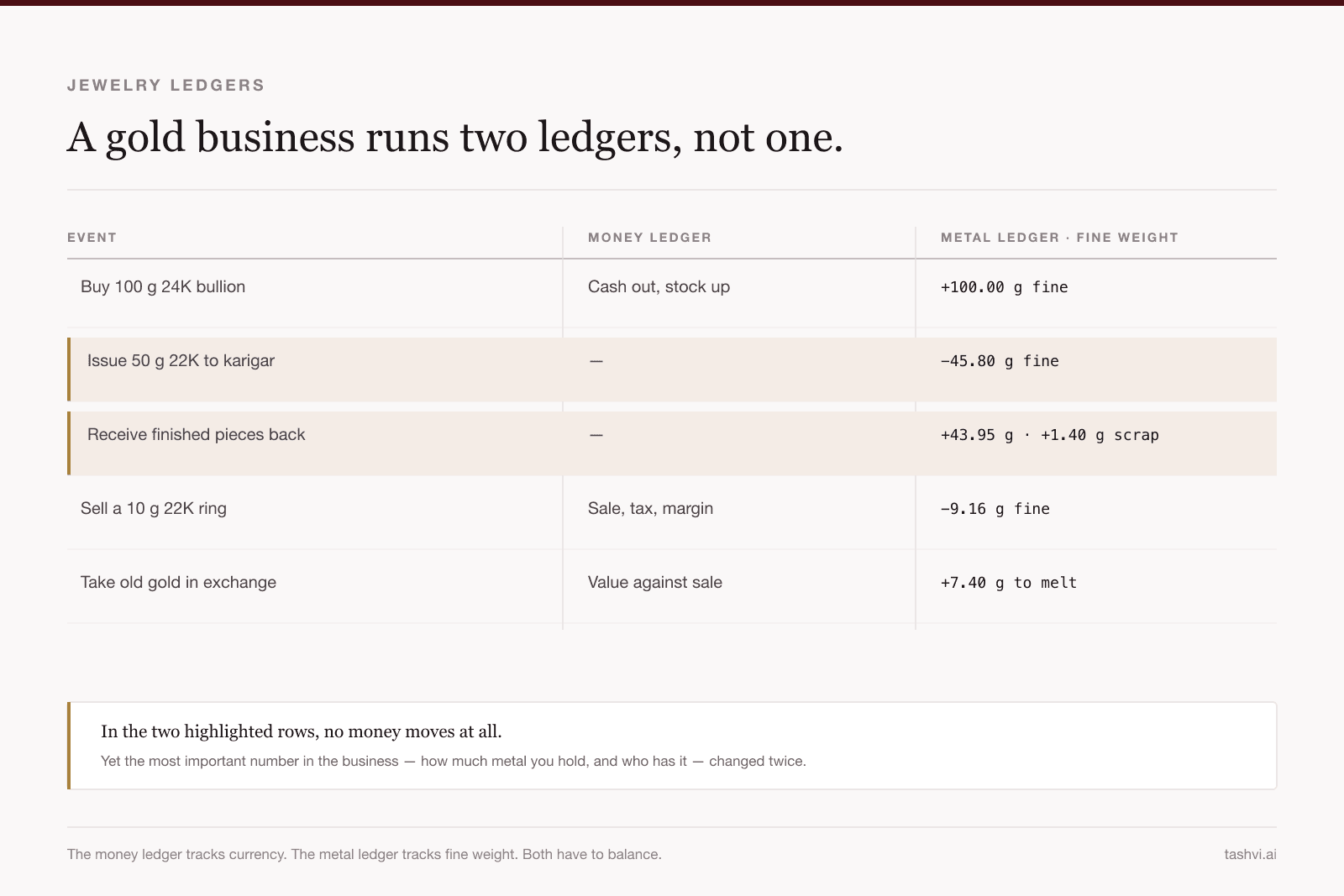
The metal ledger is denominated in fine weight — grams of pure metal, karat stripped out. Every physical movement of gold produces an entry in it, whether or not money changed hands:
| Event | Money ledger | Metal ledger |
|---|---|---|
| Buy 100 g of 24K bullion | Cash out, stock up | +100.00 g fine in |
| Issue 50 g 22K to a karigar | (nothing) | −45.80 g fine, to karigar account |
| Receive finished pieces back | (nothing) | +43.95 g fine, +1.40 g scrap |
| Sell a 10 g 22K ring | Sale, tax, margin | −9.16 g fine out |
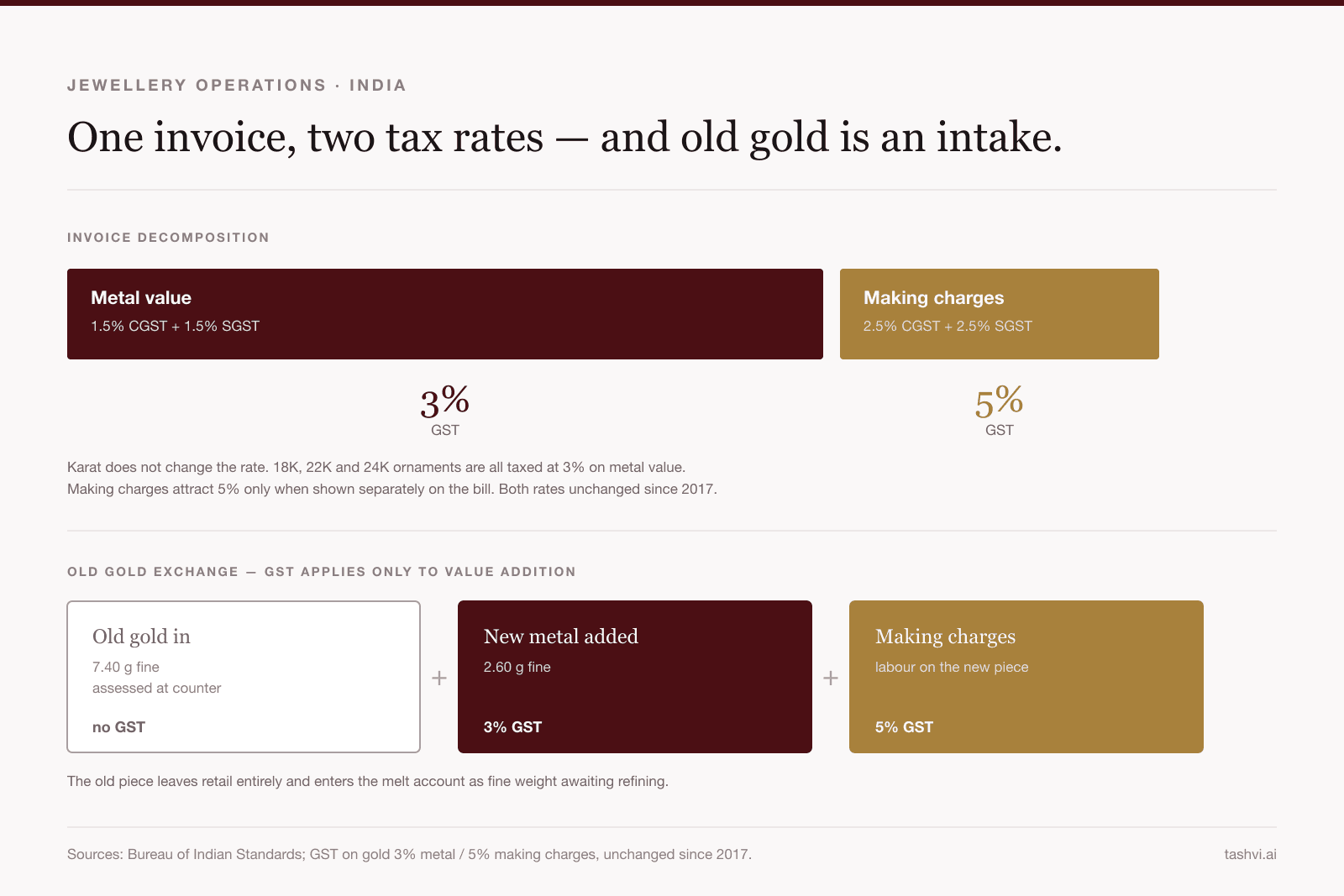
| Take old gold in exchange | Value against sale | +7.40 g fine, to melt account |
Look at rows two and three. No money moves at all, and yet the most important number in the business — how much metal you actually have, and who is holding it — changed twice. A system that only records transactions when cash moves is blind to exactly the movements where metal goes missing.
Fine weight is the unit, not gross weight
The metal ledger only works if everything is converted to fine weight before it is posted. Gross weight is not comparable across karats:
- 10 g of 22K = 9.16 g fine (91.6% pure)
- 10 g of 18K = 7.50 g fine (75%)
- 10 g of 14K = 5.83 g fine (58.5%)
Three pieces of identical gross weight represent three different quantities of the same commodity. Add them together as "30 g" and the number is meaningless. This is why a karat column is not optional decoration on a stock report — it is what makes the arithmetic valid.
This is not a jewelry-shop eccentricity; it is how the metal trades at the top of the market. The LBMA Good Delivery technical specifications require every acceptable gold bar to carry its own serial number, an assay mark and a fineness stamped to four significant figures, and define the bar by its fine gold content — a minimum of 350 and a maximum of 430 fine troy ounces. A list of bars is the sum of individually weighed and assayed fine contents, not a count of bars.
Stones complicate it further, because stone weight sits inside gross weight and has to be removed before conversion. A 12 g ring holding 1.5 ct of diamonds is carrying roughly 0.3 g of stone, so the metal is 11.7 g gross, and the fine weight follows from that. Systems that skip the stone deduction overstate the metal position on every set piece in the building.
Karigar accounts are metal accounts
The karigar ledger — the account held against a goldsmith or workshop — is where the metal ledger earns its keep. It is a running balance in grams, not rupees:
- Issue. Fine weight goes out against a job order, dated, with the job identified.
- Receipt. Finished pieces come back and are weighed. Fine weight in.
- Scrap return. Filings, offcuts and sweeps come back separately and are weighed.
- Wastage. What is left over is the loss, expressed as a percentage of the weight issued.
Issue 50.00 g. Receive pieces totalling 46.00 g and scrap of 2.00 g. Unrecovered metal is 2.00 g, or 4.0% of the weight issued.
For scale: wastage on 22K work typically runs 3% to 7% depending on design complexity, rising to 6–12% on 18K where finer detailing and alloy mix increase loss. India's export norms are far tighter — DGFT Public Notice 30/2024-25, effective 1 January 2025, allows 2.25% on handcrafted plain gold and platinum and just 0.45% on mechanised. Those are regulatory ceilings for export, not a description of bench reality.
The single number is not that interesting. The series is. Once you have a few months of it, every craftsman has a normal range, and the value of the ledger is that it makes an abnormal one visible. A karigar whose wastage drifts from 4% to 8% over two quarters is either working with a different metal, changing technique, or something else is happening — and without a metal account, that drift is invisible. It looks like rounding.
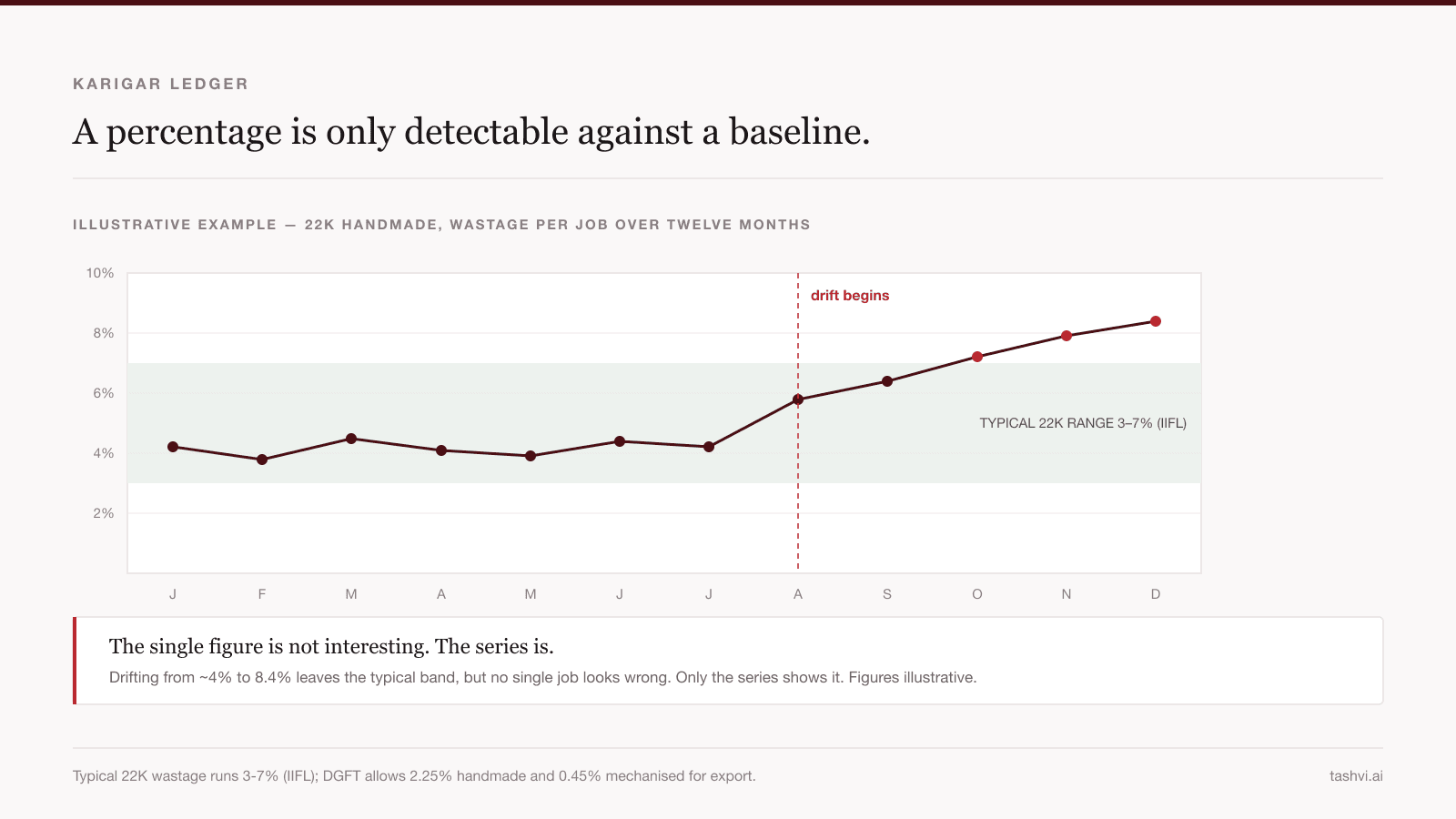
This is the practical argument for the whole apparatus. Losses in a jewelry business are rarely a single dramatic event. They are a slow percentage, and a percentage is only detectable against a baseline.
Customer accounts held in metal
The customer khata is a running account, and in jewelry it frequently is not denominated in money at all. Common cases:
- Old gold left against a future order. The customer has deposited metal, not cash. What they are owed is a quantity, and its value moves with the rate.
- Advance bookings at a fixed rate. The customer has locked a price. You have taken on rate exposure until the piece is delivered.
- Gold savings schemes. Instalments paid over months, converted to metal at each payment or at maturity depending on the scheme's terms.
- Credit against returns and exchanges.
Every one of these is a liability that changes value without any transaction occurring. Held only in the money ledger as a rupee figure, they quietly become wrong the moment gold moves. Held in the metal ledger as a weight, they stay correct and can be revalued at will.
The melt account closes the loop
Jewelry is one of the few categories where inventory is legitimately destroyed as part of normal operations. Old gold comes in, unsold designs are broken up, scrap accumulates and goes to a refiner.
The melt account is where pieces stop being pieces and become weight again:
- An item record is closed. Its fine weight moves to the melt account.
- Scrap and sweeps accumulate against the same account.
- The lot goes to a refiner. Some percentage comes back as usable metal.
- The refining loss is the difference, and it should sit inside a known range.
Run this properly and metal is conserved on paper the way it is in physics. Every gram is accounted for as stock, as work in progress with a named karigar, as sold, or as a documented loss. That total is the thing you can actually audit.
Where the two ledgers meet
They reconcile at valuation. The metal ledger says how much fine metal you hold and where it is. The money ledger says what the business is worth. Connecting them requires a rate, and which rate is a real decision:
- Cost rate — what you paid. Stable, comparable across periods, and increasingly fictional as time passes.
- Market rate — today's. Accurate for replacement and insurance, volatile for reporting.
- Average rate — a weighted average of acquisitions. Usually the compromise, and the one most accounting standards point toward.
This is also where accounting standards have something to say. IAS 2 Inventories permits FIFO or weighted-average cost for interchangeable goods, requires specific identification for those that are not, and requires the same formula to be applied consistently to inventories of similar nature and use. It also caps carrying value at the lower of cost and net realisable value.
The point is not that one is correct. It is that the choice has to be explicit and consistent, and that you should be able to produce the position on any of them. A business that can only report at cost has no idea what it is holding.
What breaks with only a money ledger
If everything above sounds like overhead, these are the specific failures it prevents. Each is common:
- Karigar drift goes unnoticed because wastage is never computed against a baseline.
- Old gold is undervalued or overvalued at intake, because there is no metal account to post it against.
- Aged stock is reported at cost while replacement cost has moved, so margin reporting is confidently wrong.
- Advance bookings quietly become loss-making when the rate moves against a locked price nobody is tracking.
- A physical count cannot be reconciled because there is no expected weight to compare it to — only an expected count, which tells you nothing about metal.
- Refining loss is invisible, so an abnormal recovery percentage never gets questioned.
None of these announce themselves. They surface as a business that is somehow less profitable than the margins suggest it should be.
What to look for
If you are evaluating jewelry ledger software or an inventory system with a metal account, these are the load-bearing capabilities:
| Capability | Why it matters |
|---|---|
| Fine weight as a native unit | Gross weight across karats does not add up |
| Automatic purity conversion | Per-piece calculation, not a column default |
| Stone weight deduction | Otherwise every set piece overstates metal |
| Karigar accounts with issue/receipt/wastage | The only way drift becomes visible |
| Customer accounts denominated in metal | Rate-exposed liabilities stay correct |
| Melt and refining reconciliation | Closes the loop; makes loss auditable |
| Selectable valuation basis | Cost, market and average all have uses |
| Immutable transaction log | The audit trail is the loss prevention |
A system that holds metal only as a text field on a stock record is a money ledger with a weight column, which is not the same thing.
Where design fits
The metal ledger tells you what you hold. It does not tell you what you should have made. Stock that ages into scrap was commissioned before anyone tested whether there was appetite for it — and every gram that goes through the melt account once was a decision made too early.
Tashvi AI
Decide before the metal is committed
Explore and compare design directions in seconds, so the pieces you commission are the ones worth making. Free to start.
Sources
- London Bullion Market Association — Good Delivery Rules: technical specifications
- IFRS Foundation — IAS 2 Inventories
- IIFL — Gold making charges and wastage percentage
- DGFT — Public Notice 30/2024-25: revised wastage limits for jewellery exports
Related reading
Frequently Asked Questions
Quick answers to the questions readers ask most about this guide.
What is a metal ledger in a jewelry business?
A metal ledger is an account denominated in fine weight rather than currency. It records grams of pure metal in and out — received from suppliers, issued to karigars, returned as finished pieces, recovered from scrap and old gold, and sold. It runs in parallel with the money ledger, and a jewelry business is only reconciled when both balance.
Why do jewelers keep accounts in grams instead of currency?
Because metal is the underlying commodity and its price moves daily. If a karigar is issued 50 g and returns pieces weighing 46 g plus 2 g of scrap, the 2 g difference is the fact that matters, and it is the same fact whether gold rose or fell that week. Recording the transaction only in currency loses the physical quantity and makes the loss impossible to see.
What is a karigar ledger?
A karigar ledger is a metal account held against an individual goldsmith or workshop. It records fine weight issued for a job, fine weight received back as finished pieces, weight returned as scrap and filings, and the resulting wastage. Over time it shows each craftsman's normal wastage percentage, which is what makes an abnormal one visible.
What is a customer khata in a jewelry shop?
A khata is a running customer account. In jewelry it can be denominated in money, in metal, or both — a customer may hold a credit balance in rupees, a quantity of old gold left against a future order, or instalments paid into a savings scheme. Accounts held in metal have to be revalued as rates move, which is why they belong in the metal ledger rather than only in accounts receivable.