How to Run a Jewelry Stocktake Without Closing the Store
The annual full count is the worst way to verify jewelry stock — slow, disruptive, and too late to act on what it finds. Here is how to run a rolling count by zone, reconcile by weight as well as by piece, and investigate a variance properly.
The traditional jewelry stocktake is a bad process that persists because it feels rigorous. Close on a Sunday, bring everyone in, count everything, reconcile against the register, find a discrepancy, and then try to work out what happened over the preceding twelve months.
The problem is not the counting. It is the detection time. Discovering in March that something went missing at some point since last March is nearly useless — the custody trail is cold, the staff rota is a memory, and nobody can reconstruct who handled the piece. A count that takes a year to close the loop is an accounting exercise, not a control.
What follows is how to get the same assurance with far shorter detection time and without closing.
Cycle counting: the shape of the alternative
Cycle counting verifies a subset of stock on a rotating schedule, so everything is checked several times a year and no single session shuts the business.
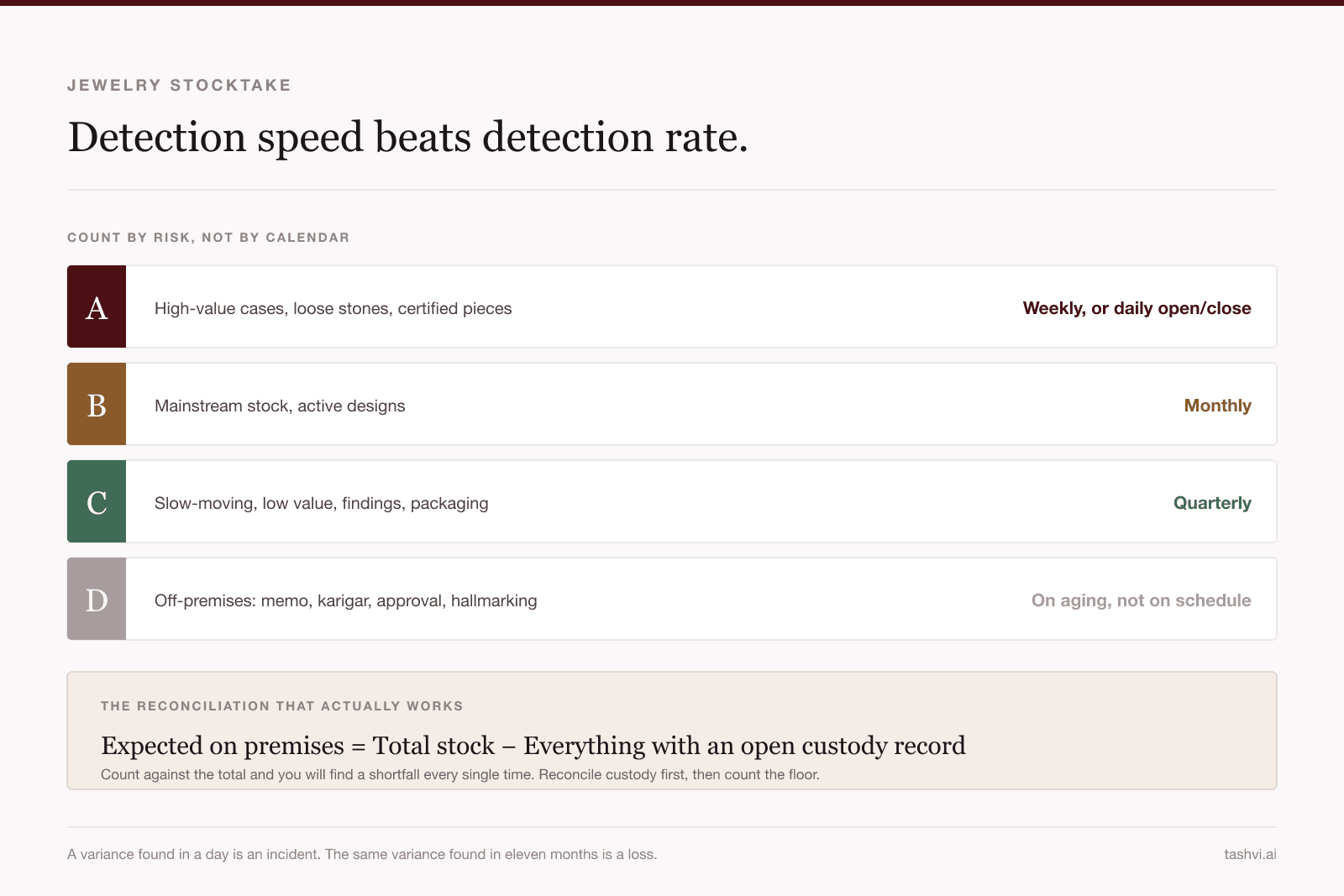
Divide stock by risk rather than by convenience. A workable split:
| Tier | What's in it | Count frequency |
|---|---|---|
| A | High-value cases, loose stones, certified pieces | Weekly, or daily open/close |
| B | Mainstream stock, active designs | Monthly |
| C | Slow-moving, low-value, packaging and findings | Quarterly |
| D | Off-premises: memo, karigar, approval, hallmarking | On aging, not on schedule |
Tier A is not really a stocktake — it is an open-and-close verification of the cases that carry most of the value, and it takes minutes. That single habit closes detection time from twelve months to one day for the stock that matters most.
Tier D is different in kind and gets its own section below, because it is where most unreconciled counts actually come from.
Reconcile in two units
A jewelry count that produces one number is only doing half the job. You need two reconciliations, and they catch different failures:
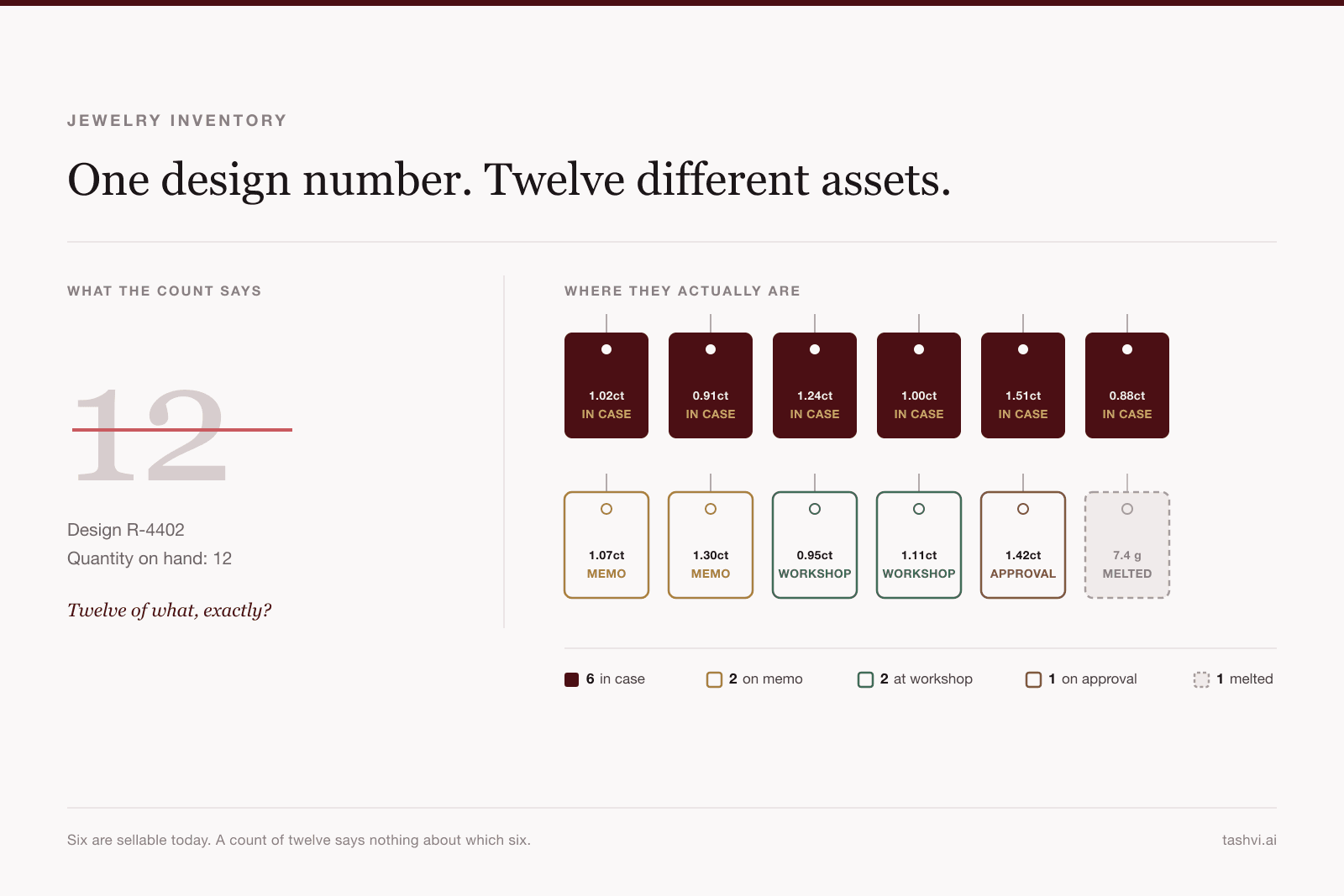
Pieces against the item register. Every physical piece matched to its record by its own identifier — not by design number. This is what tells you which item is missing rather than that the count is off by one. If your stock is recorded at design level rather than serialized per piece, this reconciliation is not available to you and the count cannot do its main job.
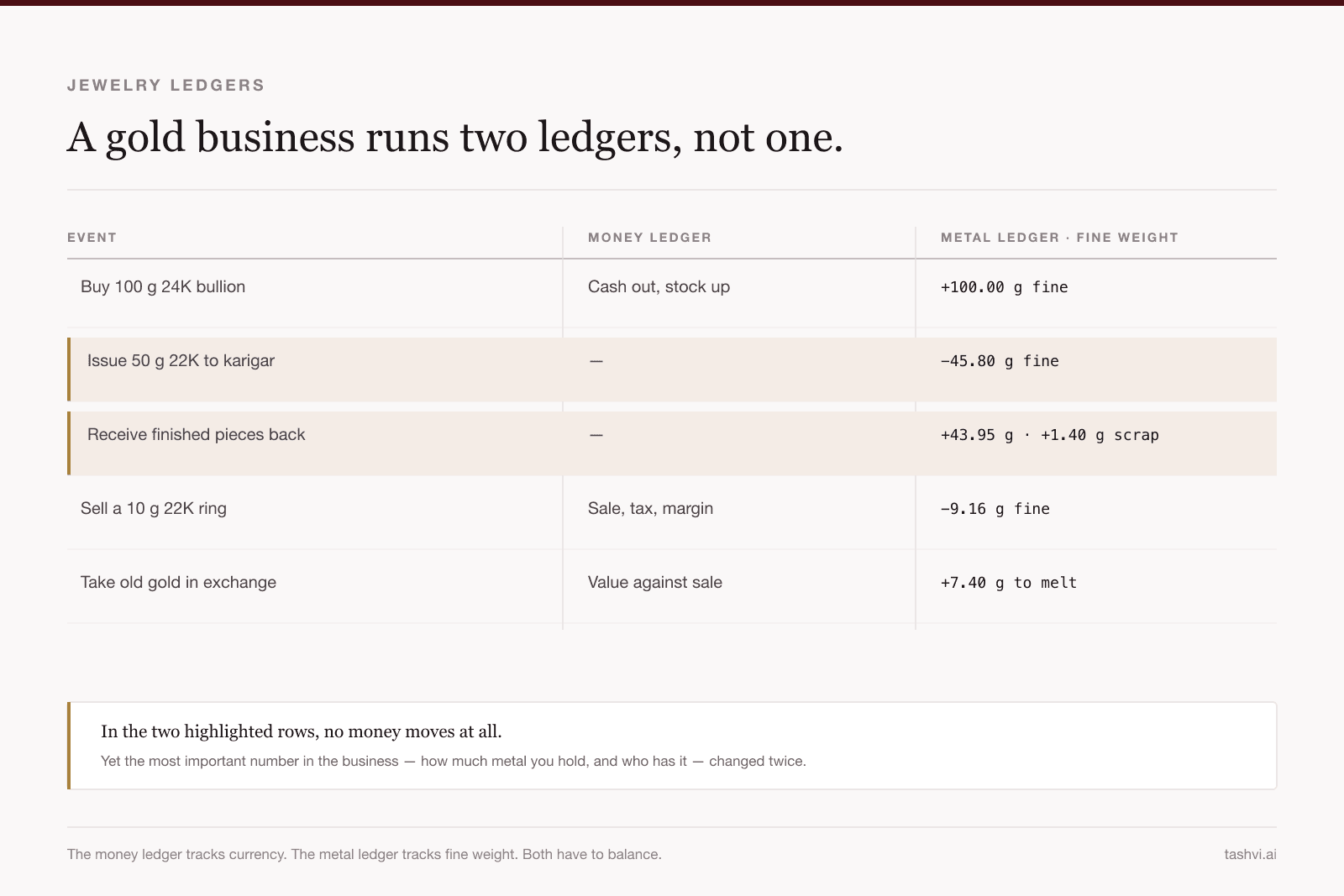
Fine weight against the metal account. Total fine weight on the shelf compared with what the metal ledger says should be there. This catches what a piece count cannot: a piece that is present but altered, a substitution, or a stone quietly swapped.
Neither alone is sufficient. A count says the ring is there. A weight says the ring is the right ring.
The absent-but-legitimate problem
This is the single biggest reason jewelry counts fail to reconcile, and it is a records problem rather than a counting problem.
At any moment, stock you own is not on the premises:
- Out with a karigar or workshop
- On memo or consignment with another retailer
- Out on approval with a customer
- At a hallmarking or assaying centre
- At a grading laboratory
- Out for repair
Compare shelf contents against total stock and you will find a shortfall every single time, then spend hours reconstructing which absences were legitimate. The fix is to count against an expected-on-premises figure — total stock minus everything with an open custody record.
Which means the custody records have to be right before you start counting. In practice, run the off-premises reconciliation first: pull everything with an open custody state, confirm each one is genuinely where the record says, and only then count the floor. Items that have been at a polisher for eleven weeks are found by this step, not by the count.
Running the count itself
A few things that make the difference between a count that produces a usable number and one that produces an argument:
Freeze movement, don't stop trading. Count a zone while it is closed to movement rather than closing the store. Anything sold mid-count is recorded and reconciled against the count sheet afterwards.
Two people, blind. The person counting should not be able to see the expected figure. A count sheet pre-printed with quantities produces confirmation, not verification. Blind counts find things.
Never count against the count. The person who normally has custody of a case should not be the sole counter for it.
Weigh, don't assume. Take the weight from your scale. An item record's stored weight is what you are testing, not an input to the test.
Record the date and the counter. A variance is only investigable if you know when the last clean count was and who performed it.
Investigating a variance
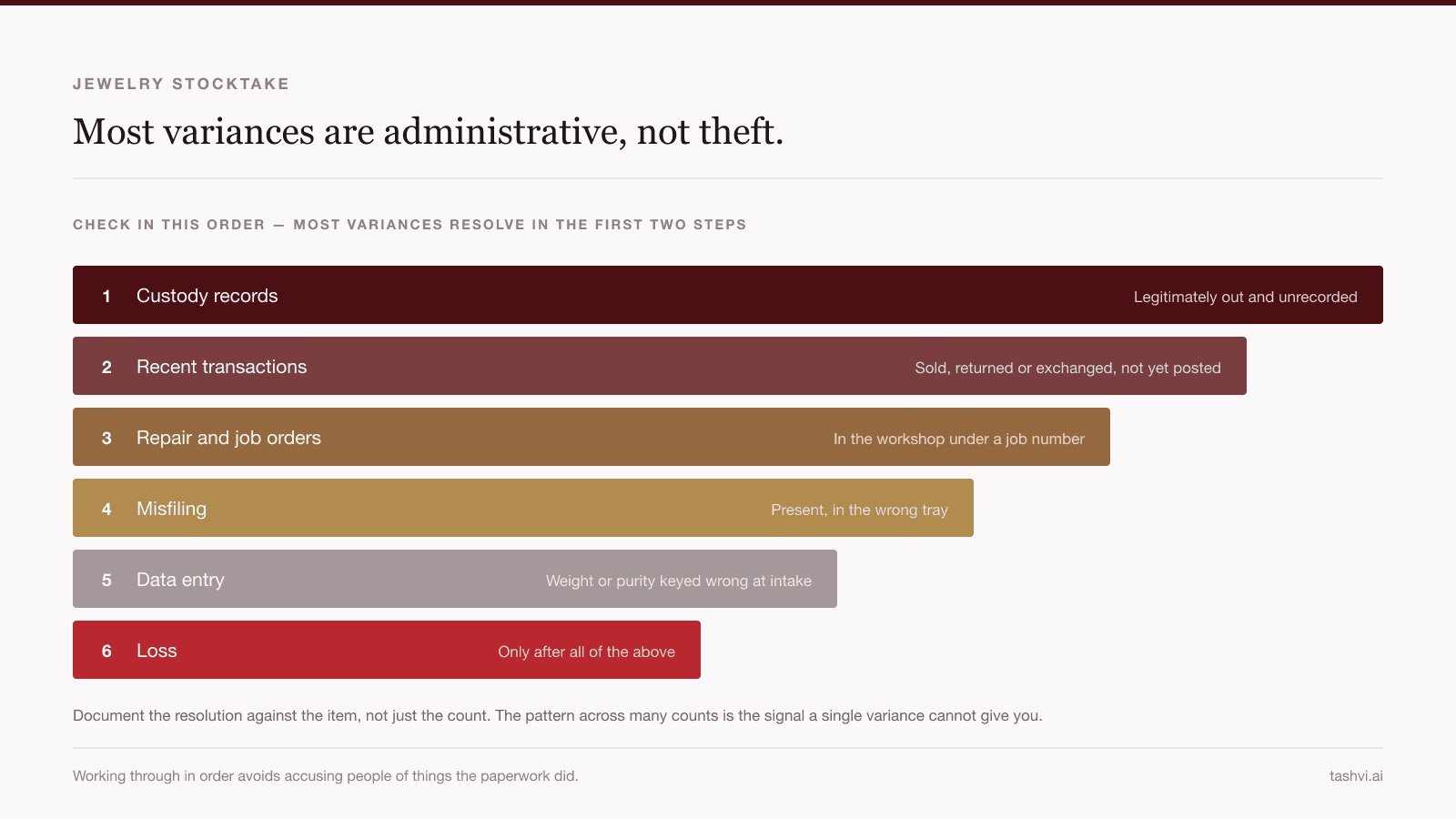
Most variances are administrative, not theft, and working through them in order avoids accusing people of things the paperwork did. Check in this sequence:
- Custody records. Is the piece legitimately out and unrecorded? By far the most common answer.
- Recent transactions. Sold, returned, or exchanged and not yet posted.
- Repair and job orders. In the workshop under a job number rather than as stock.
- Misfiling. Physically present in the wrong case or the wrong tray. Common with similar designs.
- Data entry. Weight or purity keyed incorrectly at intake, so the expected figure was always wrong.
- Only then, loss.
Document the resolution against the item, not just the count. The pattern across many counts is the useful signal — a particular zone, shift or supplier recurring across several investigations tells you something no single variance can.
What "acceptable variance" actually means
There is no universal acceptable figure, and adopting one is the mistake. The National Retail Federation's 2023 National Retail Security Survey put average retail shrink at 1.6% of sales in FY 2022, up from 1.4%, representing about $112.1 billion across US retail.
There is a jewelry-specific figure worth putting beside it. The Jewelers' Security Alliance 2025 Annual Crime Report recorded $144.7 million in total losses from crimes against US jewelry firms across 1,233 crimes — a 13% fall in the number of crimes from 1,420 in 2024, but a slight rise in dollars from $142.5 million. On-premises burglaries caused more loss than any other category despite falling from 305 to 262 incidents. JSA attributes part of the divergence to gold moving from roughly $2,500 to $4,500 an ounce over the year.
Fewer incidents, higher losses. That pattern is the whole argument for severity over frequency. The NRF figure, by contrast, is an all-retail average and should not be read across to jewelry directly. Jewelry usually has better physical controls — locked cases, small teams, high scrutiny. What it has instead is severity. The same percentage applied to jewelry's unit values is a completely different number, and a single unexplained absence can exceed a general retailer's entire monthly shrink allowance.
The practical implication is the one this whole article turns on: in jewelry, detection speed matters more than detection rate. A variance found within a day, with a custody trail showing who last held the piece, is an incident you can resolve. The same variance found eleven months later is simply a loss.
Documentation worth keeping
Count records serve a second purpose beyond stock accuracy. For insurance claims, and for demonstrating that records are maintained and retrievable, what matters is:
- Date, zones covered, and who counted
- Expected versus actual, in pieces and in fine weight
- Variances and how each was resolved
- Photographs and certificate references for high-value pieces
- The custody position at the time of the count
Keep these as a series. A single count proves very little; a consistent run of them is what establishes that the business has control of its stock.
Where design fits
A count tells you what you have. It has nothing to say about whether you should have made it — and the pieces that turn up in every count, year after year, unsold, were commissioned before anyone tested the demand.
Tashvi AI
Fewer pieces that sit in the case
Explore design directions and decide what's worth making before it becomes stock you have to count. Free to start.
Sources
- National Retail Federation — 2023 National Retail Security Survey
- Jewelers' Security Alliance — 2025 Annual Crime Report
Related reading
Frequently Asked Questions
Quick answers to the questions readers ask most about this guide.
How often should a jewelry store do a stocktake?
Rather than one annual full count, most jewelry businesses are better served by cycle counting — verifying a defined zone or category on a rotating schedule so everything is counted several times a year and no single count closes the store. High-value cases warrant weekly or daily verification; slow-moving categories can be quarterly. The goal is short detection time, not comprehensive coverage on one date.
Why do jewelry counts never reconcile?
Usually because items that are legitimately absent were never recorded as absent. Pieces out with a karigar, on memo with another retailer, out on approval, at a hallmarking centre or in for repair are still your stock but not on your premises. A count that compares shelf contents against total stock will show a shortfall every time. Reconciling requires an expected-on-premises figure, not a total.
Should a jewelry stocktake count pieces or weigh them?
Both. Counting pieces verifies item identity; weighing verifies metal. A count alone will not detect a substituted or altered piece, and a weight alone will not tell you which item is missing. Reconciling in two units — pieces against the item register and fine weight against the metal account — is what makes a jewelry count meaningful.
What is an acceptable variance in a jewelry stocktake?
There is no universal figure, and treating one as acceptable is the mistake. What matters is establishing your own normal range and investigating departures from it. Given jewelry's per-unit value, a variance that would be a rounding error in general retail can be a significant loss — the NRF put average retail shrink at 1.6% of sales in FY 2022, and the same percentage against jewelry's unit values is a very different number. The Jewelers' Security Alliance recorded $144.7 million of crime losses across 1,233 incidents in 2025 - fewer crimes than 2024, but higher total losses.