Understanding Hallmarks and Purity Stamps on Jewelry
Decode the hallmarks and purity stamps on gold, silver, and platinum jewelry to verify authenticity, metal content, and origin at a glance.
Hallmarks and purity stamps are tiny markings pressed into precious metal jewelry that reveal the metal's exact composition, the manufacturer's identity, and often the place and year of production. Learning to read these stamps gives you the ability to verify any piece of jewelry at a glance.
Every reputable jeweler, whether working with gold, silver, or platinum, follows a hallmarking tradition that stretches back centuries. These small impressions carry enormous weight. They separate authenticated fine jewelry from unverified pieces, and they protect buyers from misrepresentation. Whether you are shopping for an engagement ring, evaluating an inherited bracelet, or building a collection, understanding hallmarks is one of the most practical skills you can develop.
The History and Purpose of Hallmarking
The practice of hallmarking precious metals dates back to 1300 in England, when King Edward I enacted a statute requiring all gold and silver items to be tested by "the Guardians of the Craft" before sale. The Worshipful Company of Goldsmiths began testing and marking items at Goldsmiths' Hall in London, and the term "hallmark" itself derives from this location. France established its own system in 1275, making it one of the earliest hallmarking nations, and by the 16th century most major European trading centers had adopted similar protections.
The fundamental purpose of a hallmark has never changed. It guarantees that the metal content of a piece matches what the seller claims. Before hallmarking became widespread, unscrupulous traders would sell base metals disguised as gold or silver, defrauding buyers who had no reliable way to test purity on their own.
Today, hallmarking systems exist across the globe. Some countries mandate hallmarks by law, while others rely on voluntary compliance or trade guidelines. Regardless of the legal framework, a proper hallmark remains one of the strongest indicators of jewelry authenticity.
Tashvi AI
See your design in 14K, 18K, or platinum before you buy
Design a piece once and render it in any metal and purity — photorealistic, free, in seconds. Know exactly what that hallmark will stand for on your finger.
Components of a Complete Hallmark
A full hallmark typically consists of several distinct marks stamped side by side. Each mark communicates a specific piece of information about the jewelry. Understanding what each component represents makes the entire system easy to decode.
The Purity or Fineness Mark
The purity mark is the most critical element. It tells you the exact proportion of precious metal in the alloy, which is why changing the karat of a design changes the mark on the finished piece. This number is expressed using the millesimal fineness system, which represents purity in parts per thousand. For example, a stamp reading 750 means the piece contains 750 parts pure gold out of 1,000 total parts, or 75 percent gold.
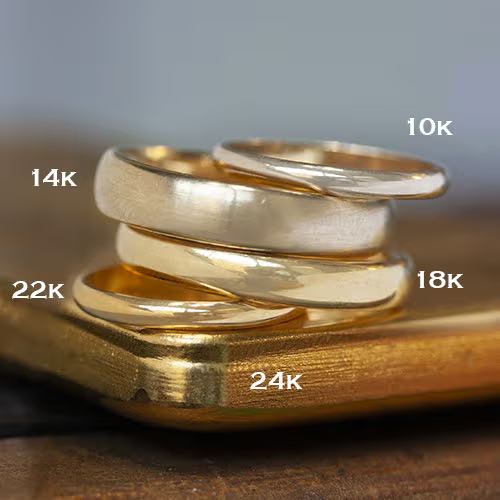
This system is now the international standard and has largely replaced older conventions like the karat system in official hallmarking, though karat stamps such as 14K or 18K remain common in the United States. You can learn more about how karats translate to purity levels in our guide on types of gold from 10K through 24K.
The Maker's Mark or Sponsor's Mark
The maker's mark identifies the person or company responsible for sending the piece to the assay office for testing. It usually appears as a set of initials enclosed within a distinctive shape, such as an oval, shield, or rectangle. This mark creates a direct chain of accountability between the manufacturer and the finished product.
The Assay Office Mark
The assay office mark indicates which testing facility examined and certified the piece. In the United Kingdom, each assay office has a unique symbol. The London Assay Office uses a leopard's head, Birmingham uses an anchor, Sheffield uses a York rose, and Edinburgh uses a castle. These symbols have remained largely consistent for centuries, making it possible to identify the testing location on antique pieces as well.
The Date Letter
Historically, many hallmarking systems included a date letter that changed annually, allowing buyers and appraisers to determine exactly when a piece was assayed. Each assay office used its own sequence of letters and font styles. While date letters are no longer mandatory in many jurisdictions, they remain valuable for dating antique and vintage jewelry.
Gold Hallmarks and Purity Stamps
Gold is the most commonly hallmarked precious metal, and its purity stamps are the ones you will encounter most frequently. The millesimal fineness system provides a precise and universally understood way to express gold content.
The following table shows the most common gold purity stamps and their equivalent karat values.
| Millesimal Fineness | Karat Equivalent | Gold Content | Common Use |
|---|---|---|---|
| 999 | 24K | 99.9% | Investment bars, coins, some Asian jewelry |
| 916 | 22K | 91.6% | Traditional Indian and Middle Eastern jewelry |
| 750 | 18K | 75.0% | Fine jewelry worldwide |
| 585 | 14K | 58.5% | Standard jewelry in the US and Europe |
| 417 | 10K | 41.7% | Budget jewelry in the US and Canada |
| 375 | 9K | 37.5% | Affordable jewelry in the UK and Australia |
| 333 | 8K | 33.3% | Common in Germany and parts of Eastern Europe |
The 417 stamp deserves special attention because 10 karat is the minimum gold content that can legally be sold as "gold jewelry" in the United States and Canada. Anything below 10K in these markets cannot be marketed as gold. In Germany and several other European countries, 8 karat (333) is the legal minimum, which is why you will encounter 333-stamped pieces on European vintage jewelry that would not meet the US threshold.
When you see any of these numbers stamped on a piece of gold jewelry, you can immediately determine its purity level. A ring stamped 750 contains exactly the same gold percentage whether it was made in Italy, India, or the United States. This universality is one of the greatest strengths of the millesimal system.
Some gold jewelry also carries additional stamps indicating the color alloy. White gold, rose gold, and yellow gold all share the same purity numbers but contain different alloy metals that produce their distinctive colors. The hallmark confirms purity regardless of color.
If you are trying to determine whether a piece of gold is genuine without access to hallmark records, our guide on how to tell if gold jewelry is real at home walks you through practical testing methods you can use yourself.
Silver Hallmarks and Purity Stamps
Silver hallmarking follows the same millesimal fineness logic as gold, but the purity numbers are different because silver alloys use different standard compositions.
| Millesimal Fineness | Name | Silver Content | Notes |
|---|---|---|---|
| 999 | Fine Silver | 99.9% | Very soft, mainly used for bullion and some art pieces |
| 958 | Britannia Silver | 95.8% | Higher purity standard, used in UK silverware |
| 925 | Sterling Silver | 92.5% | The global standard for silver jewelry |
| 900 | Coin Silver | 90.0% | Historical standard, common in antique pieces |
| 800 | European Silver | 80.0% | Common in continental European silverware |
Sterling silver, marked 925, is by far the most common silver used in jewelry. The remaining 7.5 percent typically consists of copper, which adds the strength and durability that pure silver lacks. Britannia silver at 958 offers a higher purity but is softer and less practical for everyday wear.
You might also encounter the abbreviation "SS" or the word "Sterling" stamped on silver pieces, particularly those made in the United States. These text stamps serve the same purpose as the numeric 925 mark, though the numeric system is considered more universally recognizable.
When comparing silver to other precious metals for jewelry, the characteristics differ significantly in terms of durability, maintenance, and price. Our metal selection guide comparing platinum, gold, and silver helps you understand which metal best suits different types of jewelry.
Platinum Hallmarks and Purity Stamps
Platinum hallmarking is less varied than gold or silver because platinum jewelry tends to use a narrower range of purities. The metal's natural hardness and density make it suitable for jewelry at very high purity levels.
| Millesimal Fineness | Platinum Content | Common Use |
|---|---|---|
| 999 | 99.9% | Rare in jewelry, mainly industrial and investment |
| 950 | 95.0% | The standard for fine platinum jewelry worldwide |
| 900 | 90.0% | Used in some jewelry and dental applications |
| 850 | 85.0% | Minimum standard for platinum jewelry in many countries |
The 950 stamp dominates the platinum jewelry market. A piece stamped Pt950 or simply 950 contains 95 percent pure platinum alloyed with 5 percent of metals such as ruthenium, cobalt, or iridium. These alloying metals improve workability without significantly reducing platinum's exceptional durability.
In the United Kingdom, platinum has been subject to mandatory hallmarking since 1975. The platinum hallmark includes the same components as gold and silver hallmarks, with the addition of a distinctive orb symbol that identifies the metal as platinum rather than white gold or palladium.
One important distinction is that platinum jewelry must meet higher minimum purity thresholds than gold in most countries. While gold can legally be sold at 37.5 percent purity (9K) in some markets, platinum generally must contain at least 85 percent pure platinum to be labeled and sold as platinum jewelry.
Palladium Hallmarks and Purity Stamps
Palladium is the newest precious metal to receive formal hallmarking recognition. The United Kingdom brought palladium under mandatory hallmarking legislation in January 2010, and other countries have followed. Palladium's silvery-white appearance closely resembles platinum, which makes proper hallmarking especially important for distinguishing between the two metals.
| Millesimal Fineness | Palladium Content | Common Use |
|---|---|---|
| 999 | 99.9% | Investment grade, rarely used in jewelry |
| 950 | 95.0% | Fine palladium jewelry |
| 500 | 50.0% | Alloyed palladium jewelry, more affordable range |
A piece stamped Pd950 contains 95 percent pure palladium alloyed with 5 percent of other metals for improved workability. The 500 fineness standard contains equal parts palladium and other alloy metals, making it a more budget-friendly option that still qualifies as precious metal jewelry.
In the UK hallmarking system, the shape surrounding the palladium fineness number changed in 2010. Items hallmarked before that year used a trapezium shape, while items from 2010 onward feature a set of three connected ovals. This shape change was introduced specifically to help jewelers and consumers distinguish palladium hallmarks from the similar-looking platinum marks at a glance.
Hallmarking Systems Around the World
Different countries have developed their own hallmarking traditions, regulations, and enforcement mechanisms. Understanding the major systems helps you evaluate jewelry from any origin.
The United Kingdom System
The UK operates one of the oldest and most rigorous hallmarking systems in the world. Under the Hallmarking Act of 1973 and its subsequent amendments, it is a criminal offence to describe an unhallmarked article as being made of gold, silver, platinum, or palladium. The four UK assay offices in London, Birmingham, Sheffield, and Edinburgh test and mark thousands of items daily.
According to the Birmingham Assay Office, every item of precious metal weighing above a specified threshold must be independently tested and hallmarked before it can be offered for sale with a description of its metal content. This mandatory system provides one of the strongest consumer protections in the global jewelry market.
The weight thresholds that trigger mandatory hallmarking in the UK are 1 gram for gold, 1 gram for palladium, 0.5 grams for platinum, and 7.78 grams for silver. Articles below these weights are exempt from the hallmarking requirement, though many manufacturers choose to hallmark lighter pieces voluntarily. Pre-1950 items are also exempt, provided the seller can demonstrate minimum fineness and prove the manufacturing date.
UK date letters follow an alphabetical cycle that changes every January 1st. Until 1999, including a date letter was compulsory, making it an invaluable tool for dating antique and vintage British jewelry. Since 2000, the date letter has become optional, though many manufacturers still request it. Each assay office historically used its own unique letter font and shield shape for date letters, so an "A" from London looked different from an "A" from Birmingham. Reference charts published by each assay office allow collectors to match a specific letter style to an exact year of assay.
The Indian BIS System
India introduced mandatory hallmarking of gold jewelry through the Bureau of Indian Standards (BIS) to combat widespread purity fraud. Since June 2021, gold jewelry sold in India must carry the BIS hallmark, which includes the BIS logo, a purity or fineness number, a six-digit alphanumeric HUID (Hallmark Unique Identification) number, and the assaying and hallmarking center's identification mark.
This system was designed to protect the millions of Indian consumers who purchase gold jewelry as both adornment and investment. The HUID number allows any piece to be traced back to the specific jeweler and hallmarking center, creating full accountability.
The United States Approach
The United States takes a markedly different approach. There is no mandatory hallmarking requirement for precious metal jewelry. Instead, the Federal Trade Commission (FTC regulates jewelry marketing through its Guides for the Jewelry, Precious Metals, and Pewter Industries. These guidelines require that any quality marks stamped on jewelry must be accurate and must be accompanied by a registered trademark or maker's mark.
In practice, this means that a ring sold in the US might carry a stamp such as "14K" along with a manufacturer's logo, but no independent assay office has necessarily verified that claim. The burden falls on the manufacturer to ensure accuracy, and the FTC enforces compliance through legal action when violations are discovered.
The French System
France uses one of the most symbol-rich hallmarking traditions in the world, relying on animal and figure motifs rather than simple numeric stamps. The French system dates back to 1275, and today every piece of precious metal sold in France must carry a guarantee mark applied by an authorized assay office.
For 18 karat gold (750 fineness), the guarantee mark is an eagle's head facing right. This symbol has been in continuous use since 1838 and is the most frequently encountered French gold mark. For 14 karat gold, the mark is a seashell, and for 9 karat gold it is a clover. French sterling silver (925 fineness) carries a Minerva head, the goddess of wisdom, wearing a helmet. Platinum at 950 fineness is marked with a dog's head.
The owl mark is a distinctive French hallmark applied to imported jewelry. Since 1893, the owl has been struck onto foreign-made pieces that have been tested and approved by French customs assay offices. If you find an owl stamp on a piece of gold or silver jewelry, it confirms that the item was manufactured outside France but has passed French purity testing. Every French piece also carries a lozenge-shaped maker's mark containing the artisan's or company's initials, making it possible to trace any item back to its source.
The Italian System
Italy replaced its older star-based hallmarking system with a numeric approach aligned with the millesimal fineness standard. Under the current system, Italian jewelry carries a fineness number alongside a maker's identification code. The maker's code consists of a number indicating the province, followed by two letters identifying the specific manufacturer within that province.
The shape surrounding the fineness number on Italian jewelry also communicates information. For gold pieces at or above 750 fineness, the number appears inside a rectangular frame with rounded ends. For gold below 750, the frame uses pointed angular ends. This shape distinction allows quick visual identification of whether a piece meets the 18 karat threshold.
Italian gold jewelry is most commonly found at 750 (18K) fineness, as Italian goldsmiths have traditionally favored higher-purity alloys. If you encounter a piece stamped "750" alongside the word "Italy" or "Made in Italy," the combination confirms both purity and country of manufacture.
The Vienna Convention System
The Vienna Convention on the Control of the Fineness and the Hallmarking of Precious Metal Objects, signed in 1972, established the Common Control Mark (CCM) system. Member countries, which include Austria, the Czech Republic, Denmark, Finland, Ireland, Israel, Latvia, Lithuania, the Netherlands, Norway, Poland, Portugal, Slovakia, Sweden, Switzerland, the United Kingdom, and others, mutually recognize each other's hallmarks.
A piece hallmarked in any CCM member country can be sold in any other member country without additional testing. The CCM appears as a set of balance scales within a shape that indicates the metal type. This system greatly simplifies international trade in precious metals.
How to Read and Verify Hallmarks on Your Jewelry
Reading hallmarks requires a bit of practice and the right tools. The stamps are intentionally small to avoid disrupting the jewelry's design, so magnification is essential.
Start with a jeweler's loupe offering at least 10x magnification. Hold the jewelry under bright, direct light and examine the inner surface of rings, the clasp area of necklaces and bracelets, or the post and back of earrings. These are the most common locations for hallmark stamps.
Look for the purity number first. This is usually the largest and most legible stamp. Once you identify whether you are dealing with gold (common numbers include 375, 585, 750, 916, 999), silver (800, 925, 958, 999), or platinum (850, 900, 950, 999), you have the foundational information about the piece.
Next, examine any accompanying marks. A maker's mark in a distinctive border identifies the manufacturer. An assay office symbol tells you where the piece was tested. A date letter, if present, narrows down the year of production. For antique jewelry, these secondary marks can be even more valuable than the purity stamp for establishing provenance and value.
Common Stamps That Are Not Hallmarks
Not every marking on jewelry is a hallmark. Some stamps indicate other properties or are purely decorative. Recognizing these prevents confusion.
The letters "GF" or "GP" stand for gold filled and gold plated, respectively. These indicate that the piece is not solid gold but rather a base metal coated with a layer of gold. "RGP" means rolled gold plate. "GEP" stands for gold electroplated, and "HGE" means heavy gold electroplate, indicating a slightly thicker gold layer than standard plating but still far from solid gold. A stamp reading "1/20 14K GF" means the piece is gold filled with a 14 karat gold layer that constitutes one-twentieth of the item's total weight. None of these are hallmarks of gold purity, and a piece bearing these stamps should never be represented as solid gold.
Similarly, "EP" on silver pieces means electroplated, "EPNS" means electroplated nickel silver, and "German Silver" or "Nickel Silver" contains no actual silver at all despite the name. You may also encounter "Vermeil," which refers to sterling silver coated with a layer of gold at least 2.5 microns thick. While vermeil has genuine precious metal content in its silver base, it should not be confused with solid gold. Understanding these distinctions is crucial when evaluating any jewelry purchase.
Why Hallmarks Matter for Jewelry Insurance and Resale
Hallmarks play a significant role beyond the initial purchase. When insuring jewelry, an insurance appraiser relies heavily on hallmarks to confirm metal purity and authenticity. A properly hallmarked piece is easier and often less expensive to insure because the purity has already been independently verified, reducing the need for destructive testing.
For resale, hallmarked jewelry commands higher prices and sells more quickly than unhallmarked equivalents. Buyers and dealers trust hallmarked pieces because the purity has been guaranteed by an independent authority. Antique jewelry with intact, legible hallmarks is particularly valued by collectors.
If you own valuable jewelry, ensuring it is properly hallmarked and appraised is an important step in protecting your investment. Our guide on jewelry insurance covers what you need to know about coverage, appraisals, and documentation.
Spotting Counterfeit and Misleading Hallmarks
Unfortunately, fake hallmarks do exist. Counterfeiters sometimes stamp base metal jewelry with purity marks to deceive buyers. Knowing the warning signs helps you avoid costly mistakes.
Visual Inspection of the Stamp
Genuine hallmarks are cleanly struck with sharp, well-defined edges. The stamps sit uniformly on the metal surface without signs of uneven pressure or blurring. Counterfeit marks often appear shallow, poorly aligned, or slightly smeared. The font and proportions may differ subtly from authentic hallmarks, which follow strict design specifications set by assay offices. Look for "blobby" or uneven lettering, stamps that sit at a slight angle to the jewelry surface, or numbers where the depth varies across the impression.
Missing or Inconsistent Marks
Another red flag is a purity stamp that appears without any accompanying maker's mark. In most regulated markets, a purity mark must be accompanied by a registered maker's mark or sponsor's mark. A standalone purity number, especially on jewelry from countries with mandatory hallmarking, should raise questions about authenticity. Also watch for mismatched information, such as a "750" fineness stamp paired with a "14K" karat stamp on the same piece, since those represent different purities.
Common Counterfeiting Methods
One sophisticated technique involves taking a genuine hallmarked gold ring, creating a mold from it, and casting a replica in base metal or gold-plated brass. The resulting fake carries what appears to be an authentic hallmark transferred from the original. These cast copies can sometimes be identified by slightly rounded or soft-looking stamp edges, because the casting process loses fine detail compared to a die-struck original.
Another common fraud involves scraping away the "GF" (gold filled) or "GP" (gold plated) designation from a piece and re-stamping it with "14K" or "585" to pass it off as solid gold. Examine the area around any purity stamp carefully for signs of filing, buffing, or surface irregularity that might indicate a mark has been removed and replaced.
Quick Physical Tests
Since counterfeiters can fake stamps, a few quick physical checks add an extra layer of confidence. Real gold is not magnetic, so holding a strong neodymium magnet near the piece can reveal ferrous base metals underneath a gold coating. The ceramic scratch test is another simple method, where real gold leaves a golden streak on unglazed ceramic tile while many fakes leave a dark or black mark. For a non-destructive density check, genuine 18K gold has a density of approximately 15.6 grams per cubic centimeter, noticeably heavier than brass (8.5 g/cc) or copper (8.9 g/cc) of the same size.
The safest approach is to purchase from established, reputable jewelers and to request documentation when buying high-value pieces. For significant purchases such as engagement rings or investment-grade pieces, consider having the item independently tested by an accredited laboratory. You can also cross-reference hallmarks using online databases maintained by assay offices such as the London Assay Office and the Birmingham Assay Office.
When evaluating diamonds set in hallmarked jewelry, the metal hallmark confirms the setting's authenticity, but the gemstone requires its own certification. Our complete diamond buying guide explains how to evaluate diamond quality independently.
Quick Reference for the Most Common Jewelry Stamps
The following consolidated table brings together the most frequently encountered stamps across gold, silver, and platinum jewelry. Keep this as a handy reference when examining any piece.
| Stamp | Metal | Purity | Equivalent |
|---|---|---|---|
| 375 | Gold | 37.5% | 9 Karat |
| 585 | Gold | 58.5% | 14 Karat |
| 750 | Gold | 75.0% | 18 Karat |
| 916 | Gold | 91.6% | 22 Karat |
| 999 | Gold | 99.9% | 24 Karat |
| 800 | Silver | 80.0% | European Silver |
| 925 | Silver | 92.5% | Sterling Silver |
| 958 | Silver | 95.8% | Britannia Silver |
| 850 | Platinum | 85.0% | Minimum Platinum Standard |
| 950 | Platinum | 95.0% | Standard Platinum Jewelry |
Beyond numeric stamps, you may encounter text abbreviations and symbols. "KT" or "K" following a number indicates the karat system for gold. "Pt" preceding a number identifies platinum. "Pd" preceding a number identifies palladium. "STG" or "Sterling" confirms sterling silver.
Country-specific symbols add further layers of identification. In France, the eagle's head guarantees 18K gold, the seashell marks 14K gold, the clover indicates 9K gold, the Minerva head certifies sterling silver, and the owl confirms an imported piece that has passed French assay testing. In the United Kingdom, a leopard's head means the London Assay Office, an anchor means Birmingham, a rose means Sheffield, and a castle means Edinburgh. Italian jewelry carries a numeric provincial code alongside the maker's initials rather than pictorial symbols. In the Netherlands, a sword mark has historically identified precious metals tested in the Dutch system.
Practical Tips for Jewelry Buyers
Armed with an understanding of hallmarks, you can approach any jewelry purchase with greater confidence. Here are the key takeaways to apply in practice.
Always ask to see the hallmark before completing a purchase. A reputable jeweler will gladly show you the stamp and explain what each component means. If the seller cannot or will not show you a hallmark, treat that as a significant warning sign, especially for pieces priced as solid precious metal.
When buying jewelry online, look for clear photographs of the hallmark in the product listing. Reputable online retailers include close-up images of their stamps. If hallmark photos are not available, request them before placing your order.
For antique and estate jewelry, hallmarks serve double duty. They confirm metal purity and help establish the period, origin, and potentially the specific craftsman who made the piece. Antique hallmark databases, many of which are freely available online through assay office websites, can help you decode unfamiliar marks and date your jewelry accurately.
When traveling internationally, remember that hallmarking standards differ by country. A piece purchased in a country with mandatory hallmarking, such as the UK or India, carries stronger purity guarantees than one from a market with voluntary standards. This does not mean unhallmarked jewelry is necessarily inferior, but it does mean you should take extra steps to verify purity claims independently.
Finally, consider having any unhallmarked fine jewelry you already own professionally tested and hallmarked. Many assay offices accept items from the public for testing, and the small fee is well worth the peace of mind and increased resale value that a proper hallmark provides.
Design Your Own Fine Jewelry with Tashvi AI
Ready to create jewelry worthy of its own hallmark? Tashvi AI helps you design custom rings, necklaces, and earrings in gold, platinum, and silver with photorealistic AI renders. Experiment with different metals and purity levels before going to production.
Start designing for free at Tashvi AI →
Final Thoughts
Hallmarks and purity stamps are the jewelry industry's built-in consumer protection system. These tiny marks, often overlooked by casual buyers, carry centuries of testing standards and legal accountability. Whether you are examining a new purchase, appraising a family heirloom, or simply curious about the markings on your favorite ring, the ability to read and verify hallmarks puts you in control.
The millesimal fineness system, with its straightforward numeric stamps, makes purity verification accessible to anyone willing to look closely. Combine that knowledge with an understanding of maker's marks, assay office symbols, and the hallmarking regulations of different countries, and you have a powerful toolkit for navigating the precious metals market with confidence.
Take a moment the next time you hold a piece of fine jewelry to flip it over and examine the tiny stamps pressed into the metal. Those small numbers and symbols represent a promise, backed by centuries of tradition and modern regulation, that the metal in your hands is exactly what it claims to be.
Frequently Asked Questions
Quick answers to the questions readers ask most about this guide.
What is a hallmark on jewelry
A hallmark is an official mark stamped onto precious metal jewelry that certifies its purity, origin, and authenticity. Hallmarks are applied by authorized assay offices or government bodies and serve as consumer protection, guaranteeing that the metal content meets the stated standard.
What does 750 stamped on gold jewelry mean
The number 750 indicates that the piece contains 75 percent pure gold, which corresponds to 18 karat gold. This millesimal fineness system expresses gold purity as parts per thousand. Similarly, 585 means 14K gold at 58.5 percent purity and 375 means 9K gold at 37.5 percent purity.
What does 925 mean on silver jewelry
The 925 stamp indicates sterling silver, meaning the piece contains 92.5 percent pure silver alloyed with 7.5 percent other metals, usually copper. This is the international standard for sterling silver jewelry. Fine silver marked 999 contains 99.9 percent pure silver but is too soft for most jewelry.
Are hallmarks required on all jewelry
Requirements vary by country. The United Kingdom mandates hallmarks on gold, silver, and platinum above certain weights. India requires BIS hallmarking on gold jewelry. The United States does not require hallmarks but enforces accuracy through FTC guidelines. Many countries have voluntary hallmarking systems.
How can I read the hallmarks on my jewelry
Use a jeweler's loupe with 10x magnification to examine the stamp clearly. Look for the purity number such as 750 or 925, a maker's mark identifying the manufacturer, an assay office symbol indicating where it was tested, and a date letter if applicable. Online hallmark databases help identify unfamiliar marks.