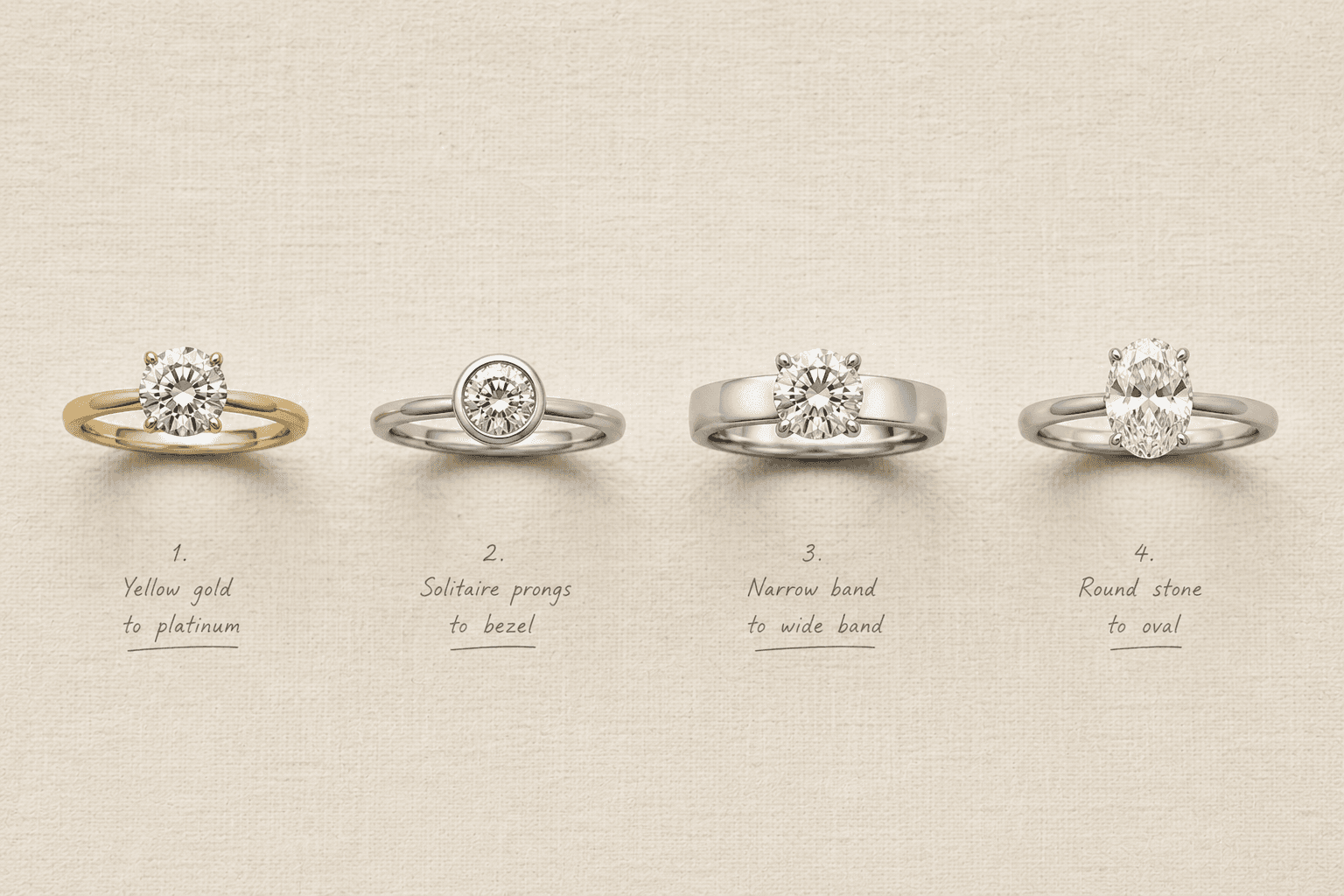
What to Expect When Commissioning a Custom Jewelry Piece
Discover what happens when you commission custom jewelry, from initial consultations and design sketches to production timelines and final delivery. Set realistic expectations for your bespoke jewelry journey.
What Really Happens When You Commission Custom Jewelry
Commissioning a custom jewelry piece involves a collaborative journey between you and a skilled designer, typically spanning 4 to 10 weeks from the first conversation to the moment you hold the finished piece. Understanding each stage helps you set realistic expectations, make better decisions, and enjoy the process rather than stress about unknowns.
Many people assume that ordering custom jewelry is an intimidating, opaque process reserved for the wealthy. In reality, commissioning a bespoke piece has become surprisingly accessible. Whether you are creating an engagement ring or a meaningful birthday gift, knowing what to expect transforms the experience from daunting to delightful.
The Emotional Side of Custom Jewelry
Before diving into the practical steps, it is worth acknowledging that commissioning custom jewelry is often an emotional experience. You might be designing a ring to propose with, creating a piece that honors a loved one, or celebrating a personal milestone. These emotions are part of what makes custom jewelry special, and a good jeweler will honor that.
Do not hesitate to share the story behind your piece. The best custom jewelry carries meaning in its design, and your jeweler needs to understand that meaning to translate it into metal and stone.
Phase 1 - The Discovery Conversation
Your journey begins with an initial consultation. This might happen in person, over video call, by phone, or through a detailed questionnaire. During this conversation, your jeweler will ask about your style preferences, intended occasion, budget range, and timeline requirements.
Come prepared with visual references. Screenshots from Instagram, Pinterest boards, photos of jewelry you admire, or even rough hand-drawn sketches all help communicate your vision. The more reference material you provide, the more accurately your jeweler can interpret your ideas.
Your jeweler will also ask practical questions about the intended wearer. For rings, they will need a ring size. For necklaces, they will ask about preferred length and pendant weight. For earrings, they will inquire about sensitivity to certain metals and preferred closure types.
Phase 2 - Concept Development
After your consultation, the designer begins translating your vision into tangible concepts. Depending on the jeweler's process, you might receive hand-drawn sketches, digital illustrations, or preliminary 3D renderings.
This phase is exploratory. Your designer may present 2 to 3 distinct concepts, each interpreting your vision differently. One might be more classic, another more contemporary, and a third might blend elements in an unexpected way. Review each concept with an open mind, as sometimes the design you did not initially expect becomes your favorite.
Pay attention to proportions in the concept sketches. A ring that looks elegant in a sketch might feel chunky when made at actual size if proportions are not right. Ask your designer to indicate actual dimensions so you can gauge the physical presence of the piece.
Phase 3 - Detailed Design and CAD Modeling
Once you select a concept direction, your designer creates a detailed CAD (Computer-Aided Design model. This is a precise, three-dimensional digital representation of your piece that can be viewed from every angle, rotated, and even placed on a virtual hand or neck for scale.
CAD modeling is where the magic happens. You can see exactly how the setting will hold the gemstone, how the band will taper, and how light will interact with the surfaces. Modern CAD software produces photorealistic renderings that give you an incredibly accurate preview of the finished piece.
This is your most important opportunity to request changes. Adjusting a digital model takes hours. Adjusting a finished piece takes weeks and significantly more money. Be thorough in your review. Ask your designer to show the piece from the top, side, bottom, and at an angle on a hand or body for context.
Questions to Ask During CAD Review
Consider asking about the thickness of the band at its thinnest point, since very thin bands can bend over time. Ask about prong size and placement, as larger prongs offer more security but can obscure the stone. Inquire about comfort fit versus standard fit for rings, and request to see the piece with and without gemstones to evaluate the metalwork on its own merits.
Phase 4 - Material Sourcing
With the design approved, your jeweler sources materials. For simple pieces using standard metals, this is straightforward. For pieces featuring specific gemstones, this phase can take additional time as the jeweler searches for stones meeting your criteria.
If your piece includes a significant center stone, most jewelers will present several options for your approval. They may send photos, videos, or gemstone certificates for each candidate. Understanding diamond quality factors or gemstone characteristics helps you make informed choices during this phase.
Some jewelers work with specific stone dealers and can source unusual gems on request. If you want something specific, like a Montana sapphire or a Colombian emerald, mention this during your initial consultation so the jeweler can factor sourcing time into your timeline.
Phase 5 - Production
Production is where your design becomes physical. The typical production process includes several distinct stages.
First, a wax model or 3D-printed prototype is created from the CAD file. Some jewelers send this prototype to you for a final size and proportion check before proceeding. Next, the wax model goes through the lost-wax casting process, where molten metal replaces the wax to create the raw jewelry piece.
After casting, the piece undergoes finishing work including filing, sanding, and polishing. If the design includes gemstones, the setter carefully places and secures each stone. Finally, the piece receives its final polish and any surface treatments like rhodium plating for white gold.
This entire production phase typically takes 2 to 4 weeks. Complex designs with multiple stones or intricate details may take longer.
Phase 6 - Quality Inspection and Finishing
Before your piece ships, it should undergo thorough quality inspection. A professional jeweler checks every aspect, from the security of stone settings to the smoothness of the finish, the accuracy of dimensions, and the overall structural integrity.
Some jewelers photograph each piece under magnification so you can see the level of detail in the finished work. Others create short videos showing the piece from multiple angles under different lighting conditions. These final images often become your most treasured documentation of the piece.
Phase 7 - Delivery and Aftercare
Your finished piece should arrive in protective packaging via insured, trackable shipping. Many jewelers include a presentation box, care instructions, and any relevant gemstone certifications.
Once you receive the piece, inspect it carefully. Try it on and check for comfort, examine the finish under natural light, and ensure all stones are secure. Most reputable jewelers offer a satisfaction period, typically 7 to 14 days, during which you can raise any concerns.
Ask about aftercare services. Many custom jewelers offer complimentary cleaning, inspection, and minor adjustments for a period after purchase. Understanding proper jewelry care helps protect your investment for decades to come.
How Tashvi AI Enhances Your Commission Experience
One of the biggest challenges in commissioning custom jewelry is clearly communicating what you want. Tashvi AI bridges this gap by letting you generate detailed, photorealistic jewelry designs from text descriptions. Instead of arriving at a consultation with vague ideas or a folder of other people's designs, you can present AI-generated visuals of exactly what you envision.
This dramatically accelerates the concept phase and reduces the number of revision rounds needed. Designers have reported that clients who arrive with AI-generated concepts move through the design process 40 to 60 percent faster. You can explore different metal options, gemstone arrangements, and design styles before spending a single dollar on professional design time.
Try designing on Tashvi AI free
Setting Yourself Up for Success
The key to a successful custom jewelry commission is clear communication, realistic expectations, and patience. Trust the process, engage actively during the design phase, and do not hesitate to ask questions at every stage. The result will be a piece that carries your personal story in every curve of metal and facet of stone.
Frequently Asked Questions
Quick answers to the questions readers ask most about this guide.
What is the first step in commissioning custom jewelry?
The first step is an initial consultation where you discuss your vision, budget, and timeline with a jeweler. You will share inspiration images, describe desired materials, and outline any sentimental elements you want incorporated into the design.
How many design revisions are typical for custom jewelry?
Most jewelers include 2 to 3 revision rounds in their standard pricing. Additional revisions beyond that may incur extra fees. The goal is to perfect the design digitally before any physical production begins.
Do I get to see my custom jewelry before it is finished?
Yes, reputable jewelers share progress at key stages including concept sketches, 3D CAD renderings, and sometimes wax models. Some also send photos during stone setting and final polishing so you can track the piece throughout production.
What if I change my mind during the custom jewelry process?
Changes are easiest and least costly during the design phase. Once production begins, modifications become more difficult and expensive. Most jewelers have clear policies about when changes can be made and any associated costs.
Should I tip my custom jeweler?
Tipping is not standard practice in the custom jewelry industry. Jewelers set their prices to cover their craftsmanship and time. However, referrals and positive reviews are always appreciated and help support their business.