What Are AI-Generated Jewelry Designs and How Do They Work?
Understand how AI-generated jewelry designs work, from text prompts to photorealistic renderings. Learn the technology behind AI jewelry design, its capabilities, limitations, and how it is transforming the industry.
How AI Creates Jewelry Designs From Your Ideas
AI-generated jewelry designs are created by artificial intelligence systems that interpret text descriptions or visual inputs and produce detailed, photorealistic renderings of jewelry pieces, using deep learning models trained on vast collections of design data to understand aesthetics, proportions, materials, and structural relationships. This technology has made professional-quality jewelry visualization accessible to everyone, regardless of design experience.
The rise of AI in jewelry design represents one of the most significant shifts in how people explore and create personal adornment. What once required expensive software, years of training, and professional expertise can now be accomplished in seconds with a simple text description.
The Technology Behind AI Jewelry Design
Understanding how AI generates jewelry designs helps you use these tools more effectively and set realistic expectations for what they can and cannot do.
Neural Networks and Deep Learning
At the core of AI jewelry design are deep neural networks, computational systems loosely inspired by the human brain. These networks have been trained on millions of images, learning to recognize and generate visual patterns including shapes, textures, colors, materials, and spatial relationships.
The training process involves showing the AI vast quantities of jewelry images along with descriptions. Over time, the AI learns associations between words and visual elements. It understands that "vintage" implies certain design motifs, that "halo setting" means a center stone surrounded by smaller stones, and that "rose gold" has a specific warm, pink-tinged appearance.
From Text to Image
When you type a prompt like "elegant pear-shaped sapphire pendant with diamond accents in white gold," the AI processes each element of your description and generates an image that combines all of those elements into a cohesive design.
The generation process involves multiple stages. First, the AI interprets the semantic meaning of your prompt, identifying key design attributes. Then it constructs a visual representation that satisfies all the described criteria while maintaining aesthetic coherence and realistic proportions.
Training Data and Design Knowledge
The quality of AI jewelry designs depends heavily on the breadth and quality of training data. Advanced platforms have been trained on diverse jewelry traditions, including contemporary minimalist designs, classical European styles, art deco geometry, Indian bridal jewelry, and many other traditions from around the world.
This broad training enables the AI to generate designs across many styles and to combine elements from different traditions in novel ways. When you ask for a piece that blends vintage art deco elements with modern minimalism, the AI can create something genuinely new by drawing on its understanding of both styles.
What AI Jewelry Design Can Do
The capabilities of AI jewelry design tools have expanded rapidly over the past few years.
Rapid Concept Exploration
The most transformative capability is speed. A human designer might produce 2 to 3 concept sketches in a day. AI can generate dozens of unique design variations in minutes. This rapid iteration lets you explore a much wider range of possibilities before committing to a direction.
Style Translation
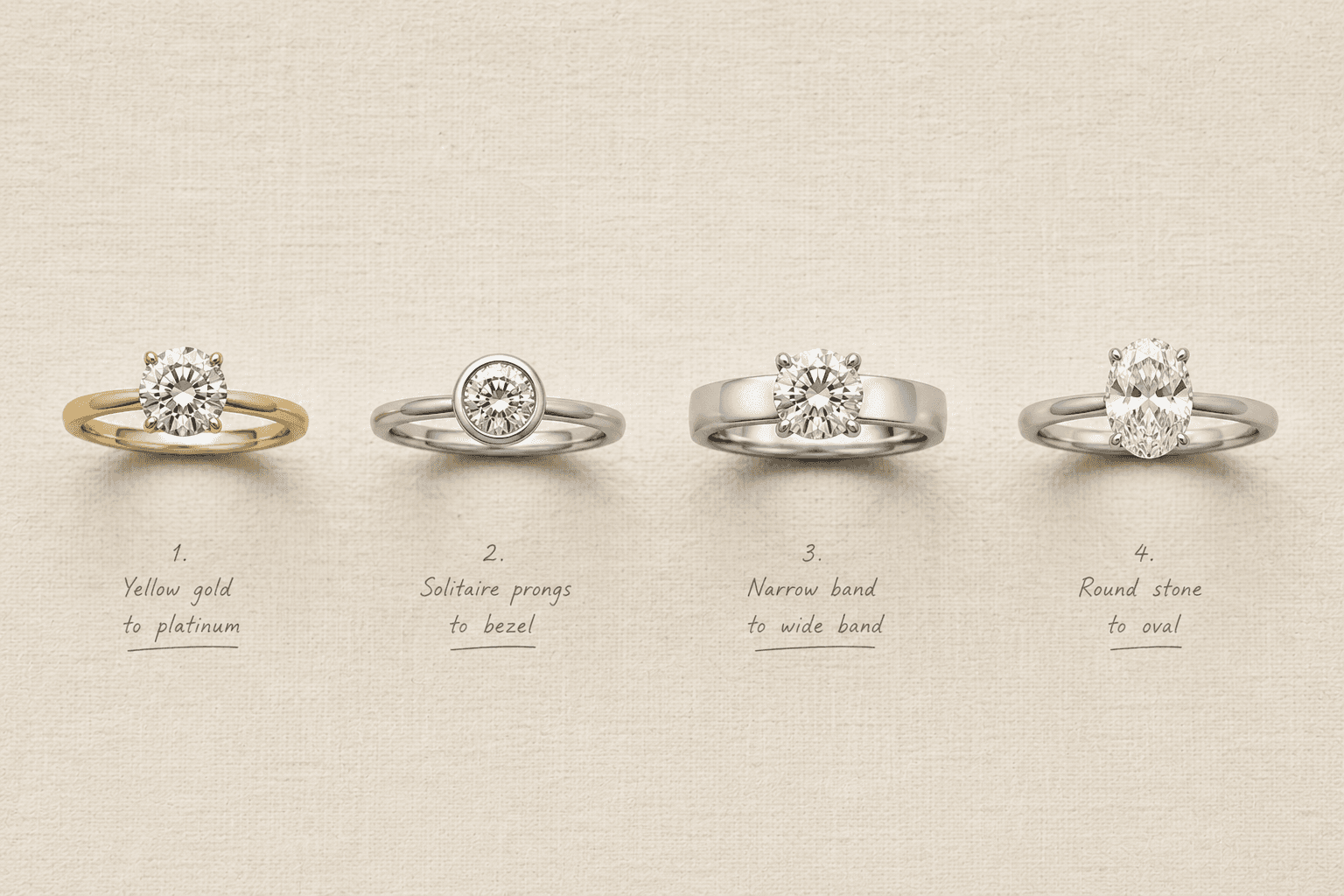
AI excels at translating between styles. You can take a ring design you love and ask the AI to reimagine it in a different aesthetic, a modern ring rendered in an art nouveau style, or a classic solitaire reinterpreted with contemporary geometric elements.
Material Visualization
Seeing how a design looks in different metals is invaluable for decision-making. AI can render the same design in yellow gold, white gold, rose gold, platinum, and silver, letting you compare appearances instantly.
Design Variation Generation
Starting from a concept you like, AI can generate variations that explore different proportions, gemstone arrangements, band widths, and detail levels. This "controlled exploration" helps you refine your preferences without starting from scratch each time.
What AI Jewelry Design Cannot Do (Yet)
Being honest about limitations helps you use AI tools with appropriate expectations.
Precise Technical Specifications
Current AI generates visual representations, not engineering blueprints. The renders may not include exact carat weights, precise metal thicknesses, or detailed structural specifications needed for manufacturing. A professional jeweler translates the visual concept into a technically viable piece.
Manufacturing Feasibility Assessment
An AI-generated design may look beautiful but include elements that are structurally unsound, impossible to cast, or impractical to wear. Very thin metal sections, impossible prong arrangements, or gemstone settings that would not secure the stone in real life can appear in AI outputs. This is why collaboration with experienced jewelers remains essential.
Tactile and Wearability Evaluation
No rendering can tell you how a ring will feel on your finger, whether a necklace will hang at the right angle, or whether a bracelet will be comfortable during daily wear. These physical considerations still require human expertise and, ideally, physical prototyping.
How AI Fits Into the Jewelry Design Workflow
AI is most powerful when integrated into a broader design workflow rather than used in isolation.
Phase 1 - AI-Powered Exploration
Start by generating multiple AI designs to explore your preferences. Try different styles, materials, and design elements. This phase replaces hours of browsing Pinterest and jewelry websites with targeted, efficient exploration.
Phase 2 - Refinement and Selection
Review your AI-generated designs and identify the elements that resonate most strongly. Note what works and what does not across multiple designs. Combine your favorite elements into a refined concept.
Phase 3 - Professional Collaboration
Bring your AI-generated concepts to a professional jeweler for technical evaluation and refinement. The jeweler assesses manufacturability, suggests practical improvements, and creates production-ready specifications.
Phase 4 - Production
The finalized design moves into traditional production processes including CAD modeling, prototyping, casting, stone setting, and finishing. The AI-generated concept serves as the creative foundation that guides the entire production process.
AI Design Tips for Better Results
Getting great results from AI jewelry design tools requires understanding how to write effective prompts.
Be specific about materials, mentioning not just "gold" but "14K yellow gold" or "rose gold." Specify gemstone types, shapes, and arrangements. Describe the overall style using reference terms like vintage, minimalist, bohemian, art deco, or romantic.
Include context about the intended use. An everyday ring needs different design considerations than a special occasion statement piece. Mentioning the purpose helps the AI generate appropriately scaled and styled designs.
Describe negative space and proportion. "A delicate band with a prominent center stone" communicates proportion in ways that help the AI generate balanced compositions.
The Future of AI in Jewelry Design
AI jewelry design technology is advancing rapidly. Upcoming capabilities include real-time 3D model generation from text descriptions, automatic manufacturing feasibility analysis, virtual try-on using augmented reality, and AI-assisted pricing based on detected materials and complexity.
The integration of AI with traditional CAD software is particularly promising. Future workflows may allow designers to use AI for initial concept generation, then seamlessly transition into precise CAD modeling for production specifications.
How Tashvi AI Leads the Way
Tashvi AI represents the cutting edge of accessible AI jewelry design. The platform translates your text descriptions into photorealistic jewelry renderings, making professional-quality design exploration available to everyone. Whether you are a first-time buyer exploring engagement ring ideas or a professional designer seeking rapid concept generation, Tashvi AI delivers stunning visualizations in seconds.
The platform understands jewelry-specific terminology, design traditions, and aesthetic preferences, producing results that are not just visually impressive but genuinely useful as starting points for real jewelry production.
Try designing on Tashvi AI free
Embracing the AI-Enhanced Future
AI-generated jewelry designs are not replacing human creativity. They are amplifying it. By handling the labor-intensive work of visualization and concept exploration, AI frees both consumers and professional designers to focus on what matters most, the personal meaning and emotional significance that transforms metal and stone into treasured jewelry.
Frequently Asked Questions
Quick answers to the questions readers ask most about this guide.
Are AI-generated jewelry designs original or copied from existing pieces?
AI-generated designs are original creations, not copies. The AI has learned design principles, aesthetics, and structural relationships from vast datasets, but generates new combinations rather than reproducing existing pieces. Each output is a unique interpretation of your specific prompt.
Can AI-generated designs actually be manufactured?
Many AI-generated designs can be manufactured, though some may require modifications for structural integrity or manufacturing feasibility. Experienced jewelers can evaluate AI designs and suggest practical adjustments while preserving the creative intent of the original concept.
Do I own the rights to AI-generated jewelry designs?
Ownership policies vary by platform. Most AI jewelry design tools, including Tashvi AI, grant you full rights to use the generated designs for personal or commercial purposes. Always review the terms of service for the specific platform you are using.
How accurate are AI-generated jewelry renderings?
Modern AI can produce photorealistic renderings that closely represent how a finished piece would look. However, subtle details like exact light refraction through specific gemstone cuts or the precise texture of hand-finished metal may differ slightly in the physical piece.
Will AI replace human jewelry designers?
AI is unlikely to replace skilled jewelry designers. Instead, it serves as a powerful tool that enhances their capabilities. AI excels at rapid concept generation and visualization, while human designers bring nuanced understanding of wearability, cultural significance, and emotional storytelling.