How Generative Adversarial Networks Create Unique Jewelry Patterns
Generative adversarial networks (GANs) are producing one-of-a-kind jewelry patterns that no human designer could envision alone. Learn how these competing neural networks generate novel textures, filigree designs, and organic forms that push the creative boundaries of jewelry design.
Generative adversarial networks create unique jewelry patterns by pitting two neural networks against each other in a creative competition. The generator network produces novel designs while the discriminator network evaluates their realism, driving continuous improvement until the system generates textures, filigree patterns, and organic forms that are both original and visually compelling, pushing jewelry design beyond the limits of human imagination alone.
The quest for originality is central to jewelry design. Every designer wants to create something that has never been seen before, a pattern, a texture, or a form that surprises and delights. Yet human creativity, while boundless in theory, operates within the constraints of what we have seen, experienced, and can mentally recombine. Generative adversarial networks offer a different kind of creativity, one rooted in mathematical pattern analysis and synthesis, that can produce genuinely novel designs outside the boundaries of human visual memory.
Understanding the GAN Architecture
To appreciate how GANs create jewelry patterns, it helps to understand their fundamental mechanism. Introduced by Ian Goodfellow in 2014, the GAN architecture consists of two neural networks locked in a productive rivalry.
The Generator
The generator network starts with random noise, a meaningless jumble of numbers, and attempts to transform it into a realistic image. In the context of jewelry, the generator might be tasked with creating ring designs, surface textures, or filigree patterns. Initially, its output is garbage, unrecognizable blobs of color that bear no resemblance to jewelry.
The Discriminator
The discriminator network is trained on real jewelry images and learns to distinguish between authentic designs and the generator's fakes. It acts as an increasingly sophisticated critic, identifying subtle flaws in the generator's attempts.
The Training Loop
The magic happens through iterative competition. The generator creates a batch of fake images. The discriminator evaluates them alongside real images and identifies which are fake. The generator receives feedback on where it failed and adjusts its approach. Over thousands of training cycles, the generator becomes extraordinarily skilled at producing images that the discriminator cannot distinguish from real jewelry, and in the process, it develops the ability to create entirely new patterns that are consistent with the aesthetic principles of the training data without copying any specific piece.
How GANs Generate Novel Jewelry Patterns
Several specific applications of GAN technology have proven particularly valuable in jewelry design.
Surface Texture Generation
One of the most practical applications is generating novel surface textures for metal jewelry. GANs trained on datasets of hammered, brushed, engraved, sandblasted, and organically textured metal surfaces can produce entirely new texture variations that blend characteristics from multiple sources.
A GAN might generate a texture that combines the organic irregularity of a hammered finish with the directional quality of a brushed surface, creating something that looks natural and intentional but has never been produced by a human hand. These textures can be applied to digital jewelry models for visualization and rendering, or translated into CNC toolpaths for physical production.
Filigree and Openwork Patterns
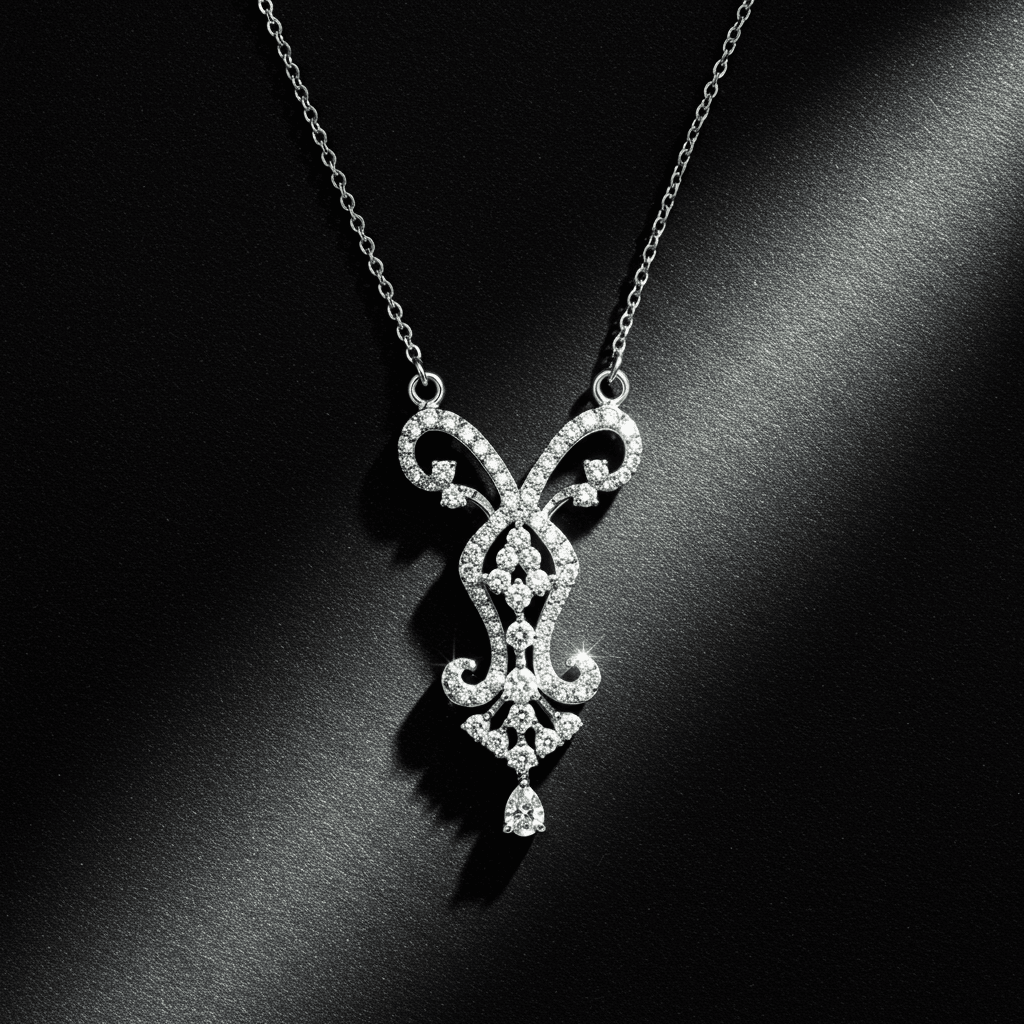
Filigree design has historically been one of the most labor-intensive aspects of jewelry creation, requiring master artisans to create intricate, interconnected wire patterns by hand. GANs trained on historical filigree from various cultures, including Indian, Portuguese, Russian, and Ottoman traditions, can generate novel patterns that honor traditional techniques while introducing unprecedented design elements.
The networks learn the underlying structural rules of filigree, such as how wires connect, how curves relate to straight segments, and how density varies across a design, and then generate new patterns that follow these rules in unexpected ways. For designers working with vintage and Art Deco aesthetics, GANs provide an inexhaustible source of period-appropriate yet completely original decorative patterns.
Organic and Nature-Inspired Forms
GANs excel at generating organic forms that blend natural references. A network trained on coral structures, branching patterns, crystal formations, and botanical forms can produce jewelry design concepts that feel deeply connected to nature without directly replicating any specific natural object.
| GAN Application | Training Data | Output Type | Design Use |
|---|---|---|---|
| Surface Textures | Metal finish photographs | Seamless texture maps | Ring bands, pendant surfaces |
| Filigree Patterns | Historical filigree images | 2D pattern designs | Openwork, gallery details |
| Organic Forms | Nature photography, coral, botanicals | 3D-like form concepts | Statement pieces, artistic jewelry |
| Gemstone Arrangements | Pave and cluster setting photos | Layout patterns | Multi-stone compositions |
| Cultural Motifs | Regional jewelry traditions | Decorative elements | Heritage-inspired collections |
The Technical Pipeline From GAN to Finished Jewelry
Transforming a GAN-generated pattern into a physical piece of jewelry requires a multi-step pipeline that bridges AI output and traditional manufacturing.
Pattern Refinement
Raw GAN outputs, while visually compelling, often contain artifacts or inconsistencies that need human correction. A designer reviews the generated pattern, cleans up any irregularities, and makes aesthetic judgments about which elements to keep and which to modify. This curatorial step is where human taste and manufacturing knowledge intersect with AI creativity.
Digital Modeling
The refined 2D pattern is translated into a 3D model using CAD software. For surface textures, this might involve converting the pattern into a displacement or bump map that can be applied to a ring band or pendant surface. For filigree patterns, it means tracing the design into 3D wire geometry that can be printed and cast. Understanding the nuances of jewelry design elements and principles ensures that the AI-generated pattern works as a cohesive part of the larger design.
Manufacturability Assessment
Not every beautiful pattern can be physically produced. Extremely fine details may not survive the casting process. Undercut geometry may prevent mold release. Structural weak points may compromise durability. An experienced jeweler or CAD technician evaluates the design against manufacturing constraints and makes necessary modifications.
Prototyping and Production
The finalized 3D model is 3D printed as a wax or resin pattern, cast in metal, and finished by hand. The result is a piece that carries the creative DNA of the GAN's algorithmic imagination, refined and realized through traditional craftsmanship.
GANs vs. Diffusion Models in Jewelry Design
The AI landscape has evolved significantly since GANs dominated the generative image space. Diffusion models, which power tools like DALL-E, Midjourney, and Stable Diffusion, have surpassed GANs in general image generation quality. However, GANs retain specific advantages for jewelry pattern creation.
GANs tend to produce more consistent, repeatable patterns because their training process enforces structural coherence. Diffusion models excel at generating complete scenes and complex compositions but can struggle with precise, tileable patterns. For texture and pattern generation specifically, GANs often produce results that are more directly useful in manufacturing pipelines.
Many modern AI jewelry tools use hybrid approaches, combining GAN-based pattern generation with diffusion-model-based scene composition to produce both novel designs and photorealistic visualizations.
Creative Possibilities Beyond Human Imagination
Perhaps the most exciting aspect of GAN-generated jewelry patterns is their ability to explore design spaces that human designers rarely access. The networks operate without preconceptions about what jewelry "should" look like. They do not favor symmetry unless the training data overwhelmingly features it. They do not default to common design tropes unless those tropes dominate the dataset.
By carefully curating training data, designers can steer GANs toward unexplored aesthetic territories. Training on a mix of microscopic crystal structures, architectural blueprints, and traditional Japanese textile patterns, for example, might produce jewelry designs that no human would conceive because no human has simultaneously internalized all those visual influences at a mathematical level.
This is not about replacing human creativity but about expanding its horizons. The designer's role shifts from inventor to curator, selecting the most compelling outputs from a vast field of AI-generated possibilities and refining them into wearable, meaningful pieces.
How Tashvi AI Leverages Generative Technology for Jewelers
Tashvi AI incorporates advanced generative AI technology to help jewelers create original designs without needing to understand the technical details of neural network architectures. The platform's reference-based design system allows designers to upload inspiration images, and the underlying AI models, including techniques derived from GAN and diffusion research, generate new jewelry concepts that capture the style and spirit of the references while producing entirely original designs.
This approach makes the creative power of generative AI accessible to every jeweler, whether they are a tech-savvy digital designer or a traditional bench jeweler exploring AI for the first time. The AI handles the complex pattern synthesis and image generation, while the jeweler provides the creative direction and manufacturing expertise. For designers exploring how AI compares to traditional design methods, Tashvi AI offers a practical, hands-on introduction to generative design technology. Try designing on Tashvi AI free to discover what generative AI can create from your inspiration images.
The Ethical Dimension
As with all AI-generated content, GAN-created jewelry patterns raise questions about authorship, originality, and the role of human creativity. If a GAN produces a stunning filigree pattern that a designer refines and manufactures, who is the creator? These questions do not have simple answers, but the jewelry industry is generally moving toward a collaborative model where AI is viewed as a creative tool rather than an autonomous creator.
The most important ethical principle is transparency. Designers who use GAN-generated patterns as part of their process should be comfortable disclosing that AI played a role in the creative development. This transparency builds trust with customers who increasingly care about the story and process behind the jewelry they wear.
Frequently Asked Questions
Quick answers to the questions readers ask most about this guide.
What is a generative adversarial network in simple terms?
A generative adversarial network (GAN) consists of two neural networks that work against each other. One network (the generator) creates new images, and the other (the discriminator) judges whether they look real. Through this competition, the generator learns to produce increasingly realistic and creative outputs.
How are GANs different from other AI image generators?
GANs were among the first AI architectures capable of generating realistic images. While newer diffusion models (like those behind DALL-E and Midjourney) have surpassed GANs in general image quality, GANs remain valuable for specific applications like texture generation, style transfer, and pattern creation where their training approach produces particularly coherent results.
Can GAN-generated jewelry patterns actually be manufactured?
Yes, but with caveats. GAN outputs are 2D images that need to be interpreted and translated into 3D manufacturing files by a designer or specialized software. Some patterns may need simplification for casting or printing feasibility. The AI generates inspiration and starting points, while human expertise ensures manufacturability.
Do GAN-generated designs infringe on existing jewelry copyrights?
GAN-generated designs are new creations, not copies of existing pieces, even though the network learned from existing designs during training. However, if a GAN output closely resembles a specific copyrighted design, legal questions could arise. Most jewelry applications use GANs for pattern and texture generation where originality is clearer.
What training data do jewelry GANs need?
Jewelry GANs typically train on curated datasets of thousands to tens of thousands of jewelry images, organized by category such as ring designs, filigree patterns, gemstone arrangements, or surface textures. The quality and diversity of training data directly impact the quality and variety of generated outputs.