Moissanite vs Diamond 2026: Can You Actually Tell the Difference?
Moissanite costs 90% less ($300 vs $4,000) and sparkles more. Compare durability, fire, resale — and the one test that tells them apart instantly.
Moissanite vs Diamond: Quick Answer
Moissanite is a lab-created gemstone that costs 80-90% less than diamond while offering superior sparkle and near-identical hardness. Pricing benchmarks sourced from Charles & Colvard (original moissanite manufacturer) and Rapaport for diamond comparison. The main trade-offs: moissanite has more rainbow fire (some love it, purists don't), no resale value (I Do Now I Don't peer-to-peer marketplace data, and lacks diamond's cultural prestige. For budget-conscious couples who prioritize appearance over tradition, moissanite is the smartest choice in 2026.
Tashvi AI
See how your ring looks with moissanite vs diamond
Design the same ring with moissanite and diamond in photorealistic 3D. Tashvi AI renders both in seconds — free, no CAD skills.
2026 Comparison at a Glance
| Factor | Moissanite | Natural Diamond | Lab Diamond | Source |
|---|---|---|---|---|
| Price (1ct equivalent) | $300-600 | $4,000-8,000 | $800-1,500 | Charles & Colvard / Rapaport / Tenoris |
| Hardness (Mohs) | 9.25-9.5 | 10 | 10 | GIA Gem Reference |
| Brilliance | 2.65-2.69 RI | 2.42 RI | 2.42 RI | GIA optical properties |
| Fire (dispersion) | 0.104 | 0.044 | 0.044 | GIA optical properties |
| Resale Value | ~0% | 20-60% | 10-40% | WP Diamonds resale data |
| Origin | Lab-created | Earth-mined | Lab-created | — |
| Ethical Concerns | None | Potential | None | Human Rights Watch diamond industry report |
What Is Moissanite?
Moissanite is a gemstone composed of silicon carbide (SiC), originally discovered in 1893 by French chemist Henri Moissan in a meteor crater in Arizona. Natural moissanite is extraordinarily rare—far rarer than diamond—so virtually all moissanite jewelry today features lab-created stones.
If you're also considering lab-grown diamonds as an alternative, see our complete lab-grown vs natural diamond comparison for pricing and resale value details.
The gemstone gained popularity in the late 1990s when Charles & Colvard developed methods to grow gem-quality moissanite crystals. Today, multiple companies produce moissanite, with quality and pricing varying significantly between manufacturers.
Why Moissanite Became Popular
Several factors drove moissanite's rise as the leading diamond alternative:
Affordability without sacrifice: Unlike cubic zirconia (which scratches and clouds), moissanite offers diamond-like durability at a fraction of the cost.
Ethical certainty: Lab creation eliminates concerns about conflict diamonds or environmental mining impact.
Superior optical properties: Moissanite actually outperforms diamond in measurable brilliance and fire metrics.
Improving quality: Modern moissanite (especially "Forever One" and premium grades) achieves colorless, eye-clean quality indistinguishable from fine diamonds to casual observers.
The Science: Why Moissanite Sparkles Differently
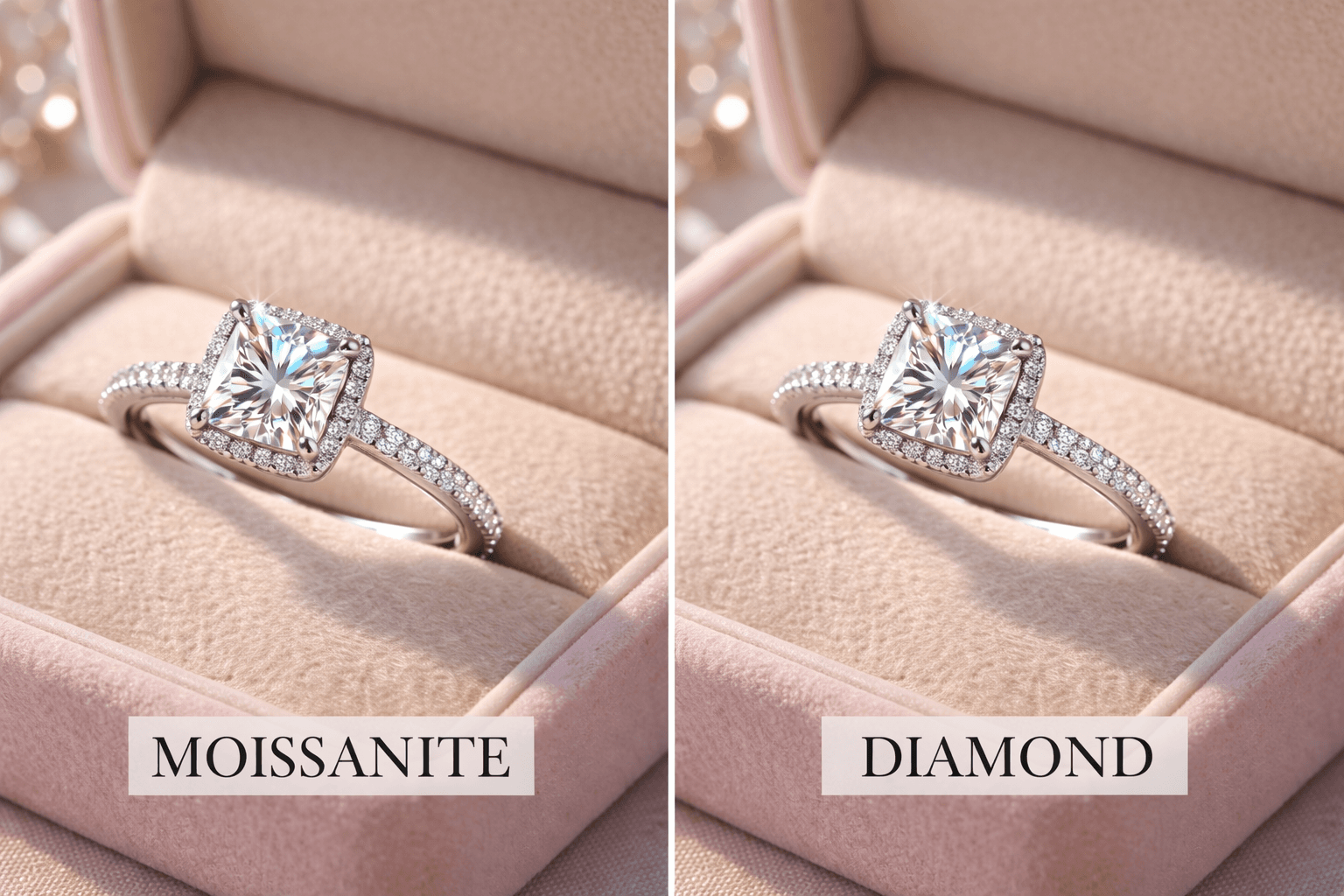
Understanding the optical differences helps you decide which stone suits your preferences.
Refractive Index (Brilliance)
The refractive index measures how much a stone bends light, creating the white sparkle we call brilliance.
- Moissanite: 2.65-2.69 RI
- Diamond: 2.42 RI
Moissanite's higher refractive index means it returns more light to your eye, creating intense white sparkle. In practical terms, moissanite appears slightly more brilliant than diamond in most lighting conditions.
Dispersion (Fire)
Dispersion measures how a stone splits white light into spectral colors—the rainbow flashes called "fire."
- Moissanite: 0.104 dispersion
- Diamond: 0.044 dispersion
Moissanite has 2.4x more fire than diamond. This creates more colorful rainbow flashes, especially in direct sunlight or bright lighting. Some people love this extra fire; diamond purists find it "too sparkly" or "disco ball-like."
Double Refraction
Here's the key scientific difference: moissanite is doubly refractive while diamond is singly refractive.
When light enters moissanite, it splits into two rays traveling at different speeds. This causes a "doubling" effect where facet edges appear slightly duplicated when viewed under magnification. Diamond never shows this effect.
To the naked eye, double refraction is invisible. But jewelers and gemologists use it as the definitive identification method—if you see doubled facets under 10x magnification, it's moissanite (or another doubly refractive stone), never diamond.
Price Comparison: The Real Numbers
The cost difference between moissanite and diamond is dramatic and represents the primary reason most buyers choose moissanite.
1-Carat Equivalent Pricing (2026)
Prices below sourced from Charles & Colvard and Moissanite International for moissanite retail ranges, Tenoris retail analytics for lab-grown diamond pricing, and Rapaport / IDEX Diamond Index for natural diamond pricing.
| Stone Type | Price Range | Cost per Carat |
|---|---|---|
| Premium Moissanite (DEF color) | $400-600 | $400-600 |
| Standard Moissanite | $200-400 | $200-400 |
| Lab-Grown Diamond (G/VS1) | $800-1,500 | $800-1,500 |
| Natural Diamond (G/VS1) | $4,000-8,000 | $4,000-8,000 |
Note: Moissanite is sold by millimeter size, not carat weight. A "1-carat equivalent" moissanite measures 6.5mm diameter but weighs approximately 0.88 carats due to lower density.
Size Comparison Pricing
The savings multiply with larger stones. Moissanite pricing from Charles & Colvard retail prices and Moissanite International; natural diamond pricing from the Rapaport Price List and IDEX Online Diamond Index.
| Size (mm) | Diamond Equivalent | Moissanite Price | Natural Diamond Price | You Save |
|---|---|---|---|---|
| 6.5mm | 1.0 ct | $400-600 | $5,000-8,000 | $4,400-7,400 |
| 7.5mm | 1.5 ct | $600-900 | $10,000-18,000 | $9,400-17,100 |
| 8.0mm | 2.0 ct | $800-1,200 | $20,000-40,000 | $19,200-38,800 |
| 9.0mm | 3.0 ct | $1,200-1,800 | $45,000-90,000 | $43,800-88,200 |
At larger sizes, moissanite becomes almost absurdly affordable compared to diamond. A 3-carat equivalent moissanite costs roughly $1,500 — the same visual impact as a $60,000+ natural diamond (Rapaport 3ct G/VS1 benchmark).
What You Could Buy Instead
If your budget is $5,000 for an engagement ring, here's what each option gets you:
With Moissanite ($5,000 budget):
- 2.5-carat equivalent center stone (8.5mm)
- Platinum setting with pavé band
- Matching wedding band
- Money left for honeymoon
With Lab Diamond ($5,000 budget):
- 1.5-carat center stone
- 14k white gold setting
- Simple solitaire design
With Natural Diamond ($5,000 budget):
- 0.8-1.0 carat center stone
- 14k white gold setting
- Minimal accent stones
Durability: Can Moissanite Handle Daily Wear?
Engagement rings endure significant stress—daily wear, hand washing, accidental impacts, and decades of use. How does moissanite hold up?
Hardness Comparison
The Mohs hardness scale measures scratch resistance:
| Gemstone | Mohs Hardness | Scratch Resistance |
|---|---|---|
| Diamond | 10 | Hardest natural substance |
| Moissanite | 9.25-9.5 | Harder than sapphire |
| Sapphire/Ruby | 9 | Excellent |
| Cubic Zirconia | 8-8.5 | Good (but scratches over time) |
| Glass | 5.5 | Poor |
Moissanite sits between sapphire and diamond—hard enough that normal activities won't scratch it. You'd need diamond dust or another moissanite to create scratches.
Toughness (Impact Resistance)
Hardness and toughness are different properties. Toughness measures resistance to chipping and breaking from impacts.
Both diamond and moissanite have excellent toughness, though diamond can chip along cleavage planes if struck at specific angles. Moissanite has no cleavage planes, making it slightly more resistant to chipping in certain scenarios.
For practical purposes, both stones handle engagement ring life exceptionally well.
Heat Resistance
Moissanite withstands jeweler's torch temperatures used for repairs and resizing—up to 1,800°C. This means your ring can be serviced without removing the stone, unlike some heat-sensitive gems.
Long-Term Durability
Unlike cubic zirconia, which clouds and scratches within years, moissanite maintains its appearance indefinitely. Rings worn daily for 20+ years show no degradation in sparkle or clarity. The stone requires no special maintenance beyond normal cleaning.
The Visual Differences: Can People Tell?
This is the question everyone asks: will people know it's not a diamond?
What Casual Observers See
In normal social situations—across a dinner table, in an office, at a party—nobody can distinguish moissanite from diamond. The stones are too similar in appearance for untrained eyes to detect any difference.
A 2019 study by The Knot found that 67% of respondents couldn't identify moissanite when shown comparison photos of both stones.
What Trained Eyes Notice
Jewelers and gemologists may notice:
- More rainbow fire: Moissanite throws more colorful flashes, especially in sunlight
- Slightly different brilliance pattern: Subtle differences in how light returns
- Double refraction under magnification: The definitive identifier
However, even professionals often need to test stones rather than identify by sight alone.
The "Disco Ball" Question
Some diamond enthusiasts criticize moissanite's extra fire as looking "fake" or "too sparkly." This is subjective—many people prefer the additional rainbow flashes and find diamonds look dull by comparison.
The fire difference is most noticeable in:
- Direct sunlight
- Bright artificial lighting
- Larger stones (2+ carat equivalent)
In softer indoor lighting, the difference diminishes significantly.
Side-by-Side Reality
If you place a moissanite and diamond of similar quality side by side under the same lighting, a careful observer might notice the moissanite has more colorful sparkle. Separated and worn normally, even jewelry professionals struggle to identify which is which without testing equipment.
Moissanite Grades and Quality
Not all moissanite is equal. Understanding grading helps you choose quality stones.
Color Grades
Moissanite uses a similar color grading system to diamonds:
| Grade | Color Description | Price Level |
|---|---|---|
| D-E-F | Colorless | Premium ($$$) |
| G-H-I | Near-colorless | Mid-range ($$) |
| J-K | Faint yellow | Budget ($) |
Premium colorless moissanite (DEF) appears identical to high-grade diamonds. Lower grades show slight warmth, similar to I-J color diamonds.
Cut Quality
Cut dramatically affects moissanite's appearance. Well-cut moissanite maximizes brilliance and minimizes the "disco ball" effect some dislike. Poorly cut stones look dull or overly flashy.
Look for:
- Hearts and Arrows: Precision cut with symmetrical patterns
- Excellent/Ideal cut grades: Optimal proportions for light return
- Branded cuts: Charles & Colvard Forever One, Brilliant Earth Moissanite
Clarity
Most gem-quality moissanite is eye-clean (no visible inclusions). Unlike diamonds, where clarity significantly affects price, moissanite clarity grades matter less because the manufacturing process produces consistently clean stones.
Brand Differences
Major moissanite brands and their positioning:
| Brand | Quality Tier | Notable Features |
|---|---|---|
| Charles & Colvard Forever One | Premium | Original patent holder, lifetime warranty |
| Brilliant Earth Moissanite | Premium | Ethically focused branding |
| MoissaniteCo | Mid-range | Good value, various cuts |
| Loose moissanite (various) | Budget | Variable quality, research needed |
Popular Moissanite Shapes: Which Cut Is Best?
Moissanite is available in all standard gemstone cuts. Each shape affects how the stone displays brilliance and fire. For a deep dive into how different shapes affect appearance and value, see our complete diamond shapes guide—the same principles apply to moissanite.
Round Brilliant Moissanite
The most popular choice for moissanite engagement rings. Round brilliant cuts maximize light return and display moissanite's fire evenly. This shape shows the most "disco ball" effect in larger sizes—beautiful to some, excessive to others.
Best for: Traditional tastes, maximum sparkle, timeless style
Oval Moissanite
Oval cuts elongate the finger and appear larger than round stones of equivalent carat weight. The elongated shape distributes fire more subtly than round cuts, creating a slightly more diamond-like appearance.
Best for: Those who want size without excessive fire, elegant finger elongation
Cushion Cut Moissanite
Cushion cuts combine a square shape with rounded corners, creating a romantic, vintage aesthetic. The larger facets produce broader flashes of fire rather than the intense pinpoint sparkle of rounds.
Best for: Vintage-inspired designs, softer sparkle, romantic aesthetics
Emerald Cut Moissanite
Emerald cuts feature step-cut faceting with long, linear flashes rather than the brilliant-cut fire pattern. This dramatically reduces moissanite's rainbow fire, creating the most diamond-like appearance of any cut.
Best for: Those concerned about moissanite looking "too sparkly," Art Deco styles, sophisticated minimalism
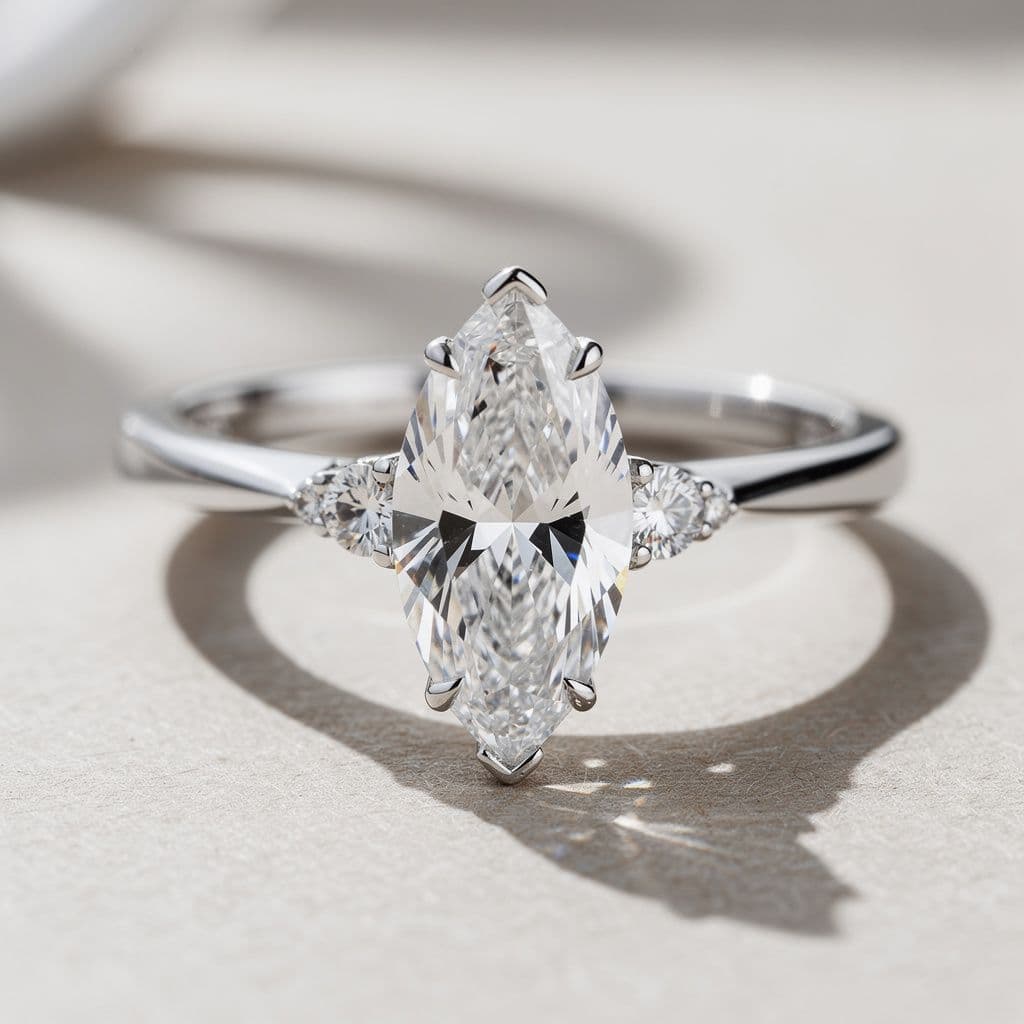
Pear and Marquise Moissanite
These elongated fancy shapes create dramatic, unique looks. Both appear larger than round stones and offer distinctive silhouettes. Fire displays along the length of the stone.
Best for: Statement pieces, unique personal style, maximum apparent size
Radiant and Princess Cut Moissanite
Square and rectangular brilliant cuts combine geometric shapes with maximum fire. These show more sparkle than emerald cuts but maintain clean, modern lines.
Best for: Modern aesthetics, those who want both shape and sparkle
Resale Value: The Honest Truth
This is moissanite's biggest weakness compared to diamond.
Moissanite Resale: Essentially Zero
Moissanite has virtually no secondary market. If you try to resell a moissanite ring, you'll likely receive:
- 0-10% of original purchase price from jewelers
- Slightly more through private sale, but limited buyer interest
Why? Moissanite is lab-created in unlimited quantities, so there's no scarcity driving used market value.
Diamond Resale: 20-60%
Natural diamonds retain 20-60% of retail value when resold, depending on quality and market conditions. This isn't great compared to other investments, but it's meaningful for high-value stones.
Lab-grown diamonds resell for 10-40%, declining as production costs fall.
Does Resale Matter?
Consider your intentions:
Resale matters if:
- You view the ring as a financial asset
- You might upgrade to a larger diamond later
- Family heirloom value is important
Resale doesn't matter if:
- The ring represents commitment, not investment
- You'll wear it forever regardless of value
- You prioritize size and appearance over asset value
Most couples never resell engagement rings. The practical difference between moissanite's 0% and diamond's 30% resale often never materializes.
Moissanite vs Lab-Grown Diamond
With lab diamonds now 60-80% cheaper than natural diamonds, how does moissanite compare to this middle-ground option?
Price Comparison
| Stone | 1-Carat Equivalent | 2-Carat Equivalent |
|---|---|---|
| Moissanite | $400-600 | $800-1,200 |
| Lab Diamond | $800-1,500 | $2,000-4,000 |
| Savings with Moissanite | 50-70% | 50-70% |
Optical Properties
| Property | Moissanite | Lab Diamond |
|---|---|---|
| Refractive Index | 2.65-2.69 | 2.42 |
| Fire (dispersion) | 0.104 | 0.044 |
| Appearance | More rainbow fire | Classic diamond look |
Which Should You Choose?
Choose moissanite if:
- Maximum size for budget is priority
- You like extra sparkle and fire
- You're not concerned about "real diamond" status
Choose lab diamond if:
- You want a real diamond (chemically identical to natural)
- You prefer classic diamond brilliance over moissanite's fire
- Slightly better resale value matters
- You may tell people it's a diamond
Moissanite vs Cubic Zirconia: Why There's No Comparison
Many people confuse moissanite with cubic zirconia (CZ), but they're fundamentally different stones with vastly different performance for engagement rings and wedding jewelry.
The Critical Differences
| Property | Moissanite | Cubic Zirconia |
|---|---|---|
| Hardness | 9.25-9.5 | 8-8.5 |
| Durability | Lifetime | 2-5 years |
| Scratching | Virtually impossible | Scratches easily |
| Clouding | Never | Yellows and clouds |
| Price (1ct eq.) | $300-600 | $20-50 |
| Brilliance | 2.65-2.69 RI | 2.15-2.18 RI |
Why CZ Fails as an Engagement Ring Stone
Cubic zirconia scratches. At 8-8.5 hardness, CZ is softer than everyday materials like sand and dust (which contain quartz at 7 hardness). Within months of daily wear, CZ develops visible scratches that dull its appearance.
CZ clouds and yellows. The crystal structure degrades with exposure to UV light, body oils, and cleaning products. After 2-5 years, CZ stones appear hazy and discolored—a dead giveaway that screams "cheap."
CZ looks fake. With lower refractive index (2.15 vs. moissanite's 2.65), CZ lacks the intense brilliance of moissanite or diamond. Side by side, CZ appears obviously artificial.
When CZ Makes Sense
Cubic zirconia works for:
- Fashion jewelry worn occasionally
- Travel rings (protecting your real ring)
- Costume jewelry
- Testing a style before buying moissanite
For engagement rings, wedding bands, or any jewelry worn daily, moissanite is the only sensible diamond alternative. The price difference ($300 vs. $30) is negligible for a piece worn for decades.
Ethical Considerations
Both moissanite and lab-grown diamonds offer ethical advantages over mined natural diamonds.
Moissanite: Clean by Default
All jewelry moissanite is lab-created, eliminating:
- Conflict diamond concerns
- Environmental mining impact
- Worker exploitation issues
The silicon carbide production process is energy-intensive but far less environmentally damaging than diamond mining.
The Disclosure Question
Some couples worry about "deceiving" others with moissanite. Consider:
- No one is entitled to know your ring's composition
- Most people never ask
- If asked directly, honesty is best
- Many moissanite wearers proactively share their choice and explain the ethical/financial reasoning
There's no deception in wearing moissanite unless you explicitly claim it's a diamond. The stone is a legitimate gemstone with its own identity, not a "fake diamond."
Best Settings for Moissanite
Certain ring settings complement moissanite's unique optical properties.
Settings That Enhance Moissanite
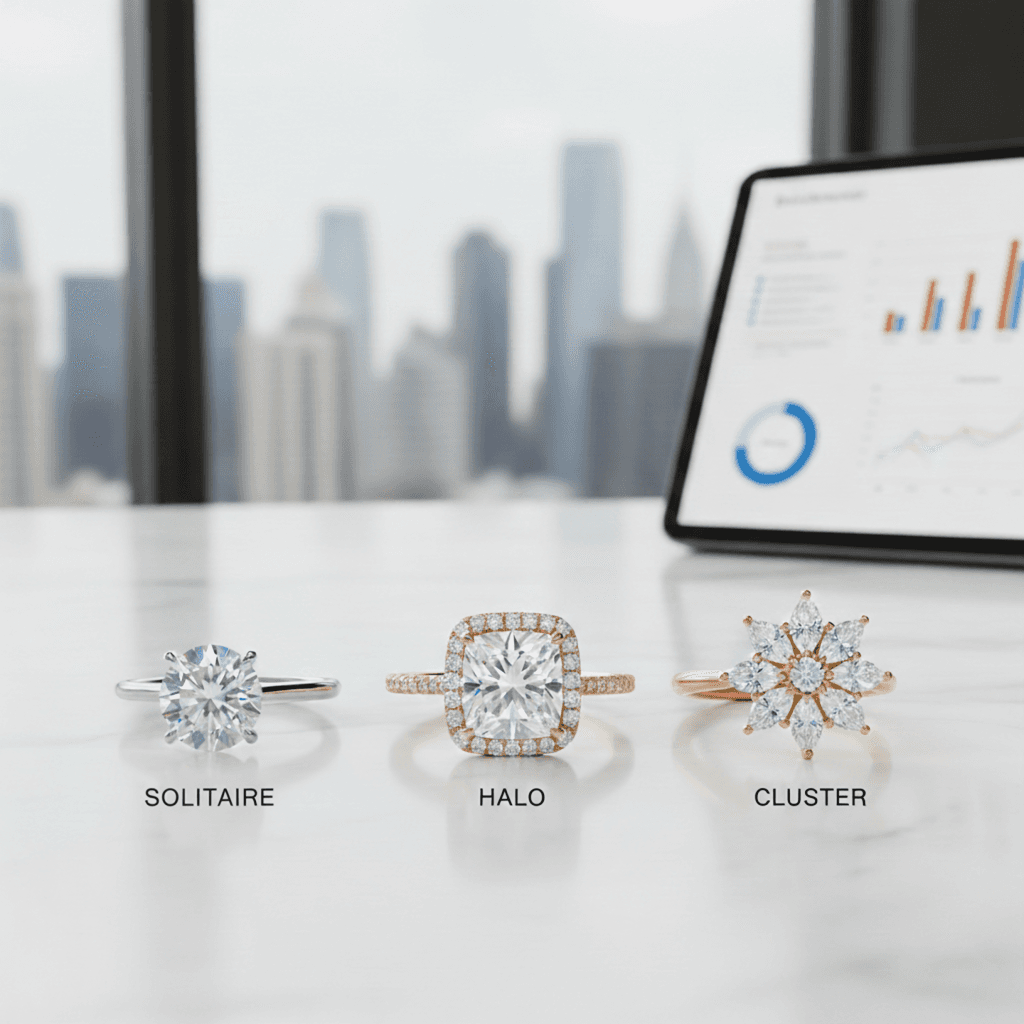
Solitaire: Classic and timeless, lets the moissanite's brilliance take center stage. The clean design works with any stone size.
Bezel: The metal rim slightly reduces fire intensity, which some prefer for a more diamond-like appearance.
Three-Stone: Moissanite side stones matched to the center create cohesive sparkle at a fraction of all-diamond cost.
Settings to Consider Carefully
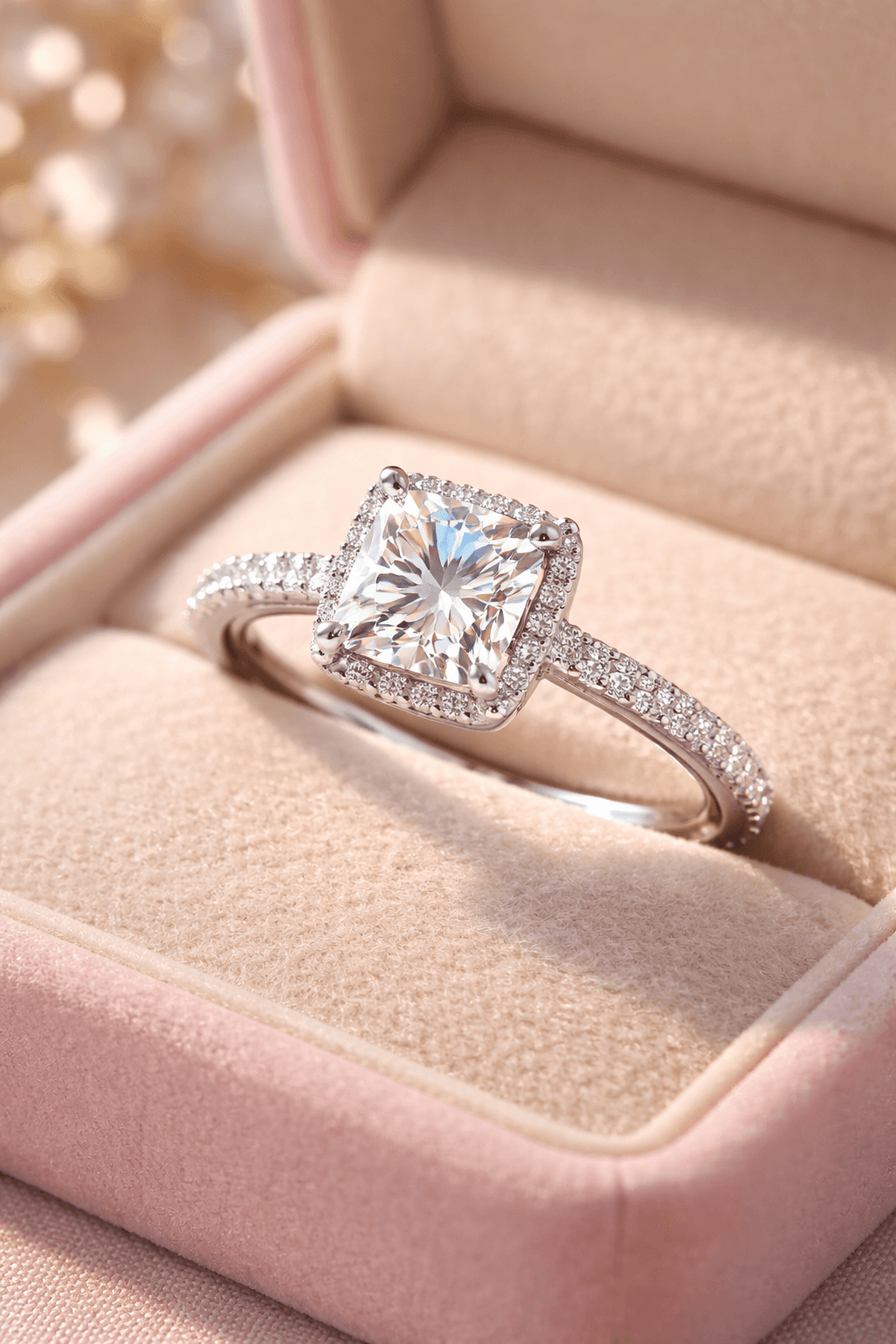
Halo: Surrounding a moissanite with smaller moissanites amplifies the already-intense fire. Some love this; others find it excessive.
Pavé Bands: Moissanite pavé creates continuous sparkle but can emphasize the "disco ball" effect if that concerns you.
Metal Pairing
Moissanite works beautifully with all metals:
- White gold/Platinum: Enhances colorless appearance
- Yellow gold: Warm contrast, vintage feel
- Rose gold: Romantic, trendy aesthetic
Design Your Moissanite Ring with Tashvi AI
Visualizing your perfect moissanite engagement ring before purchasing helps ensure you'll love the final result. Tashvi AI lets you design custom moissanite rings with photorealistic rendering. (Wondering how it stacks up against other options? See our hands-on comparison of the 9 best AI jewelry design tools.)
How to Design Moissanite Rings with AI
1. Visit the Create Page: Go to design.tashvi.ai/create and describe the ring you want — or choose Guided design to be walked through it step by step.
2. Specify Your Vision: Describe your ideal ring including:
- Stone shape (round, oval, cushion, emerald, pear)
- Setting style (solitaire, halo, three-stone, vintage)
- Metal choice (white gold, yellow gold, rose gold, platinum)
- Any special details (pavé band, hidden halo, split shank)
3. Generate Designs: The AI creates photorealistic renderings in seconds, showing exactly how your moissanite ring will look.
4. Refine and Compare: Adjust elements, try different shapes, compare settings side by side.
Example Moissanite Ring Prompts
Classic Solitaire:
Elegant solitaire engagement ring with 2-carat oval moissanite,
platinum four-prong setting, thin polished band, clean modern design
Vintage-Inspired:
Art deco moissanite engagement ring with emerald cut center stone,
white gold, milgrain details, baguette side stones, geometric patterns
Modern Halo:
Round brilliant moissanite with delicate diamond halo, rose gold
cathedral setting, hidden halo under the center stone, pavé band
Why Design Before You Buy
- Visualize exact proportions: See how different carat sizes look on a hand
- Compare stone shapes: Oval vs. cushion vs. round—which suits you?
- Test settings: Solitaire might seem boring until you see it rendered beautifully
- Avoid expensive mistakes: Discover preferences before spending money
- Get manufacturing specs: Take your Tashvi design to any jeweler for production
Start designing your moissanite ring →
Who Should Choose Moissanite?
Moissanite is ideal for:
Budget-conscious couples who want maximum visual impact without maximum spending. The 90% savings allows either larger stones or more money for wedding, honeymoon, or savings.
Ethical prioritizers who want guaranteed conflict-free, environmentally minimal impact without researching diamond supply chains.
Size maximizers who want a 2-3 carat look without the $20,000-$60,000 price tag.
Extra sparkle lovers who appreciate moissanite's superior fire and brilliance rather than viewing it as a drawback.
Practical romantics who see the ring as a symbol of commitment, not a financial investment.
Who Should Choose Diamond?
Diamond remains the better choice for:
Traditionalists who value diamond's cultural significance and historical associations with engagement.
Potential resellers who want some recoupment possibility if circumstances change.
Heirloom creators who intend the ring to pass through generations with traditional value.
Subtle sparkle lovers who find moissanite's fire excessive and prefer diamond's more understated brilliance.
Those who would always wonder if they'd regret not getting a "real" diamond—peace of mind has value.
How to Buy Moissanite: Practical Tips
Where to Buy
Recommended retailers:
- Charles & Colvard: Original moissanite patent holder, premium quality
- Brilliant Earth: Ethical focus, good settings
- MoissaniteCo: Competitive pricing, variety
- Local jewelers: Many now carry moissanite; allows in-person viewing
Avoid:
- Unknown online sellers without reviews
- Prices that seem too good (quality varies significantly)
- Anyone calling moissanite "synthetic diamond" (it's not)
What to Request
- Color grade documentation: Ensure DEF if colorless matters to you
- Cut quality information: Hearts and Arrows or Ideal cuts perform best
- Warranty/Guarantee: Reputable sellers offer lifetime warranties
- Return policy: 30+ days to evaluate in various lighting conditions
Setting Expectations
When your moissanite arrives:
- View in multiple lighting conditions (sunlight, indoor, dim)
- Compare fire/brilliance to your expectations
- Check for any visible inclusions (rare but possible)
- Verify setting quality and comfort
Frequently Asked Questions
Can a jeweler tell moissanite from diamond?
Experienced jewelers may notice differences in fire intensity and can definitively identify moissanite using electrical conductivity testers or magnification (double refraction). However, many jewelers appreciate moissanite as a legitimate gemstone choice.
Will moissanite scratch or chip?
Under normal wear, no. Moissanite's 9.25-9.5 hardness resists scratching from everyday activities. It's harder than sapphire and won't chip from normal impacts. Decades of daily wear won't visibly degrade the stone.
Does moissanite turn yellow or cloudy?
No. Unlike cubic zirconia, moissanite maintains its color and clarity permanently. The crystal structure is stable and doesn't degrade. A moissanite today will look identical in 50 years.
Is moissanite a "fake diamond"?
No. Moissanite is its own gemstone with distinct properties—silicon carbide versus carbon. It's not attempting to be diamond any more than sapphire or emerald are. However, it serves as a diamond alternative for engagement rings due to visual similarity.
How should I clean moissanite?
Clean moissanite the same way you'd clean diamonds: warm water with mild dish soap, soft brush, rinse thoroughly. Ultrasonic cleaners and steam cleaners are also safe. Moissanite is highly stable and tolerates all standard jewelry cleaning methods.
Can I insure a moissanite ring?
Yes. Most jewelry insurance policies cover moissanite rings based on replacement value. Since moissanite costs less, premiums are lower than comparable diamond coverage.
Conclusion: Making Your Decision
The moissanite vs. diamond decision ultimately comes down to priorities:
Choose moissanite if you want maximum beauty per dollar, ethical certainty, and care more about appearance than resale value or tradition.
Choose diamond if cultural significance, potential resale value, and the "real thing" matter to you emotionally or practically.
Neither choice is wrong. Both create stunning engagement rings that will last a lifetime. The question is which set of trade-offs aligns with your values and circumstances.
In 2026, moissanite offers an exceptional value proposition—a gorgeous, durable, ethical gemstone at 10% of diamond's cost. For many couples, that math is simply too compelling to ignore.
Whatever you choose, the ring symbolizes your commitment. That meaning doesn't change based on what the stone is made of.
Next steps: Once you've decided on your stone, check out our complete engagement ring buying guide for setting styles, metal selection, and sizing tips. For wedding bands to match, see our wedding bands guide 2026.
Ready to design your perfect moissanite ring? Start creating with Tashvi AI and visualize your dream ring in photorealistic detail—before you spend a single dollar.
Frequently Asked Questions
Quick answers to the questions readers ask most about this guide.
Can you tell the difference between moissanite and diamond?
To the naked eye, most people cannot distinguish moissanite from diamond. However, trained jewelers can spot differences: moissanite has more colorful 'fire' (rainbow flashes), while diamonds have more white brilliance. Under magnification, moissanite shows double refraction (doubled facet edges), which diamonds never exhibit.
Is moissanite as durable as diamond for everyday wear?
Nearly. Moissanite rates 9.25-9.5 on the Mohs hardness scale versus diamond's 10. For practical purposes, moissanite is extremely scratch-resistant and suitable for daily wear engagement rings. It's harder than sapphire (9) and won't scratch from normal activities.
How much cheaper is moissanite than diamond?
Moissanite costs 80-90% less than equivalent diamonds. A 1-carat equivalent moissanite costs $300-600, while a comparable natural diamond costs $4,000-8,000. Even versus lab-grown diamonds ($800-1,500), moissanite offers 50-70% savings. Pricing data from Charles & Colvard (original moissanite manufacturer), Rapaport Price List, and Tenoris retail analytics.
Does moissanite lose its sparkle over time?
No. Moissanite maintains its brilliance permanently. Unlike cubic zirconia which clouds and scratches, moissanite's hardness and stable crystal structure ensure it looks identical decades later. It requires no special maintenance beyond normal jewelry cleaning.
Will moissanite pass a diamond tester?
Basic thermal diamond testers often identify moissanite as diamond because both conduct heat similarly. However, modern dual testers (thermal + electrical conductivity) can distinguish them. Moissanite conducts electricity while diamond does not.
What is the difference between moissanite and cubic zirconia?
Moissanite (hardness 9.25-9.5) is far more durable than cubic zirconia (hardness 8-8.5). CZ scratches, clouds, and yellows within 2-5 years of daily wear, while moissanite maintains its brilliance permanently. Moissanite costs more ($300-600 per carat) but lasts a lifetime; CZ is cheap ($20-50) but disposable. Hardness ratings per GIA Gem Encyclopedia; pricing per Charles & Colvard and standard CZ retail.
What is the best moissanite brand to buy?
Charles & Colvard (Forever One line) is the premium standard—they invented gem-quality moissanite and offer lifetime warranties. Brilliant Earth offers excellent settings with ethical branding. MoissaniteCo provides good mid-range value. Avoid unknown sellers; quality varies dramatically.
Is moissanite good for a wedding ring?
Yes. Moissanite's 9.25-9.5 hardness makes it ideal for daily wear wedding rings and bands. It won't scratch, cloud, or degrade over decades of continuous wear. Many couples choose moissanite wedding bands to match their moissanite engagement rings for a cohesive, affordable bridal set.