Should I Buy Jewelry from Stores Using AI Product Photos? A 2026 Shopper's Guide
AI jewelry photography is everywhere in 2026 — and most shoppers can't tell. Here's when AI product photos are trustworthy, when they're a red flag, and the six-item checklist to vet any retailer before you buy.
The Short Answer: Yes, but Only When the Retailer Is Transparent
If you've been shopping online recently, you've almost certainly bought — or nearly bought — jewelry photographed or enhanced with AI. Catalog shots, lifestyle scenes, even model hand shots are increasingly AI-generated. And in 2026, most shoppers can't tell the difference on a first glance.
That's not automatically a problem. The question isn't "is this photo AI" — it's "does this photo truthfully represent the piece I'm about to receive, and can I verify it?" A disclosed, accurate AI image backed by a lab certificate and a 360° video is often more trustworthy than an undisclosed studio photograph shot under inconsistent lighting.
This guide walks through what consumers actually think about AI jewelry photos, what the technology can and can't do, the current disclosure rules (FTC, California AB 853, EU AI Act), and a practical six-item checklist to vet any retailer before you buy.
What Shoppers Actually Think About AI Product Photos in 2026
The consumer data is unambiguous: shoppers don't hate AI, but they do demand to know about it.
- ~90% of consumers want to know whether an image was created with AI, per Getty Images' VisualGPS survey of 30,000+ adults across 25 countries. 98% say authentic imagery is pivotal to trust, and 76% agree "it's getting to the point I can't tell if an image is real." (Getty Images
- 75% of Americans would lose trust in AI shopping if recommendations were commercially influenced without disclosure; only 3% fully trust AI neutrality. (Quad
- 76% of consumers would switch brands for better AI transparency, and 82% see AI data control as a serious threat. (Relyance 2025 Consumer AI Trust Survey
The pattern across every recent survey is the same. Shoppers accept AI imagery when it's disclosed and backed by verification. They punish brands that hide it. The retailers who win are the ones who label clearly, not the ones who try to sneak AI past their customers.
What AI Photography Can (and Cannot) Legitimately Do for Jewelry
Jewelry is one of the hardest product categories for AI image generation. A diamond's brilliance depends on exact facet geometry and real-world light physics. A gold alloy's color depends on karat and mix. A pavé setting's sparkle depends on dozens of tiny stones set at precise angles. Prompt-only image generation — "make me a rose gold halo ring" — routinely gets these wrong.
What well-run AI photography does accurately
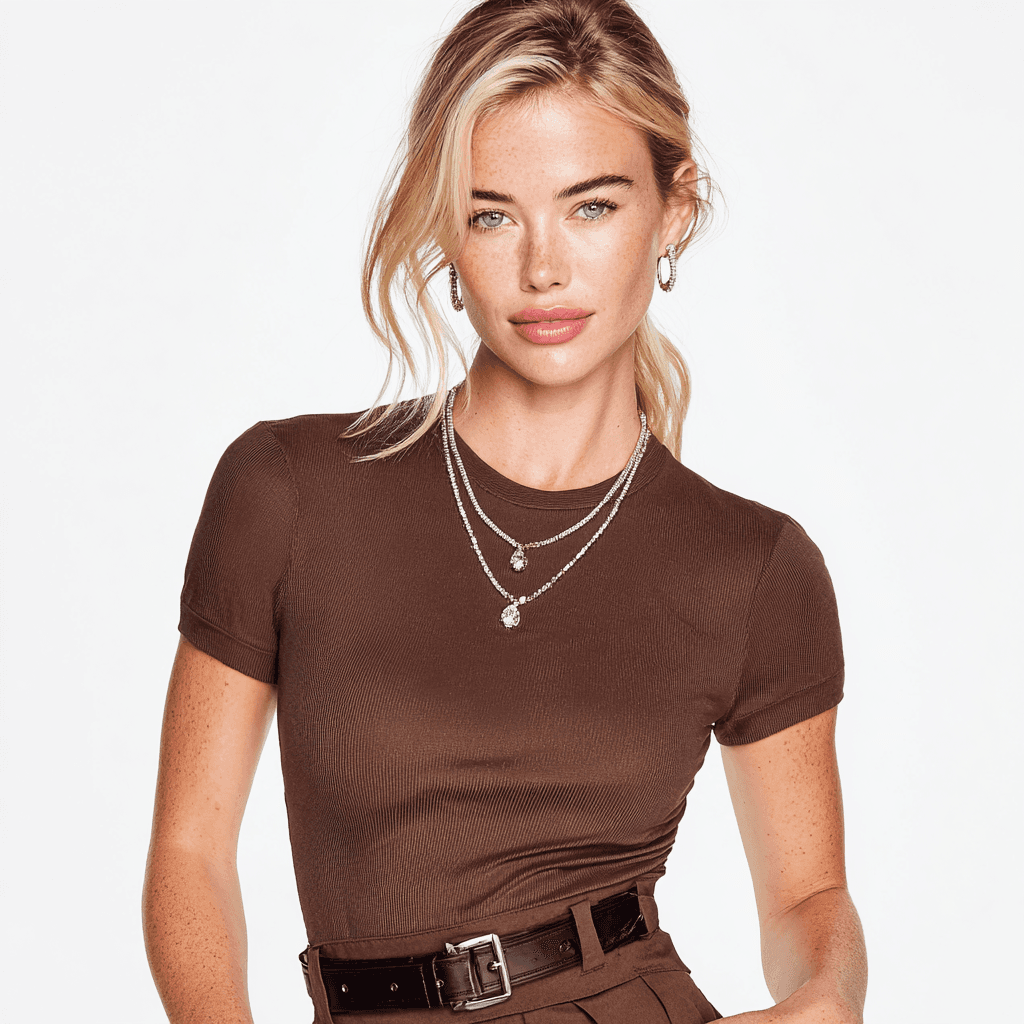
When AI is applied as an enhancement layer on top of a real product photo — the technique most ethical tools (including Tashvi use — it can reliably:
- Replace backgrounds and place the piece in lifestyle scenes
- Normalize lighting and color temperature across a catalog
- Generate model shots from a flat product photo
- Produce clean white-background e-commerce images at scale
The physical piece — its facet count, stone position, prong geometry, hallmark stamp — stays intact because it's sourced from a real photograph of the real item.
What AI photography cannot accurately do
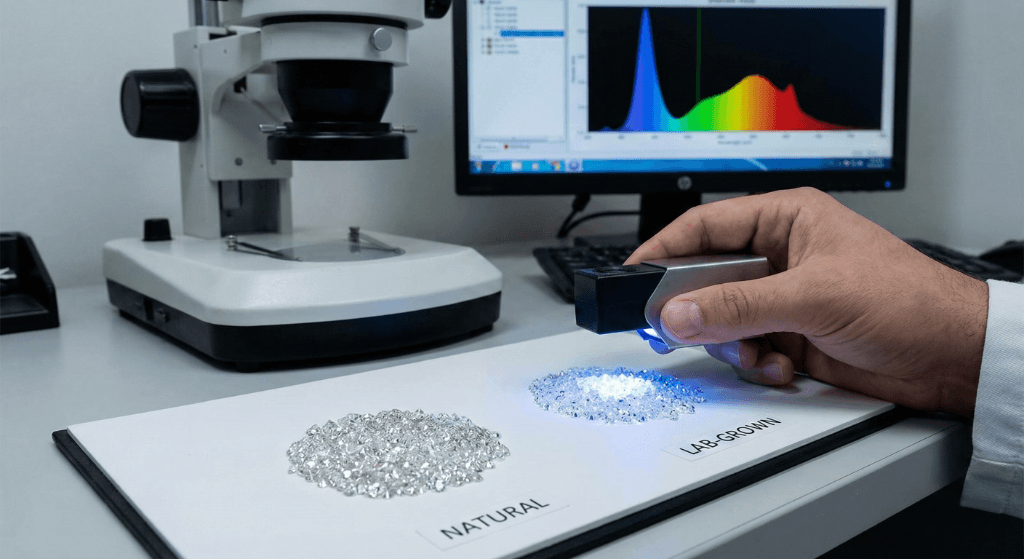
Prompt-only generation ("design me a 1-carat oval halo") mathematically averages training-data pixels. That's fine for a mood board, disastrous for a purchase decision. Research from Imagework India documents how Firefly, Midjourney, and comparable tools routinely hallucinate flat, matte textures where a diamond's specular highlights should be and alter prong count or setting geometry. If the photo you're looking at was generated without a real product as the source, it's essentially a sketch dressed up as a photograph — and the piece you receive is unlikely to match it.
This is the line that matters when you're evaluating a retailer. It's not "does this brand use AI?" It's "is the AI starting from the real piece?"
The Rules of the Road: FTC, California AB 853, and the EU AI Act
Disclosure isn't just ethics — it's increasingly law.
FTC (United States, nationwide)
The FTC's August 2024 final rule on fake and AI-generated reviews (effective October 21, 2024) prohibits deceptive AI-generated endorsements and testimonials. More broadly, the FTC's Operation AI Comply actions against Rytr (December 2024) and IntelliVision (January 2025) made clear that any AI-generated marketing claim that could mislead consumers must be "clearly, conspicuously, and timely" disclosed. There is no AI exemption from Section 5 of the FTC Act.
For jewelry retailers specifically, the FTC's Jewelry Guides already require accurate representation of stones, karat, and origin. Putting a stone in an AI-generated scene is fine. Misrepresenting the stone itself is not.
California AB 853 (effective phased through 2027-2028)
California AB 853, signed October 13, 2025, requires AI-generated images to carry provenance signals (both visible "manifest" and embedded "latent" disclosures). Large platforms must support provenance detection by January 1, 2027. Capture-device manufacturers must support disclosure embedding by January 1, 2028. Retailers who sell to California shoppers should expect to comply — and the practical move is to comply everywhere.
EU AI Act Article 50
For retailers selling into Europe, the EU AI Act's transparency obligations on AI-generated content begin enforcement in August 2026. Machine-readable disclosure (typically via C2PA / Content Credentials) becomes mandatory.
The net: in 2026, a jewelry retailer who uses AI imagery without disclosure is already on the wrong side of FTC guidance and weeks or months away from state and EU enforcement exposure. A retailer who discloses clearly — with C2PA credentials, a disclosure badge, or plain text — is doing what the law already expects.
The Six-Item Checklist: How to Vet Any Jewelry Retailer Before You Buy
Use this regardless of whether you think the photos are AI or not. It's a generally good online-jewelry checklist — AI just makes it more important.
| Check | What to look for | Red flag |
|---|---|---|
| 1. AI disclosure | Plain-language statement ("Some product imagery is AI-enhanced from real product photos") or C2PA / Content Credentials badge | No mention of AI anywhere on the site |
| 2. Video of the actual piece | 360° spin video or 20-second walk-around of the exact SKU you're buying | Only still images; seller won't provide video on request |
| 3. Lab certificate | GIA, IGI, or AGS report number you can verify on the lab's site | "Appraised by in-house expert" with no independent report |
| 4. Hallmark & engraving close-ups | Macro shot of the purity stamp (10K/14K/18K/950Pt) and any laser inscription | No stamp visible, or blurry "we can confirm after purchase" shots |
| 5. Return window | 14-30 day no-questions return with the piece unworn | "Final sale" or "custom order, no returns" on stock items |
| 6. Third-party reviews | Trustpilot, Google Reviews, or BBB with specific mentions of "the piece matched the photos" | Only onsite testimonials, or all 5-star reviews dated within a week |
A retailer that passes all six is worth buying from — whether or not they use AI. A retailer that fails two or more is risky even if every photo was shot in a traditional studio.
For more on the buyer-side checks that matter, see our guide to buying an engagement ring without getting ripped off and how to tell if gold jewelry is real at home.
Why Ethical AI Photography Is Actually Better for Consumers
The pushback against AI jewelry imagery is usually framed as a consumer-protection issue. It can be. But ethically-deployed AI is, in several meaningful ways, better for the person buying the ring.
Consistent color across a catalog. Studio photography drifts. Different photographers, different days, different white balance. You've probably bought a piece that looked warmer on screen than in the box. AI applied from a single color-calibrated source can hold lighting constant across an entire collection — which actually makes it easier to compare platinum vs white gold vs rose gold variants of the same design.
Lifestyle context that used to be reserved for the top 1%. A styled photoshoot with models, a prop stylist, and a location costs $5,000-15,000, per Shopify's product photography cost guide and Thumbtack's commercial photography pricing benchmarks. Independent and ethical jewelry brands historically couldn't afford it — which meant they couldn't sit alongside De Beers and Tiffany on a Pinterest board. AI brings that production quality to brands you'd otherwise never discover.
Cheaper photography = cheaper jewelry. Photography is one of the largest overhead lines for an online jewelry brand. Lowering it lowers retail prices, widens margins for ethical-sourcing programs, or both.
More angles, more detail, more confidence. It's now routine for an ethical brand to ship a 36-frame spin video plus 8 macro shots per SKU because AI handles background and lighting consistency. The old floor of "one catalog shot plus a side angle" is gone.
So — Should You Buy?
Yes, if:
- The retailer discloses AI use
- You can see a video of the actual piece
- A lab report backs the stones
- Returns are available
- The imagery starts from the real product (not prompt-generated from scratch)
No, if:
- The brand won't answer a simple "are these AI" question
- You can't see the piece from multiple angles in unedited video
- The "certificate" is in-house only
- Returns are forbidden on stock items
AI product photography isn't the villain. Opaque sellers are. The good news is that the same six-item checklist protects you from bad actors whether the imagery is shot with a DSLR, rendered in Keyshot, or enhanced with AI.
For the detection side of the equation, see How to Tell if Jewelry Photos Are AI-Generated — the visual tells, metadata inspection tricks, and C2PA verification tools that let you sanity-check any image yourself. And if you want the counter-argument — the case that some brands make against AI imagery entirely — we steelman it in Why Some Jewelry Brands Won't Use AI for Product Photos.
How Tashvi Approaches This
Tashvi's AI jewelry photography starts from real product inputs — the actual ring, pendant, or pair of earrings you're receiving. The physics of the stone, the cut geometry, the hallmark stamp, the metal color: all preserved from the source photograph. What AI adds is the scene — lighting, background, model context — not the jewelry itself.
That distinction is the line between "AI photography that helps consumers" and "AI photography that harms them." We think the industry is converging on it, and the regulatory pressure is going to accelerate that shift through 2026 and 2027.
Related Guides
- How to Tell if Jewelry Photos Are AI-Generated — The visual tells, metadata, and verification tools
- Best AI for Jewelry Photography 2026 — How AI product photography actually works
- AI Jewelry Rendering vs Traditional Photography — Cost, quality, and use-case comparison
- How to Buy an Engagement Ring Without Getting Ripped Off — The broader online-jewelry due diligence checklist
See how Tashvi generates AI jewelry photography from your real product — design.tashvi.ai →
Frequently Asked Questions
Quick answers to the questions readers ask most about this guide.
Is it safe to buy jewelry from a store that uses AI-generated product photos?
Yes, provided the retailer discloses AI use, provides a 360° video or multi-angle real photographs of the actual piece you're receiving, and backs the purchase with a certification (GIA, IGI, AGS) or a money-back return window. Ethical AI photography enhances real product inputs — it doesn't invent the jewelry. The risk is with sellers who hide AI use or generate images from prompts without a physical piece behind them.
How can I tell if a ring in a photo is real before I buy?
Ask for a short video of the actual piece from multiple angles, request the lab certificate number (GIA, IGI, or AGS) and verify it on the lab's website, look for macro shots of the hallmark stamp and laser inscription, and check that the retailer offers an inspection window on return. If the seller can't provide a live video or certificate, that's a red flag regardless of whether the photo is AI-generated.
What does the FTC say about AI-generated product photos?
The FTC's August 2024 final rule on fake and AI-generated endorsements (effective October 21, 2024) requires any AI-generated marketing imagery that could mislead consumers about a product to be clearly and conspicuously disclosed. In 2024-2025 the FTC acted against Rytr and IntelliVision for deceptive AI marketing. FTC Chair statements are explicit: there is no AI exemption from existing consumer protection law.
Does California's AI Transparency Act apply to jewelry retailers?
California AB 853, signed October 13, 2025, requires AI-generated images to carry provenance signals (both visible and embedded). Large platforms must be able to detect that provenance data by January 1, 2027. Jewelry retailers selling to California consumers should expect to comply — which is reasonable disclosure practice to follow anywhere in the US.
Is AI jewelry photography actually more accurate than studio photography?
It can be. Studio photography inconsistencies — different photographers, different white balance, different lighting — create color drift across a catalog. Well-run AI photography applied to real product inputs gives consistent lighting and color across every SKU, making it easier to compare pieces. The trade-off: it has to start from the actual physical piece to be accurate. Fully prompt-generated images are not.
How does Tashvi handle AI jewelry photography ethically?
Tashvi generates scene and lifestyle imagery from real product inputs — the actual ring, necklace, or earring the buyer is receiving. We don't synthesize fake jewelry from a prompt. Facet count, stone geometry, metal color, and hallmarks are preserved from the source photograph. See our full approach at design.tashvi.ai.