Best Jewelry Inventory Software for Small Businesses (2026): 9 Options Compared, With Prices
Nine jewelry inventory and POS systems compared on price, per-piece tracking, metal rates, repairs and memo: Tashvi One, Jewel360, The Edge, Gem Logic, CaratIQ, Lightspeed, Square, Zoho Inventory and Stocksmith (formerly Craftybase), plus jewellery software for India.
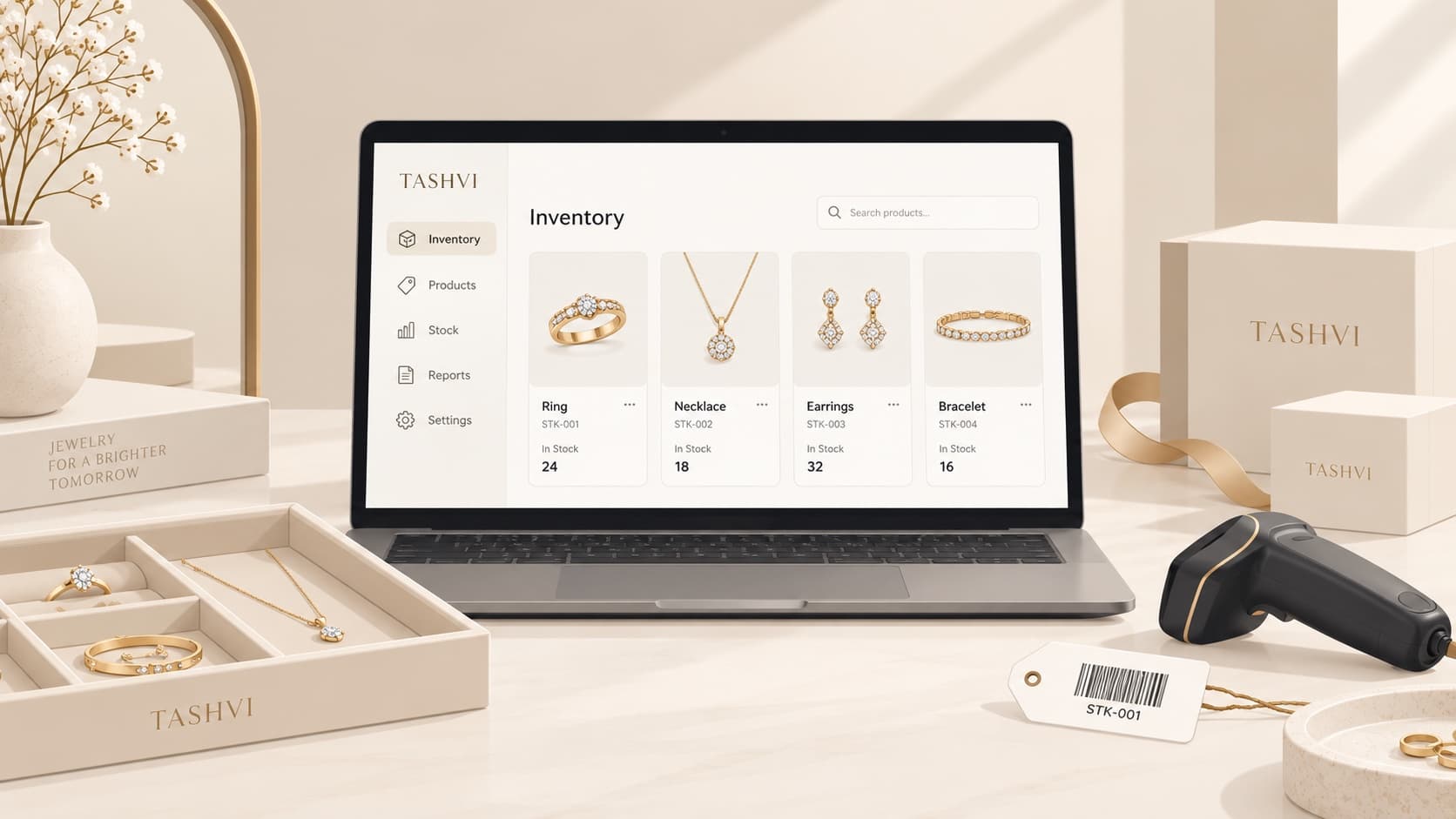
What is the best jewelry inventory software for a small business? For a small store, designer or workshop moving off a spreadsheet, start with Tashvi One. It is free, built for jewelry, and tracks every piece by weight and purity, with metal rates, invoices and stocktakes. Stores that run on repairs, memo and trade-ins every day should compare Jewel360 (from $199 a month) and The Edge (quote only). If you buy old gold over the counter, look at Gem Logic. If you need a general point of sale and can live without serial numbers, Square for Retail has a free plan. If you make jewelry rather than sell finished stock, Stocksmith (formerly Craftybase) costs your materials piece by piece.
Disclosure: Tashvi publishes this guide and makes Tashvi One. We list it first because it is the only free option here built for jewelry, and because we know it best. It is also the newest tool on this list, and it doesn't yet do repairs, memo or old gold, which several of the others do. Weigh that, and check each vendor's price on its own site before you buy.
Prices checked October 29, 2026, in US dollars unless stated. Each price comes from the vendor's own pricing page. Where a vendor doesn't document a feature, we say "ask for a demo" rather than guess.
Quick picks
| Tool | Price from | Best for |
|---|---|---|
| Tashvi One | Free | Small stores, designers and workshops leaving a spreadsheet |
| Jewel360 | $199/mo | Independent stores that want a cloud POS with repairs and memo |
| The Edge | Quote | Established stores built around repairs, appraisals and memo |
| Gem Logic | $239/mo | Stores that buy old gold at the counter |
| CaratIQ | $300/mo | One system for POS, website and marketing |
| Lightspeed Retail | $89/mo | Stores selling jewelry alongside other goods |
| Square for Retail | Free | A free POS for a small counter |
| Zoho Inventory | Free, serials $79/mo | Online sellers who want serial tracking for less |
| Stocksmith | $20/mo | Makers costing materials piece by piece |
Jewel360, Gem Logic, CaratIQ and Zoho prices are for annual billing; paying monthly costs more.
What jewelry inventory software has to do
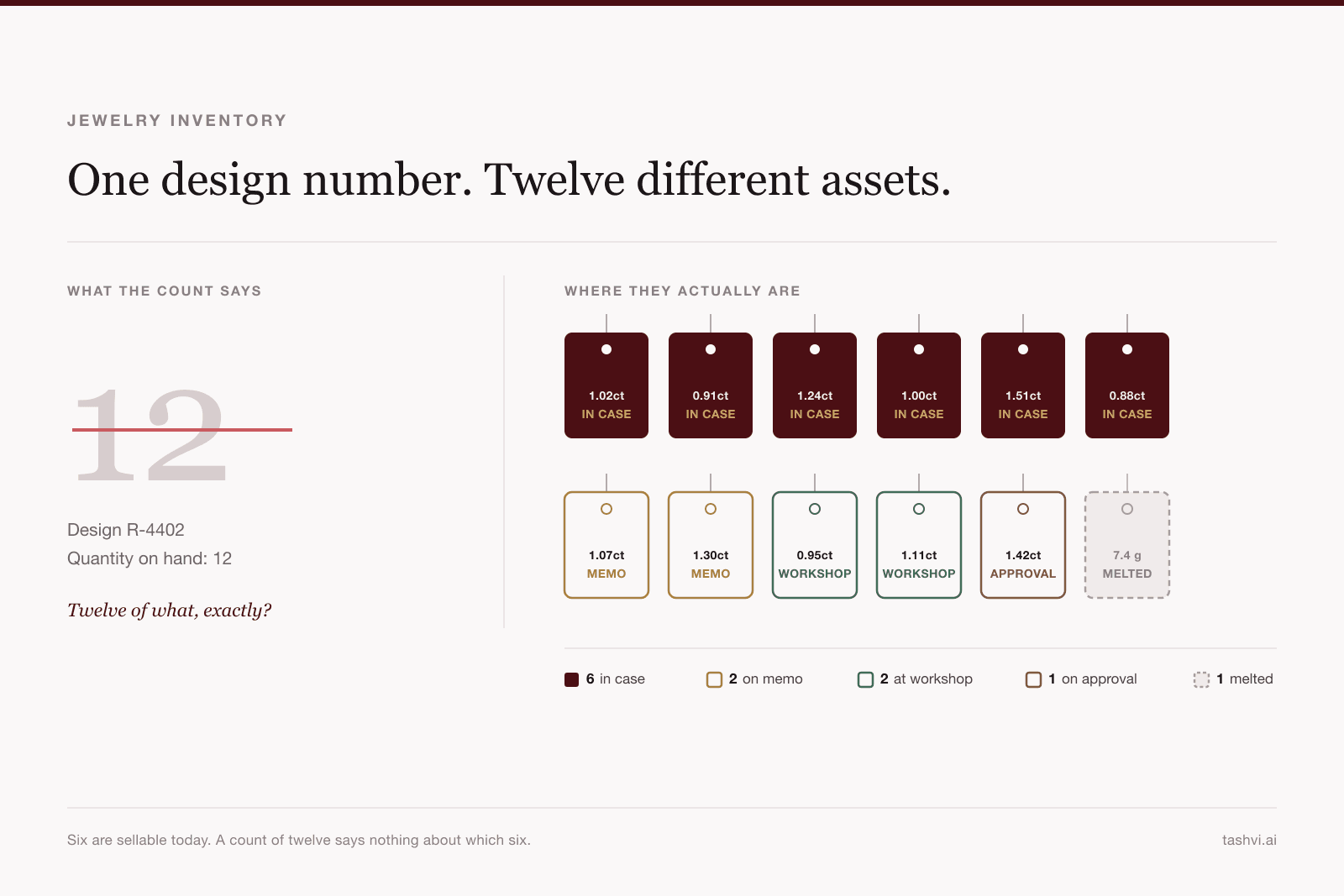
Generic inventory tools count units: sell one, the count drops by one. Jewelry doesn't work that way. Two rings of the same design can weigh different amounts, hold different stones and have cost different sums, and their value moves with the metal rate after you buy them. Before comparing tools, decide which of these you need:
- One record per piece. Called serialized or item-level inventory. Without it, "12 halo rings" doesn't tell you which twelve.
- Weight, metal and purity as real fields, and prices that follow a metal rate if you sell by weight.
- Tags that match the record. A barcode tag printed from the system, so the tray and the screen agree.
- Stock that leaves without being sold. Memo and consignment, pieces at a workshop, customer repairs.
- Tax on the invoice. Sales tax, VAT, or GST with HSN and HUID in India.
- Counts you can reconcile. A stocktake that compares what you found with what should be there.
We go deeper on each in what jewelry ERP and inventory software actually solves.
The 9 options, compared
1. Tashvi One: best free jewelry inventory software (our product)
Price: Free on every Tashvi account, including the Free plan. No trial clock, and it doesn't use design credits. The Tashvi Assistant inside it, which answers questions about your stock and prepares changes for you to confirm, is included on paid plans from $20 a month.
Best for: independent jewelry stores, designers who sell what they make, and small studios and workshops moving off a spreadsheet.
What it does:
- Every piece is its own tagged record with gross weight, metal, purity, cost and location. India shops can record HUID.
- Metal rates per gram for each metal and purity. In shops that price by weight, new sales are priced from the latest rate, and issued invoices keep their prices.
- Sales run quote, hold, deposit, invoice and payment, with returns and refunds. Invoices carry India GST (HSN, weight, purity and HUID per line), US sales tax or EU VAT.
- Supplier deliveries are booked in with freight and duty spread across the lines as landed cost.
- Stocktakes compare scanned or pasted tags with what should be there, for an owner or manager to approve.
- Eight stock reports, including dead stock and top movers, with CSV export of reports, products and stock.
- Import from a file reads Excel, CSV, Word, PDF and photos of a printed or handwritten stock list. You check every row before anything is booked in. Add from photo fills in a new product's details from a picture.
- It is part of Tashvi, the AI assistant for jewelers, so the same account also designs jewelry, builds STL and STEP files for casting and makes marketing photos.
What it leaves out: From its own screens, Tashvi One can't yet scan barcodes at the sales counter, send goods out on memo, to a workshop or for repair, record supplier returns or payments, reconcile a cash register, or show financial statements. It doesn't handle old-gold exchange, gold schemes or girvi. It runs in the browser, on a computer or phone, with no app to install.
The full feature list is in Tashvi One: free jewelry inventory software.
2. Jewel360: best cloud POS for independent jewelry stores
Price: The Startup plan is $199 a month, billed annually. The Core and Plus plans are priced by quote. There is a $750 setup fee for data migration and configuration; in October 2026 Jewel360 was refunding it for new customers once they go live and take payments through Jewel360. Hardware is extra. No free plan or trial is listed.
Best for: independent and multi-location jewelry stores that want point of sale, e-commerce and store workflows in one cloud system.
What it does:
- Startup: POS with integrated payments, pooled inventory, special orders, quotes, invoicing, e-commerce order fulfilment and a website editor, with unlimited users and products.
- Core adds serialized inventory, stone management, repairs and custom work, appraisals, memo, consignment, trade-ins, GIA and Geller's Blue Book integrations, QuickBooks and commissions.
- Plus adds multiple locations, Shopify, Avalara tax and email and SMS marketing.
What it leaves out: The one plan with a public price tracks pooled inventory, not individual pieces. Serialized pieces, repairs and memo start on Core, so get a Core quote before comparing it with the others here.
3. The Edge: best for stores built around repairs, appraisals and memo
Price: Quote only. The Edge's terms describe a licence fee that covers the first year, followed by a required annual service fee; the licence lapses if service does. Card payments carry a 3% fee.
Best for: established independent stores where repairs, appraisals, memo and trade-ins are daily work.
What it does:
- Serialized items with diamond attributes: cut, clarity, colour and carat.
- Memo and consignment stock tracked separately from stock you own.
- Barcode and RFID counts.
- Repairs and custom jobs with barcoded envelopes and automatic texts or emails, and Geller's Blue Book pricing.
- Appraisals, layaway, special orders and trade-ins at the register.
- Multiple locations, and website sync through Punchmark, GemFind and Shopify.
The Edge is made by Abbott Jewelry Systems and has been sold to jewelers since 2002.
What it leaves out: There is no published price, so you can't compare cost without a quote. It is a licence with a yearly service contract, not a month-to-month subscription. If you price by weight from a metal rate, ask how in a demo; its feature pages don't describe it.
4. Gem Logic: best for buying old gold at the counter
Price: The Essential plan is $239 a month billed annually, for one store and three users. Growth is $559 a month. Extra stores are $199 a month and extra users $29. An e-commerce website is $179 a month extra. There is a 14-day free trial. Gem Logic's site showed more than one price list in October 2026, so confirm the price in your trial.
Best for: stores that buy old gold over the counter and want prices to follow the live metal market, and groups with stores in several countries. Gem Logic says it serves jewelers in 17 countries, in 28 languages.
What it does:
- Old-gold buy-back priced from a live metal feed minus your margin, with the seller's ID and signature captured.
- Gold, silver, platinum and palladium price sync.
- Customer consignment, with memo stock kept apart from owned stock.
- Repairs in six stages with photos and SMS updates, and custom creations.
- Multiple stores with transfers between them, POS and invoicing.
What it leaves out: We couldn't confirm per-piece tracking on its pages; ask for a demo. The website is a paid add-on.
5. CaratIQ: best all-in-one POS, website and marketing
Price: Basic is $300 a month billed annually ($350 monthly), with three users per store and up to 20,000 items. Professional is $550 ($650 monthly) for five users and 50,000 items. Premium is $800 ($1,000 monthly) for seven users and 100,000 items. Extra users are $100 a month each. A free trial is offered.
Best for: stores that want the counter, the website and customer marketing in one subscription.
What it does: POS, layaways, special orders with status tracking, purchase orders from the POS, custom inventory fields, barcode and QR label printing, an e-commerce website that shares stock with the store, CRM with included SMS and email, contracts and forms, accounting and appointments.
What it leaves out: Its pages don't spell out repairs, memo and consignment, appraisals or per-piece serial tracking; ask for a demo. It has the highest starting price of the tools that publish one.
6. Lightspeed Retail: best for stores selling jewelry alongside other goods
Price: From $89 a month (Basic), $149 (Core) and $289 (Plus). Confirm whether your quote is for annual or monthly billing. Extra locations and registers cost more. No free plan.
Best for: stores that sell jewelry alongside other goods, or want a large general retail POS with a jewelry setup.
What it does: Lightspeed's jewelry store page lists serial numbers for each piece, attached certificates and appraisals, and repair work orders. Serialized items come with a serial number report, and there is a consignment workflow.
What it leaves out: Lightspeed sells two Retail versions, and serial numbers are built into one and a paid add-on in the other, so confirm which version you are being quoted. It isn't built around weight and metal rates.
7. Square for Retail: best free POS for a small counter
Price: Free, or Plus at $49 a month per location and Premium at $149. In-person card payments on the Free plan cost 2.6% + 15¢.
Best for: a small counter or market stall selling jewelry that comes in identical units, such as a fashion line.
What it does: POS, item variations such as size and metal, selling by weight in grams or ounces, low-stock alerts and barcode scanning. Plus adds barcode label printing, unit costs and cost of goods, inventory history, stock counts, vendors and purchase orders.
What it leaves out: No serial numbers. A Square community moderator wrote in September 2025 that there are no plans to add them, so two rings of the same design are one item with a count. No metal-rate pricing, repairs or memo.
8. Zoho Inventory: best low-cost serial tracking for online sellers
Price: Free for 50 orders a month, one user and one location. Standard is $29 a month and Premium $79 a month, billed annually, per organization, before tax. Serial and batch tracking start on Premium.
Best for: online sellers who already use Zoho, or want order management and serial numbers for less than a jewelry POS costs.
What it does: General inventory and order management, with serial and batch tracking, more users and more locations as you move up the plans (Premium: 3,000 orders a month, five users, four locations).
What it leaves out: It isn't built for jewelry: there are no purity fields, metal rates, repairs or memo. The Free and Standard plans have no serial tracking.
9. Stocksmith (formerly Craftybase): best for jewelry makers
Price: Pro is from $20 a month for one sales channel. Indie is $83 a month billed annually ($99 monthly), with 1,000 order lines a month and unlimited users. There is a 14-day free trial with no card needed.
The rename: Craftybase became Stocksmith on 1 July 2026. The company says it was not sold or acquired and prices didn't change; craftybase.com now redirects to stocksmith.io. Older reviews still use the old name.
Best for: makers selling handmade jewelry on Etsy or Shopify who need to know what each piece costs to make.
What it does: A bill of materials for each piece (wire, findings, stones), a real cost per piece, cost-of-goods reports, batch and lot tracking, and Etsy and Shopify sync.
What it leaves out: It isn't store software: no POS, repairs or memo.
Side-by-side comparison
| Tool | Free plan or trial | One record per piece | Metal rates | Repairs | Memo or consignment |
|---|---|---|---|---|---|
| Tashvi One | Free | ✅ | ✅ | Not yet | Not yet |
| Jewel360 | No | Core plan | Ask | Core plan | Core plan |
| The Edge | No | ✅ | Ask | ✅ | ✅ |
| Gem Logic | 14-day trial | Ask | ✅ | ✅ | ✅ |
| CaratIQ | Trial | Ask | Ask | Ask | Ask |
| Lightspeed Retail | No | ✅* | Ask | ✅ | ✅* |
| Square for Retail | Free plan | ❌ | ❌ | ❌ | ❌ |
| Zoho Inventory | Free plan | Premium plan | ❌ | ❌ | ❌ |
| Stocksmith | 14-day trial | Batch and lot | ❌ | ❌ | ❌ |
*Depends on which Lightspeed Retail version you buy. "Ask" means the vendor doesn't document it; ask for a demo.
What the first year costs
The lowest plan that does the job, before card fees and hardware:
| Tool | First-year software cost |
|---|---|
| Tashvi One | $0 |
| Square for Retail (Free plan) | $0 |
| Stocksmith (Pro) | $240 |
| Zoho Inventory (Premium, for serials) | $948 |
| Lightspeed Retail (Basic) | From $1,068 |
| Jewel360 (Startup) | $2,388, plus a $750 setup fee |
| Gem Logic (Essential) | $2,868 |
| CaratIQ (Basic) | $3,600 |
| The Edge | Quote |
Jewel360's Startup plan tracks pooled inventory; serialized pieces need the Core plan, which is priced by quote.
How to choose
- Do you need one record per piece? If you sell fine jewelry, yes. That rules out Square and the lower Zoho plans.
- Do you price by weight? You need metal rates in the system. Tashvi One and Gem Logic have them; ask the others to show you.
- How much of your stock is out of the store? If memo, consignment and repairs are daily work, shortlist Jewel360 Core, The Edge and Gem Logic.
- Do you buy old gold? Gem Logic, or in India, Marg or OMUNIM (below).
- Do you make or sell? Makers costing materials want Stocksmith. Stores want a POS.
- What does year one cost, all in? Add setup fees, extra users and locations, hardware and card processing to the monthly price.
- Can you get your data out? Ask for a CSV export of products and stock before you commit.
- Test with 20 real pieces before moving everything. Book them in, sell one, return one and count the tray.
Still on a spreadsheet?
A spreadsheet works until three things happen: you need one row per piece rather than per design, metal rates move and every price needs updating, and more than one person edits the file. We cover where each of these breaks in jewelry inventory in Excel: where the spreadsheet actually breaks.
You don't have to retype it to move. Tashvi One's Import from a file reads your existing Excel or CSV sheet, a PDF, or a photo of a printed or handwritten stock list, lays it out as products and pieces, and books nothing in until you've checked every row. Importing is free on every plan.
Jewellery software in India
Indian jewellers need more than a stock list: GST with HSN, HUID on hallmarked pieces, old-gold exchange, karigar job work with metal issued and received, and often girvi and gold savings schemes. Generic tools cover none of these. The options worth shortlisting:
- Marg ERP (jewellery): GST with e-invoice, e-way bill and TCS, HUID, old-gold exchange with purity conversion, karigar management (metal issue and receipt, labour, wastage), girvi with interest, weight and purity barcode tags, and multiple branches. Marg's ERP 9+ licences list from ₹5,550 to ₹26,000 plus GST, including a year of upgrades, with a yearly renewal after that. Ask which edition the jewellery features need. Free demo.
- OMUNIM (Online Munim): HUID, GST e-invoicing, karigar orders and metal issued to goldsmiths, girvi and gold loans, old-for-new exchange, barcode, QR and RFID tags, and a mobile app. Price on request, with a free start and demo.
- Zoho Inventory: from ₹999 a month billed annually, before GST. General inventory, not jewellery-specific.
- Tashvi One: free. It has an India GST profile, HSN, HUID on each piece and invoice line, weight and purity, and per-gram rates. It doesn't yet handle old-gold exchange, girvi, schemes or karigar job work.
If old gold and karigar accounts are daily work, Marg or OMUNIM fit better today. If you want tagged stock, weight-based pricing and GST invoices for free, start with Tashvi One and keep your karigar book alongside it. Our guide to jewellery inventory management in India explains why karigar accounts and old gold need their own records, and why a gold business runs two ledgers covers metal and money accounts.
How we compared
- Prices come from each vendor's own pricing page, checked October 29, 2026. Vendors change prices often, so check before you buy.
- Features come from vendor feature pages and help centres. Where a vendor doesn't document a feature, the table says "Ask" rather than assuming it is there or missing.
- We make Tashvi One. Everything we say about it describes screens a jeweler can open today, including what it doesn't do yet. We did not run a paid trial of every product, so treat a demo as the final test.
Related reading
- Tashvi One: free jewelry inventory software for stock, sales and billing. Everything it does, and how to set it up in 15 minutes
- Jewelry ERP and inventory software: what it actually solves. Serialization, metal-rate costing, memo stock and the compliance record
- Where a jewelry inventory spreadsheet actually breaks. Excel, Shopify and QuickBooks, and the four points they stop working
- How to run a jewelry stocktake without closing the store. Rolling counts, tray by tray
- Jewellery inventory management in India. Split GST, karigar accounts, old gold and HUID
Prices and features are as published by each vendor on the date above and can change. Tashvi is not affiliated with the other vendors named here. Tashvi One records tax on your sales; it is not tax, legal or accounting advice.
Frequently Asked Questions
Quick answers to the questions readers ask most about this guide.
What is the best jewelry inventory software for a small business?
It depends on how your shop works. For a small store, designer or workshop moving off a spreadsheet, Tashvi One is free and built for jewelry: one record per piece, weight and purity, metal rates, invoices and stocktakes. Tashvi publishes this answer and makes Tashvi One. Stores that run on repairs, memo and trade-ins every day should compare Jewel360 (from $199 a month, billed annually) and The Edge (quote only). Stores that buy old gold over the counter should look at Gem Logic. Makers who sell online should look at Stocksmith, formerly Craftybase.
Is there free jewelry inventory software?
Yes. Tashvi One is free on every Tashvi account and is built for jewelry, with tagged pieces, weight, purity, metal rates, invoices, supplier deliveries and stocktakes. Square for Retail and Zoho Inventory also have free plans, but they are general retail tools: Square has no serial numbers, and Zoho's free plan is limited to 50 orders a month without serial tracking.
How much does jewelry inventory software cost?
As checked in October 2026: Tashvi One is free. Square for Retail is free, or $49 to $149 a month per location. Zoho Inventory adds serial tracking at $79 a month billed annually. Stocksmith starts at $20 a month. Lightspeed Retail starts at $89 a month. Jewel360 starts at $199 a month billed annually, plus a $750 setup fee. Gem Logic starts at $239 a month billed annually. CaratIQ starts at $300 a month billed annually. The Edge sells a licence by quote, with a required annual service fee.
Can Square or Shopify track jewelry inventory?
They track products and counts, but not individual pieces. Square for Retail does not support serial numbers, and a Square community moderator wrote in September 2025 that there are no plans to add them. Shopify relies on third-party apps for serialized inventory. Neither prices pieces from a metal rate. Both work for jewelry sold as identical units, such as a fashion line, but not for fine jewelry where every piece has its own weight and stones.
What happened to Craftybase?
Craftybase renamed itself Stocksmith on 1 July 2026. Stocksmith says the company was not sold or acquired, prices did not change, and craftybase.com now redirects to stocksmith.io. Plans start at $20 a month, with a 14-day free trial.
What is the best jewellery software in India?
For a shop that runs old-gold exchange, karigar job work and girvi every day, Marg ERP's jewellery software and OMUNIM both cover GST, HUID, old gold and karigar accounts. Marg's ERP 9+ licences list from ₹5,550 to ₹26,000 plus GST; OMUNIM quotes on request. For free stock, weight-based pricing and GST invoices with HSN and HUID, Tashvi One is free, but it does not yet handle old gold, girvi or karigar job work.
What features does jewelry inventory software need?
Six things generic stock software usually lacks: one record per piece rather than a count, weight, metal and purity as real fields, prices that follow the metal rate, barcode tags that match the record, a way to track stock that is out on memo, at a workshop or in for repair, and invoices that carry the right tax, such as GST with HSN and HUID in India.