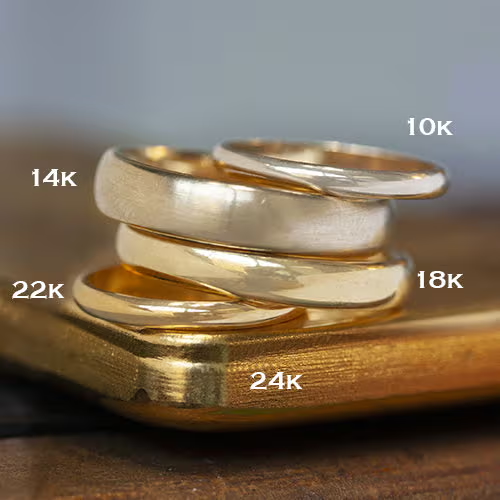
Rose Gold, Platinum or Yellow: What Actually Changes When You Switch Metal
Changing the metal changes the weight, the cost, the specifications, the maintenance schedule and sometimes the compliance position. Here is the density table, the conversion formula, and what actually shifts at the bench.
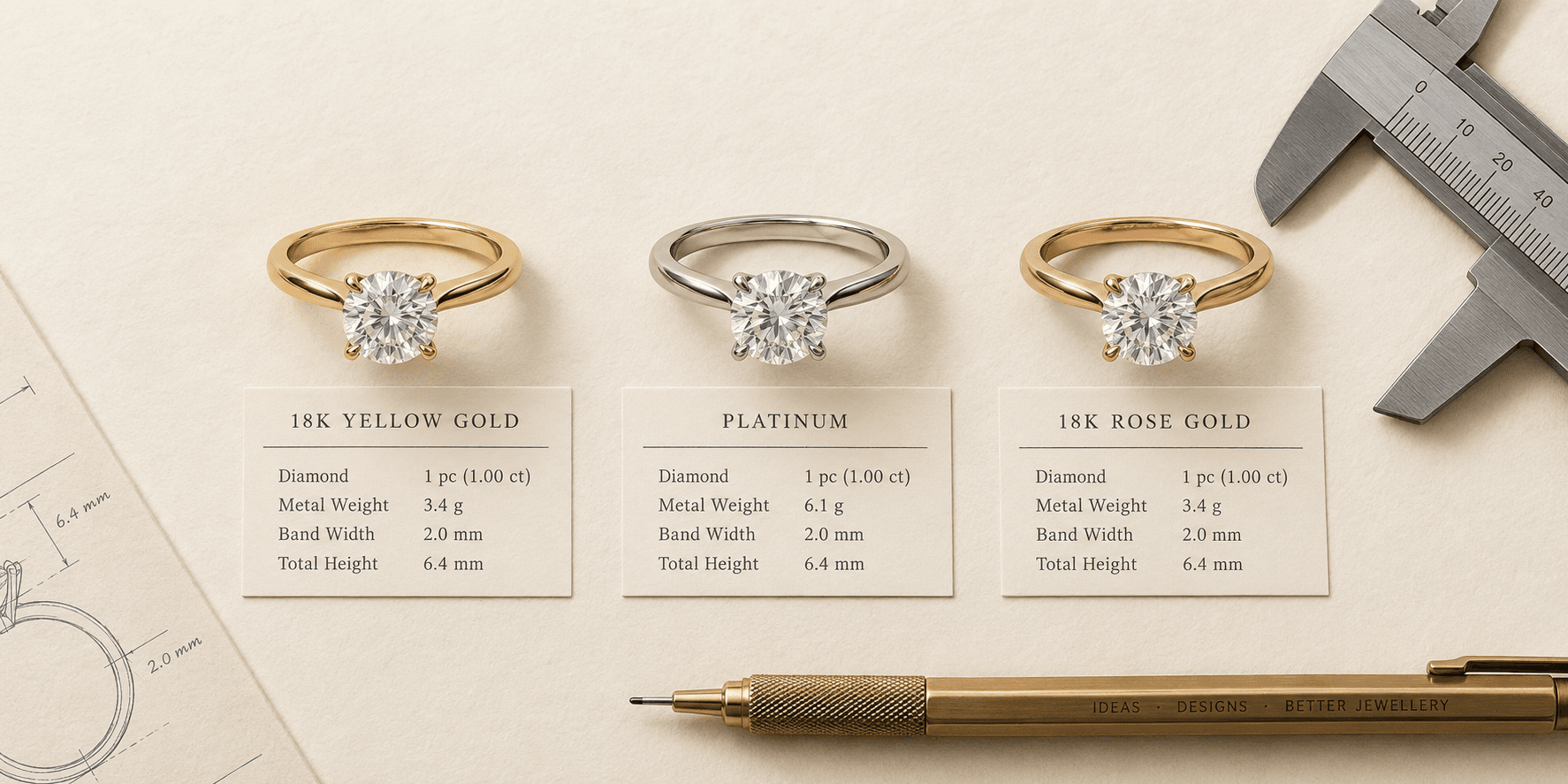
"Can I see it in rose gold?"
Across a counter, that sounds like a question about colour. It is answered in about four seconds and everyone moves on.
It is not a question about colour. Switching metal on an otherwise identical design changes the finished weight by up to half, moves the cost in two directions at once, alters what your bench has to do to set the stones, and commits your client to a maintenance schedule she has not been told about.
None of that is visible in a render. All of it turns up later.
1. The weight changes, and by more than people expect
Metals are not interchangeable by volume. A ring design occupies a fixed volume; what that volume weighs depends entirely on the density of the alloy poured into it.
Here are the working figures. These are industry reference densities — note that alloy recipes vary between suppliers, so treat them as close approximations rather than absolutes, particularly for white gold, where palladium-based and nickel-based formulations differ substantially.
| Metal | Density (g/cm³) |
|---|---|
| Platinum 950 | 20.0 – 20.9 |
| 24K gold (pure) | 19.32 |
| 22K gold | 17.75 |
| 18K yellow gold | 15.45 |
| 18K rose gold | 15.15 |
| 18K white gold | 14.8 – 16.5 |
| 14K rose gold | 13.10 |
| 14K yellow gold | 13.05 |
| 14K white gold | 12.75 |
| Palladium | 12.02 |
| Sterling silver 925 | 10.36 |
Published alloy ranges: Mettler Toledo / Kassoy, Jewelry Density Table — theoretical values quoted to ±1%, with finished ornaments reading slightly lower. Confirm the figure your own caster works to before quoting from it.
The conversion formula
To move a known weight from one metal to another on the same design:
Target weight = Original weight × (Target density ÷ Original density)
A worked example
Take a solitaire that finishes at 3.50 g in 18K yellow gold. Its volume is 3.50 ÷ 15.45 = 0.227 cm³. That volume is now fixed. Multiply it by each density:
| Same design, in… | Finished weight | vs 18K yellow |
|---|---|---|
| Platinum 950 | ~4.55 g | +30% |
| 18K white gold | ~3.60 g | +3% |
| 18K rose gold | ~3.43 g | −2% |
| 14K rose gold | ~2.97 g | −15% |
| 14K white gold | ~2.89 g | −17% |
| Sterling silver 925 | ~2.35 g | −33% |
The formula isolates one variable, and it is worth being clear about which. It tells you what a fixed volume weighs in a different metal — the part of the change that is arithmetic. It does not tell you what your bench will build. Band width and overall height do not fix volume on their own; shank thickness, shoulder section and gallery mass all move independently of them. So a finished piece can sit above its converted figure when the version in the heavier metal is built with more substance, which is why the weight on a specification card and the weight from a conversion are two different numbers. Convert to price the metal change. Weigh the wax to quote the piece.
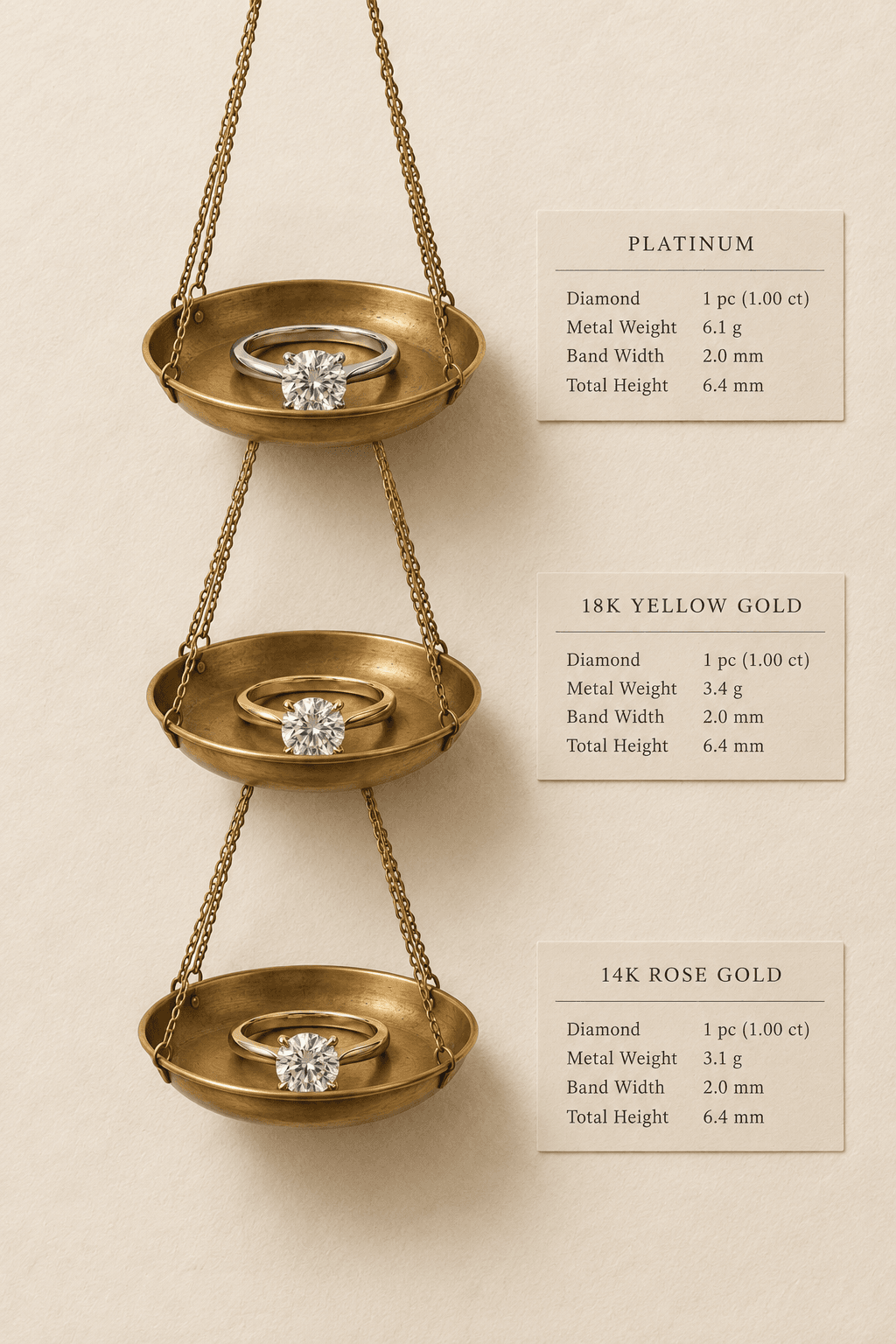
Platinum against 14K white gold on the same volume is a 57% weight difference. That is not a rounding error. It is the difference between a ring that feels substantial and one that feels slight, and clients notice it immediately when they try both on.
It also means "just quote it in platinum instead" is not a substitution. It is a different piece of metal.
If you are working the other way — from a drawing or a render rather than from a finished piece — the same arithmetic runs on an estimated volume. Estimating gold weight from a 2D design covers how close that estimate gets and where it goes wrong.
2. The cost moves for two separate reasons
Metal cost is grams multiplied by price per gram, and switching metal changes both variables at once.
More grams. As above — platinum needs roughly 30% more mass than 18K gold to fill the same volume, and around 57% more than 14K white gold.
Higher purity. Platinum jewellery is typically sold at 900 or 950 parts per thousand, meaning 90-95% pure metal. 18K gold is 75% pure. 14K is 58.3% pure. So platinum is not only heavier, a larger proportion of that heavier weight is the precious component.
And then labour. Platinum has a higher melting point and behaves differently under the torch. Many benches charge more for platinum work, and some subcontract it. Rose gold's high copper content makes it harder than yellow gold at the same karat, which is good for scratch resistance and less good when a setter is closing prongs or a piece needs sizing later.
The point for a counter conversation: the client is asking a colour question and receiving a quotation change. Better to surface that in the same breath than three days later by email. If you want the full picture of where the money goes on a bespoke piece, the real cost of making a gold ring itemises it.
3. The specifications change
This is the part that rarely makes it into a brief.
Alloy hardness shifts with colour, not just karat. 14K rose gold is 58.3% gold with the balance predominantly copper. That copper content makes it noticeably harder and more scratch-resistant than 14K yellow. 18K rose gold — roughly 75% gold, around 22% copper and a small amount of silver — sits softer, with a paler blush.
Which means the same band dimension does not behave the same way. A 1.6mm shank that is comfortable in 14K rose may be marginal in 18K yellow, because the alloys have different stiffness. Thin bands in softer alloys go out of round faster.
Rose gold has a practical ceiling. It effectively stops at 18K. Above that, there is not enough copper left in the alloy to produce the colour, and the metal reads as pale yellow instead. The karat comparison sets out what else moves with purity.
Prong work differs. Harder alloys resist bending, which is a benefit in wear and a complication in setting and future retipping. A design with delicate prongs specified in a hard alloy is a different job for the setter than the same design in a soft one.
4. The maintenance schedule changes
White gold is the one to flag explicitly, because the client will not think to ask.
White gold is not naturally white. It is a gold alloy that is bleached toward white and then rhodium plated to achieve the bright finish people associate with it. That plating is typically in the range of 0.1 to 0.5 micrometres, and on a ring — a high-contact item — it wears through under normal use within a few years, sometimes sooner on the underside of the shank.
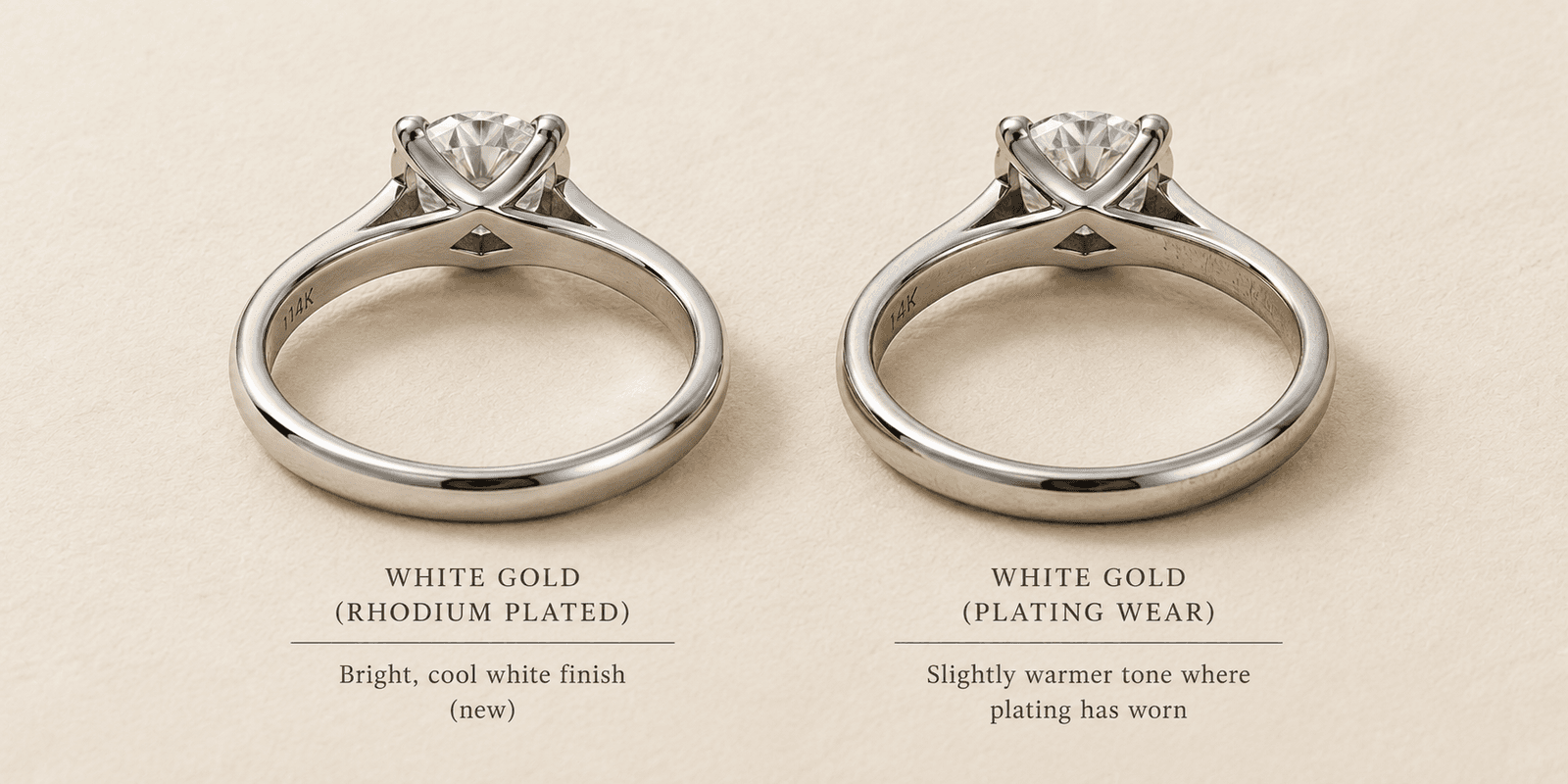
When it wears, the piece does not fail. It simply goes warmer and duller, gradually enough that the wearer often does not notice until they see it beside a freshly plated piece. Then it needs re-plating, which is a recurring cost across the life of the ring.
Platinum needs none of this. It is white all the way through, develops a soft patina rather than losing colour, and never requires plating. Yellow and rose gold are colour-stable for the same reason — the colour is in the alloy, not on it.
Say this at the point of sale. "White gold will need re-plating periodically" is a professional disclosure before purchase and an awkward conversation afterwards.
5. Sometimes the compliance position changes too
This one catches studios out, particularly when selling into or within Europe and the UK.
Nickel is a common alloying metal in traditional white gold, and it is the most heavily regulated metal in EU jewellery law because of its role as a contact allergen. Under REACH Annex XVII, Entry 27, articles intended for direct and prolonged skin contact — rings, bracelets, necklaces, watch cases — must not release nickel faster than 0.5 µg/cm² per week. For post assemblies inserted into pierced ears and other piercings, the limit tightens to 0.2 µg/cm² per week.
REACH Annex XVII, Entry 27 — nickel and its compounds: European Chemicals Agency. The UK position is summarised for retailers by Business Companion (Trading Standards), which also covers the separate lead and cadmium limits.
Three details matter and are routinely misunderstood:
The restriction is on release rate, not total content. An alloy can contain substantial nickel and still comply if it does not release. Conversely a plated item with low total nickel can fail once the coating wears. An XRF report showing total nickel content does not demonstrate compliance.
Compliance is assessed by specific test methods — EN 1811 for release measurement, and EN 12472 for coated items, which simulates wear before testing.
Test methods: BS EN 1811 (reference method for nickel release) and BS EN 12472 (simulated accelerated wear and corrosion for coated items) — Sheffield Assay Office, which tests to both.
Rhodium plating is a barrier, not a solution. It suppresses nickel release while intact. Once it wears through in normal use, the underlying alloy is exposed again. This is a large part of why palladium-based white gold has become the standard for fine jewellery in these markets.
Separately, the karat you switch to changes the hallmark. In India, BIS fineness marks correspond to the alloy: 750 for 18K, 585 for 14K, 916 for 22K, alongside the six-character alphanumeric HUID that identifies the individual article. Moving a design from 18K to 14K to hit a price point is not only a specification change — it is a different mark on the finished piece.
Indian fineness marks and the six-character alphanumeric HUID: Bureau of Indian Standards, Hallmarking.
Regulatory positions change and differ by market. UK REACH mirrors EU REACH structurally but operates as a separate regime. Confirm current requirements for the markets you actually sell into rather than relying on a summary.
The counter conversation, in one move
The practical version of all of this is a short script. When a client asks to see a design in a different metal, answer the colour question and the specification question together:
"Here it is in rose gold. Two things change with it — it comes out about half a gram lighter than the platinum, which brings the metal cost down, and unlike white gold it will never need re-plating because the colour is in the alloy rather than on the surface."
That takes eight seconds. It answers what she asked, pre-empts what she has not thought to ask, and positions you as someone who knows the piece rather than someone showing pictures.
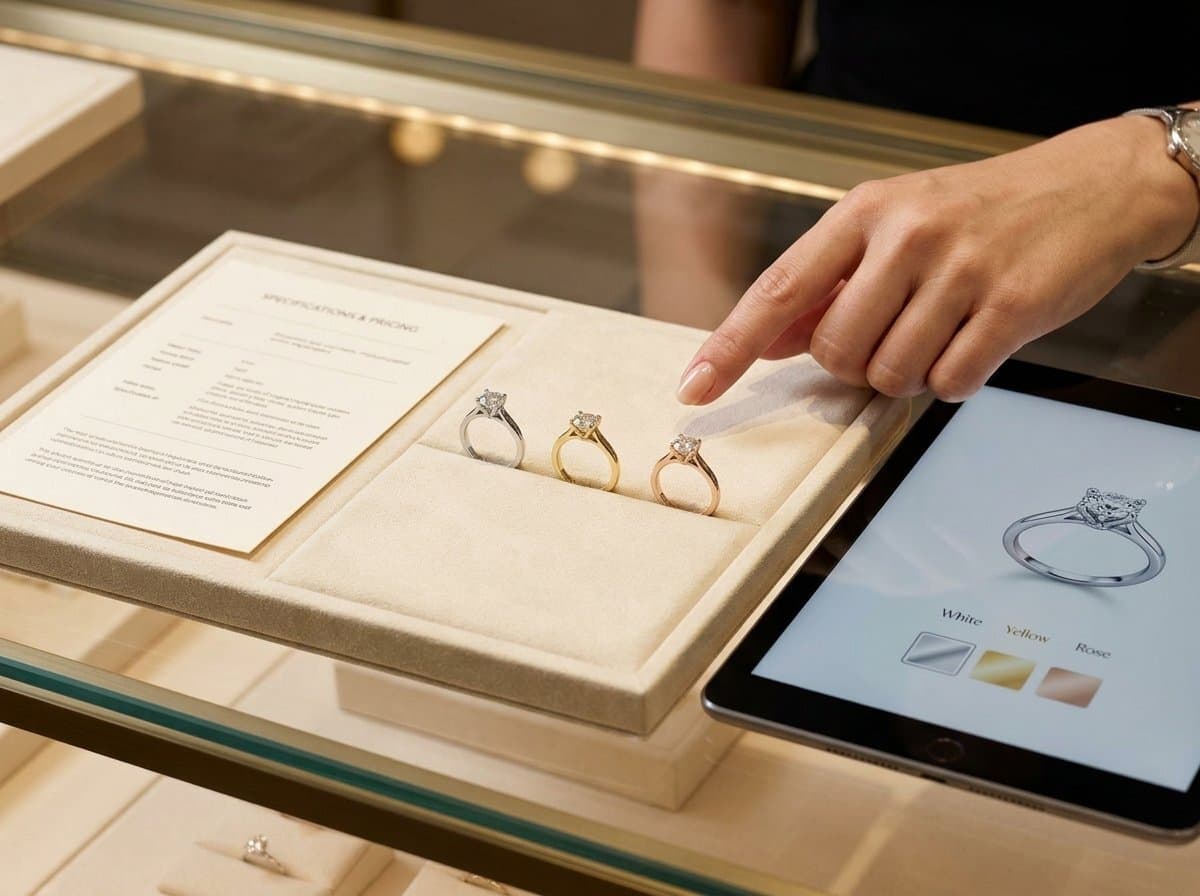
This is the argument for keeping the visual and the specification in the same view. A render answers "what does it look like." A specification answers "what am I actually buying." Clients decide faster when they get both at once, because the second one removes the doubt the first one creates.
What does not change
The design intent. The proportions. The stone. The silhouette your client fell for.
And the bench. Casting, setting, finishing and inspection take as long as they always did, and a qualified CAD designer or manufacturer still signs off dimensions, wall thickness, stone seats and material suitability before anything reaches production. Concepts and 3D drafts are a starting point, not manufacturing files.
Switching metal is a design decision with commercial and technical consequences. The tooling can show you the consequences faster. It cannot make the decision for you.
Sources
- Kassoy — Jewelry Density Table — reference densities for gold, platinum and palladium alloys
- Business Companion (UK Trading Standards) — Jewellery safety: metal content — nickel, lead and cadmium restrictions and release limits
- Sheffield Assay Office — Does your jewellery REACH the standard? — REACH nickel migration limits and BS EN 1811 / BS EN 12472 test methods
- European Chemicals Agency — REACH Annex XVII substance restrictions — Entry 27, nickel
- Bureau of Indian Standards — Hallmarking — fineness marks and HUID requirements for gold articles in India
Related reading
- Platinum vs gold vs silver: the complete metal selection guide
- How to calculate gold weight from a 2D jewelry design
- AI jewelry design: what actually gets faster, and what quietly narrows
- AI jewellery design 2026: UK, India and Australia designer's guide
- Prompt engineering for jewelry design: the six-element formula
- Jewelry ledger software: why a gold business runs two ledgers, not one
Frequently Asked Questions
Quick answers to the questions readers ask most about this guide.
How much heavier is platinum than gold in the same ring?
Roughly 30% heavier than 18K gold and around 57% heavier than 14K white gold, for the same volume of metal. Platinum 950 has a density of about 20.0-20.9 g/cm³ against 15.45 for 18K yellow gold and 12.75 for 14K white. That is the metal-only baseline: a finished platinum piece can weigh more again if it is built with heavier sections, so compare a specification card against the actual build rather than against the conversion.
How do you calculate ring weight in a different metal?
Use: target weight = original weight × (target density ÷ original density). If a ring finishes at 3.50 g in 18K yellow gold (density 15.45), the same design in platinum 950 (density ~20.1) works out at roughly 4.55 g. This assumes identical volume, which holds only when the metal changes and every section stays the same. If the heavier metal is built with a thicker shank or a more substantial gallery, the finished weight will run above the converted figure.
How much gold does it take to make a ring?
It depends entirely on the design volume rather than the ring size alone. A slim 1.6mm solitaire band might finish under 3 g in 14K, while a wide comfort-fit band with a heavy gallery can exceed 8 g in 18K. The reliable method is to weigh the wax or measure the CAD volume, then multiply by the density of the target alloy.
Why does custom jewelry cost more in platinum?
Three factors compound. Platinum is denser, so the same design needs roughly 30% more mass than 18K gold. It is sold at higher purity — typically 950 parts per thousand against 750 for 18K. And it is more demanding to work, with a higher melting point, so many benches charge a premium for platinum fabrication or subcontract it.
Does rose gold need to be re-plated?
No. Rose gold's colour comes from copper within the alloy, so it is colour-stable and needs no plating. White gold is the exception — it is plated with rhodium to achieve a bright white finish, and that layer (typically 0.1 to 0.5 micrometres) wears through on a ring within a few years and needs periodic renewal.
Is 14K or 18K rose gold better?
They serve different priorities. 14K rose gold is 58.3% gold with a higher copper proportion, giving a deeper pink and a harder, more scratch-resistant alloy suited to daily wear. 18K rose gold is 75% gold with a subtler, paler blush, higher intrinsic metal value, and a softer alloy that suits pieces worn with more care. Rose gold effectively stops at 18K, because above that there is too little copper left to produce the colour.
Does changing the metal affect hallmarking?
Yes. The fineness mark reflects the alloy. In India, BIS marks 750 for 18K, 585 for 14K and 916 for 22K, alongside the HUID that identifies the individual article. Moving a design between karats to meet a price point changes the mark on the finished piece, and requirements differ by market — confirm the position for wherever you actually sell.